
From a low cliff above the Pacific, the salt catches on your lips and the pounding surf seems to vibrate through your chest. At first, the sea resembles an unsettled expanse of steel. Once your eyes settle, though, they appear: little brown heads rising and falling among the waves, paws folded against their chests and bellies serving as floating dining tables.
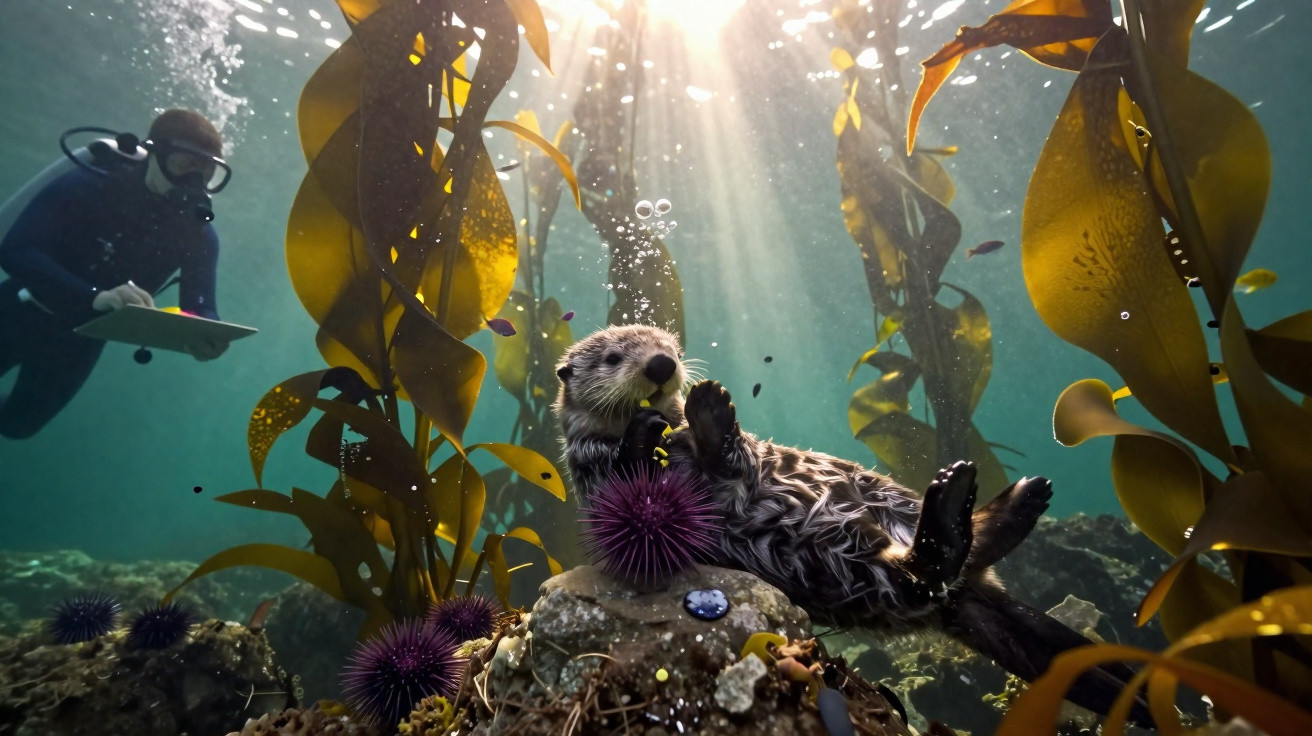
Dozens of sea otters drift in loosely gathered rafts. One turns over, another cleans its fur, while a third strikes a sea urchin against a rock with the concentration of a chef cracking a lobster claw. Out of sight below them, a whole forest is returning from the brink. Kelp moves gently in the current, fish thread through its blades and abalone are clinging to the rocks once more.
Across the Pacific coast, more than 90,000 sea otters are quietly reshaping which creatures live, feed and endure. This is far removed from the familiar tale of “cute animals”. Something much wilder is at work.
How 90,000 sea otters became unexpected ocean engineers
Imagine a section of Pacific shoreline in the late-afternoon sun. A few decades ago, divers recalled these waters as fields of bare rock, with purple and red urchins covering the seabed like a living minefield. Scattered kelp remnants remained, their stalks gnawed down to stubs by millions of hungry, spiny mouths.
Today, divers entering places where sea otters have returned find another landscape entirely. Kelp columns reach towards the light, rising twenty or thirty metres high. Bright green canopies undulate overhead, and rockfish shadows move between the fronds. Beneath the water, the sound is a muted, regular knock: shells hitting otter bellies as the animals break apart their food.
The change is unmistakable. It is like seeing an abandoned city become a woodland again.
Scientists following this shift along the Pacific coast, from Alaska and British Columbia to Washington and California, repeatedly return to the same figure: more than 90,000 sea otters now inhabit this rugged shoreline. That total remains far below their numbers before the fur trade almost eliminated them, but it is sufficient to alter the balance in hundreds of coastal hotspots.
Along central California, sites with healthy otter populations have experienced a dramatic resurgence in kelp cover compared with nearby areas where otters remain uncommon. In Alaska’s Aleutian Islands, researchers saw the consequences when orcas began preying on otters and urchin populations surged: kelp forests collapsed, biodiversity plunged and whole fisheries absorbed the impact.
When the otters returned, so did the kelp. The recovery was not slow; it was almost as if a switch had been thrown.
The mechanism is starkly straightforward. Sea urchins feed eagerly on kelp. Without predators to restrain them, they graze the stipes down to exposed rock, producing what scientists describe as “urchin barrens”. Sea otters, meanwhile, eat urchins. An individual otter can consume up to a quarter of its own body weight in food each day, much of it made up of urchins, crabs and shellfish.
As more than 90,000 otters disperse around the Pacific rim, they do more than simply exist there: they keep urchins in check. In areas patrolled by otters, urchins retreat into rock crevices and feed more passively on drifting kelp rather than stripping entire forests.
This struggle between predator and prey sets off what ecologists call a trophic cascade. Kelp forests grow denser, fish nurseries flourish and carbon storage in marine plants increases. Seabirds, seals and even local fishing economies begin to experience the knock-on effects, all because a small marine mammal needs to eat every day.
How the “sea otter effect” can be put into practice
The Pacific’s lesson is not simply that we should protect cute animals. It is more specific: we need to identify and safeguard the species that function like keystone bolts in a bridge. Sea otters are one such bolt. Remove them and the kelp ecosystem’s entire structure distorts, weakens and eventually gives way.
Coastal conservation groups have gradually developed a practical approach. First, otters need safe habitat: no shooting or trapping, alongside stricter rules for inshore fisheries where they could become entangled. Second, kelp habitat must be restored or protected, so the ecosystem can respond once otters arrive. Third, local communities and Indigenous nations that have coexisted with these animals for centuries must be involved, rather than treated as though otters were a recent discovery.
On paper, that may read like policy. In practice, it means people standing on chilly decks at daybreak, counting heads in the surf.
The complications begin where otter appetites meet human demand. Sea urchins, abalone, Dungeness crabs and clams are all valuable catches too. In some seaside towns, otter recovery is presented as unwelcome news for fishers. Fewer shellfish on the seabed can seem like an immediate blow to household income.
Researchers monitoring both economies and ecosystems are beginning to chart these compromises. In certain places, kelp recovery associated with sea otters could support particular fisheries over the long term: rockfish, lingcod and even some salmon gain from healthier inshore habitat. Elsewhere, there is a genuine short-term loss for divers who formerly collected urchins from barrens that are now becoming forests.
At a personal level, the issue is not merely statistical. A young diver aboard a boat off Vancouver Island put it plainly: “I love that the otters are back. I also need to pay my rent.” That conflict is present in many coastal discussions today.
A path forward exists, beginning with the rejection of the idea that ecosystems can be repaired through one grand intervention. No individual marine reserve, one-off grant or viral awareness campaign can by itself “save the otters” or the kelp. What has proved effective along the Pacific is a series of repeated, often unglamorous actions that align over time.
One workable option is to concentrate restoration where otters already have a foothold. This could involve replanting kelp in protected bays, cutting local runoff that makes the water murky, or moving certain fishing activity slightly further offshore to ease pressure on nearshore areas. Another is to support co-management agreements that give Indigenous communities shared authority and draw on generations of knowledge about where and when otters once prospered.
At an individual level, residents and visitors can support projects that are genuinely operating in the water. That could mean volunteering for shoreline monitoring, backing charities that restore kelp forests or voting for local measures that enlarge marine protected areas rather than reduce them.
Let’s be honest: nobody really does this every day. We become tired, distracted and pulled back to our own concerns. Yet people who do turn up, week after week and tide after tide, tend to say the same thing: seeing a dead reef come alive again is addictive.
As one marine ecologist in California told me while we bobbed near a raft of otters:
“We didn’t ‘save’ the kelp. We just gave the system a nudge and then the otters did the heavy lifting. That’s the crazy part-nature still remembers how to function if we stop breaking the key pieces.”
For those trying to make sense of it all, a few straightforward principles are useful:
- Predators aren’t luxuries – they are the architects of many ecosystems on which we rely.
- Kelp forests are more than scenery – they provide nurseries, carbon stores and buffers against storms.
- Local choices stack up – planning decisions, fishing regulations and tourism habits all steer the system in one direction or another.
Why the sea otter story matters well beyond the Pacific
The relationship between sea otters and urchins along the Pacific coast is not merely an endearing footnote in marine biology. It is a real-time example of how quickly ecosystems can reach a tipping point, and how rapidly they can shift back when a missing component returns. At a time when so many environmental stories describe gradual decline, this one offers something less common: recovery that is both visible and measurable.
We have all seen a grainy mobile-phone video of otters holding paws, followed by a flood of heart emojis in the comments. Behind that charming image lies a harder question: are we prepared to accept recovery in its full, complicated form, rather than only its photogenic side? A coast inhabited by 90,000 hungry otters brings more kelp, more fish and greater complexity, but it also creates fresh disputes, different winners and losers, and decisions that will not satisfy everyone.
The same dynamic can be seen in Yellowstone wolves and parrotfish on coral reefs. When we protect or restore species that bind many parts of an ecosystem together, the wider web can often begin repairing itself at surprising speed. That does not solve climate change, pollution or overfishing, but it does give ecosystems more room to breathe and greater resilience when shocks occur.
The next time you see still Pacific water dotted with little brown heads, think about the hidden activity below. Urchins retreating into crevices. Kelp reaching for light once again. Fish moving through a three-dimensional maze where flat stone used to lie. It is not a return to an idealised past. It is an uneven, improvised truce between people and the rest of the coast.
Perhaps that is the true lesson of these 90,000 sea otters: recovery is neither a straight line nor a single spreadsheet figure. It is a web of relationships gradually finding a new balance, one shattered urchin shell at a time, and an invitation to choose which way we want that balance to tilt.
| Key point | Detail | Why it matters to the reader |
|---|---|---|
| Sea otters as keystone predators | Over 90,000 otters along the Pacific coast are controlling urchin populations and triggering trophic cascades. | Helps you understand why one species can transform an entire seascape. |
| Kelp forest recovery | Where otters return, urchin barrens shift back into rich kelp forests that store carbon and shelter marine life. | Shows how biodiversity rebounds and links to climate and fisheries. |
| Human–nature trade-offs | Otter recovery can clash with some fisheries while boosting others, demanding local dialogue and shared management. | Gives a realistic picture of conservation’s social and economic ripple effects. |
FAQ
- Are sea otters really saving kelp forests on their own? They do much of the work by eating urchins, but recovery is strongest where otter protection, habitat restoration and sound local management come together.
- Why did sea otters almost disappear from the Pacific coast? They were hunted extensively for their dense fur from the 18th century to the early 20th century. Only a handful of small remnant populations survived, later providing the basis for today’s recovery.
- Do sea otters harm urchin fisheries? In some locations, yes: they reduce the number of large urchins available for harvesting. However, they can also aid the recovery of kelp and other fish stocks, potentially benefiting other fisheries.
- Can restoring otters really help with climate change? Indirectly, yes. Healthier kelp forests retain more carbon and shield coastlines, although this is not a substitute for reducing greenhouse gas emissions.
- What can ordinary people do to support this recovery? You can support marine protected areas and kelp and otter conservation organisations, reduce coastal pollution if you live near the shore, and consider how your seafood has been caught.





Comments
No comments yet. Be the first to comment!
Leave a Comment