
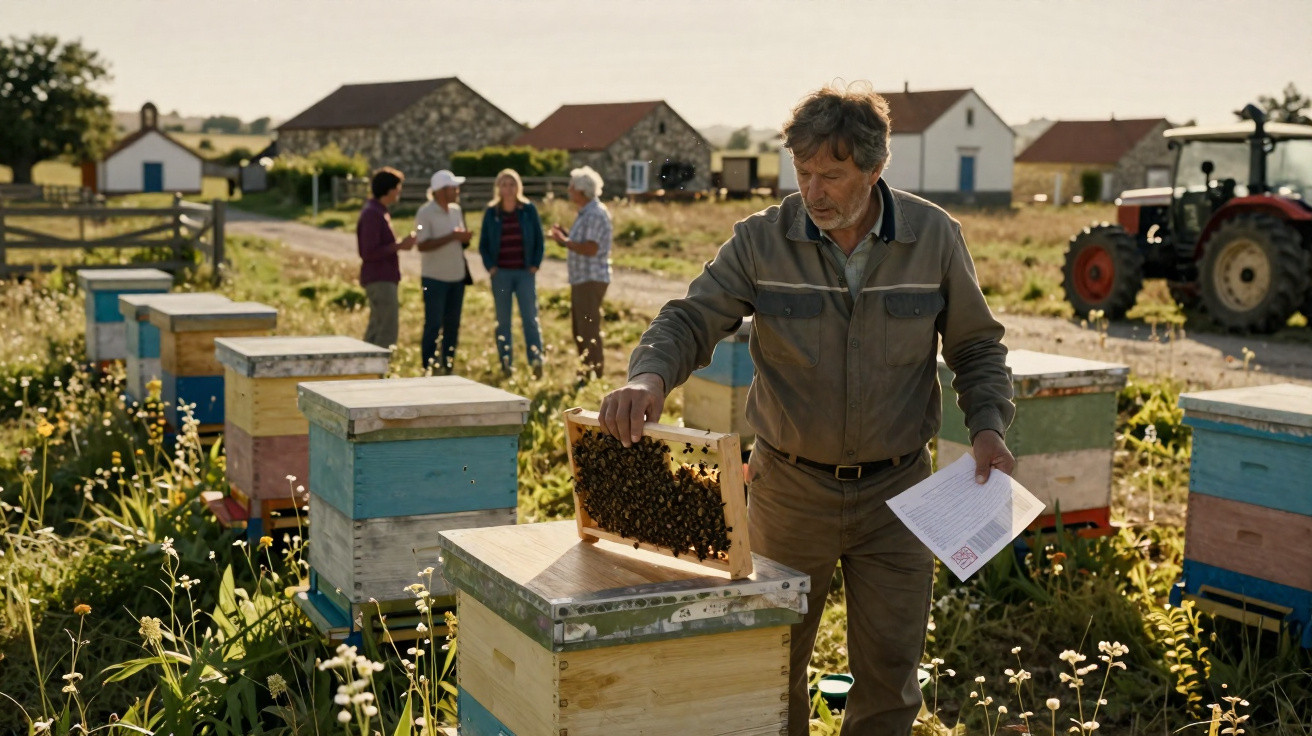
The first sound on Michael Hargreaves’ land is not a tractor or a chainsaw, but bees. Their low, even drone carries across the fields like far-off traffic, drifting through the hawthorn hedges and wildflower margins he established himself. For a decade, this softly spoken conservationist, now in his early fifties, made his 16.2-hectare plot in rural Somerset available to local beekeepers at no cost. There were no tenancy agreements and no payments: only a handshake and a mutual commitment to pollinators.
Last winter, however, the gentle buzz was overtaken by a harsher noise: raised voices at the pub, anonymous flyers pushed through letterboxes and an inflammatory Facebook thread that refused to disappear. The man who had spent ten years protecting hedgerows and barn owls was abruptly labelled a “tax cheat” and a “traitor to the village” over the very arrangement that had previously earned him local admiration.
The bees carried on working. It was the people who began fighting.
From wildflower hero to “tax cheat” in one council letter
Nothing much appeared to change. The hives remained in their usual field corner, while the same beekeepers arrived at dawn in worn-out pick-ups, jolting along the track. Michael continued his evening walks around the boundaries, recording butterflies and inspecting the recently dug ponds. Then the council sent a brown envelope, packed with dense wording and impersonal figures. His land had been reclassified, and his bill had fallen unexpectedly.
In a village where people know one another’s mortgages, that letter had the impact of a grenade. News spread that the commercial hives had caused part of the land to count as “agricultural use”, qualifying it for a lower rate. A passing remark in the village shop became pub accusations within days. Instead of discussing Michael’s barn owl boxes, residents wanted to know how much council tax he had avoided.
One neighbour insisted Michael had “boast”ed about saving thousands. Another said the hives were merely a “cover” for exploiting the rules. Old resentments, entirely unrelated to bees, suddenly found something to attach themselves to. This is how a countryside champion becomes a village villain: not through one spectacular scandal, but through a gradual build-up of bitterness centred on a line in the tax code.
The hives had begun modestly. Ten years earlier, two beekeepers brought in a couple of battered white boxes. Michael welcomed the additional pollinators for his wildflower meadows, while they valued the sheltered, pesticide-free location. No money was exchanged. It was a somewhat old-fashioned, trust-based arrangement that benefited everyone involved. In time, the two beekeepers became six, and the number of hives grew to almost 80. Their honey reached farm shop shelves under a tidy label: “From the hills above Brackenford.”
To local customers, it was an uplifting story. To people watching from the other side of the hedge, it increasingly resembled a commercial operation. “He’s running a honey farm,” one farmer grumbled as pallets of jars were loaded into a van. In repeated retellings, the fact that the jars belonged to the beekeepers rather than Michael was lost. At a parish council meeting, somebody held up a photograph of the hives on a phone and described them as “industrial.”
Even pollinator-decline figures, once used by Michael to gain support for his wildflower work, began to be interpreted differently. When he noted that 97% of wildflower meadows have disappeared since the 1930s, a councillor replied: “And how much of that you claiming as tax relief then?” No chart can account for that sort of reversal. One tax reclassification turned an environmental success into an alleged financial con, simply because people saw an advantage from which they felt excluded.
The truth behind the supposed “tax dodge” was far less dramatic, though more complicated. Because the beekeepers were present, sections of Michael’s land were treated as being in active agricultural use. The council therefore applied another rate, and his accountant advised him to accept it. Michael asked the same question three times over the telephone: “But is this actually allowed?” Each time, he received the same response: “Yes. That’s how it works.”
The tax office saw no ethical question, only a classification. Villagers saw a different picture: a man with a respectable salary and no children at the village school paying less than households in small semi-detached homes. It was lawful, but socially combustible. The beekeepers, who believed they were simply placing hives and inspecting queens, found themselves blamed for a hole in local funding that pre-dated the arrival of even one brood box.
The straightforward truth is that tax bands alone rarely provoke this much anger.
What really took hold was the belief that an “outsider” conservationist was benefiting from a system whose rules nobody else understood. Most people recognise that immediate feeling when another person receives an advantage you never knew was available: it reaches the stomach before the mind. In that emotional space, the account of a “kind landowner helping bees” easily became one of a “clever man milking green rules.” Once such a version takes root, facts find it difficult to catch up.
When good intentions meet small-village politics
At ground level, much of this dispute might have been prevented by three conversations and a laminated notice. Michael acknowledges that he never properly told his neighbours how the beekeeping agreement operated, because he worried that explaining it would appear boastful. The hives therefore simply “appeared” in one season before quietly increasing in number. From the lane, residents could see only a growing collection of white boxes. They did not see WhatsApp conversations about varroa treatment, or the late-night emergency relocation prompted by a poor weather forecast.
An older beekeeper proposed an open day, with tea and cake, a meadow walk, and someone wearing a veil to show children how the frames functioned. Michael considered it but allowed the idea to fade away. He did not want to “make a fuss.” That lack of explanation created a vacuum, which rumours, partial truths and screenshots of poorly understood tax guidance quickly filled. In a town, it might have remained an online argument. In a village with one shop, it spread beside the milk fridge, repeated loudly enough for others to hear.
Many rural communities will recognise the pattern. New arrivals bring fresh ideas and speak about rewilding, grants and biodiversity credits. Long-standing residents hear those terms and privately question what they may be losing-not only financially, but in terms of control. The resentment sharpens when apparent generosity becomes intertwined with systems that seem unfair. Someone can be doing genuine good for nature while still encountering unseen hazards, merely because they failed to explain the project field by field.
Michael is now attempting to undo years of assumptions through small, slightly uncomfortable acts. He has begun inviting neighbours to walk the land with him, not with a grand “let me educate you” attitude, but more casually: “fancy a look at the new pond?” He points out thinning wildflower strips, badger crossings and the hive site sheltered from the wind. There are no PowerPoint presentations, only muddy boots and the occasional bee rebounding from a hat.
He also faced the task he had most dreaded: making the figures public. At a crowded parish hall meeting, he laid out printed copies of his council bill, showing the former and revised amounts side by side. He confirmed that the beekeeping had altered the classification and that his tax had reduced. After a pause, he then made the offer that surprised those present: he would give the difference each year to a village fund administered by the parish rather than by him. The gesture did not end the hostility immediately, but it weakened the suggestion that he had been celebrating a private “win.”
Some readers will feel, “He should never have had to do that.” Others may respond, “He only did it because he got caught.” Both views can exist in the same room. Realistically, few people read every clause of rural tax legislation before agreeing to host a beekeeper needing space for several boxes. Michael’s experience demonstrates that generosity in a close-knit community requires more than good intentions; it also needs visible, somewhat unexciting transparency if it is not to be turned against you later.
For Michael, the most painful aspect was not the dispute about tax, but the word “traitor.” A white A4 page taped to the bus stop stated exactly that: “TRAITOR TO THE VILLAGE – PROFITS FROM OUR LOSS.” He found it early during his walk and removed it before children arrived for the bus. He kept the sheet, folded twice, in a kitchen drawer beneath his seed catalogues.
When asked what affected him most, he did not mention money. Instead, he spoke of the woman next door who no longer waved, the way conversations stopped when he entered the pub, and the beekeepers quietly asking whether they should move their hives somewhere less “complicated.” These small wounds alter the way someone sees their own gate when locking it at night.
“People think I did this for tax,” he told me, staring past the window at the hawthorn hedge. “I did it because I like bees. Now I walk my own fields and feel like I’m being filmed. I’ve never felt less at home in a place I thought I’d die in.”
- If you’re sharing land for “good causes,” write down the basics – even a one-page note setting out who does what, who pays what and what will happen if the rules change.
- Talk early, rather than waiting for the brown envelope – tell neighbours how a proposal could affect classifications, funding or footpaths before it turns into gossip.
- Make the benefits visible and shared – hold wildflower walks, school visits or honey tastings, not to show off but to make a private arrangement feel like something the village can share.
- Ask the awkward questions while everyone still likes each other – what happens if the tax band changes, someone complains or the project expands?
- Do not let rumours tell the story of your land – if you do not explain it, someone else will, and they will omit the details that make you human.
Beyond one man, one meadow and a few dozen hives
Looking beyond Michael’s hedges reveals a broader countryside conflict. Environmental schemes, tax rules, community identity and online outrage are clashing in places where people still acknowledge each other on narrow lanes. Free space for bees can become, almost overnight, a neighbour’s symbol of a system they distrust. The facts are important, but so are the feelings.
There is no neat resolution to this story. Michael is not a saint, and his critics are not caricatured villains. Somewhere between the field edges and council spreadsheets, a sincere effort to help wildlife became caught up in suspicion and personal hurt. Similar tensions arise around solar farms, rewilding schemes and even new public footpaths. Today, it is bees and council tax in one English village; tomorrow, something comparable may happen where you live, under different names and beside different hedges.
The next time a “green” scheme appears on the edge of a town or village, it may be worth looking again. Who pays what? Who gains what? Who feels excluded? It is also worth asking a quieter question: what would make it possible to share, explain and debate the arrangement early, before leaflets arrive and friendships begin to fray? That modest but uncomfortable conversation can be the difference between a community quietly proud of its bees and one where the hum in the hedgerows is overwhelmed by doors gently closing.
| Key point | Detail | Value for the reader |
|---|---|---|
| Hidden impact of tax rules | Beekeeping moved the land into a different use category, reducing the owner’s bill despite no obvious visible change on the ground | Helps you identify where apparently “harmless” arrangements may create social and financial consequences |
| Silence breeds suspicion | No early, open explanation allowed rumours and resentment about the hives to grow | Encourages you to communicate more than seems necessary about shared land or green projects |
| Generosity needs structure | Handshake arrangements can feel friendly, but may fall apart when bureaucracy and local politics create pressure | Demonstrates why even informal, well-intentioned agreements need straightforward written ground rules |
FAQ:
- Did the conservationist actually break any tax laws? Based on the documents his accountant showed and the council’s response, no. The lower rate resulted from an existing classification rule once part of the land counted as agricultural because of the beekeeping activity.
- Why did the village react so strongly if nothing illegal happened? People felt caught off guard and excluded. They saw somebody they considered comparatively well-off receiving a benefit they had not known existed, at a time when local services seemed underfunded and every bill hurt.
- Could the beekeepers have prevented this tension? They could not alter tax legislation, but they could have joined earlier discussions with neighbours, making clear that they paid no rent and that the honey business belonged to them rather than the landowner.
- Is this kind of tax reclassification common with conservation projects? Such changes happen more frequently as land use becomes less distinct between farming, nature recovery and small-scale commercial activity. The difficulty is that the rules are complex and seldom explained locally in plain language.
- What can others learn if they want to host hives or green schemes? Begin with transparency: speak to neighbours, establish whether the project could affect planning or tax, put the essentials in writing, and consider how benefits might be shared so that it feels like a village gain rather than a private perk.






Comments
No comments yet. Be the first to comment!
Leave a Comment