
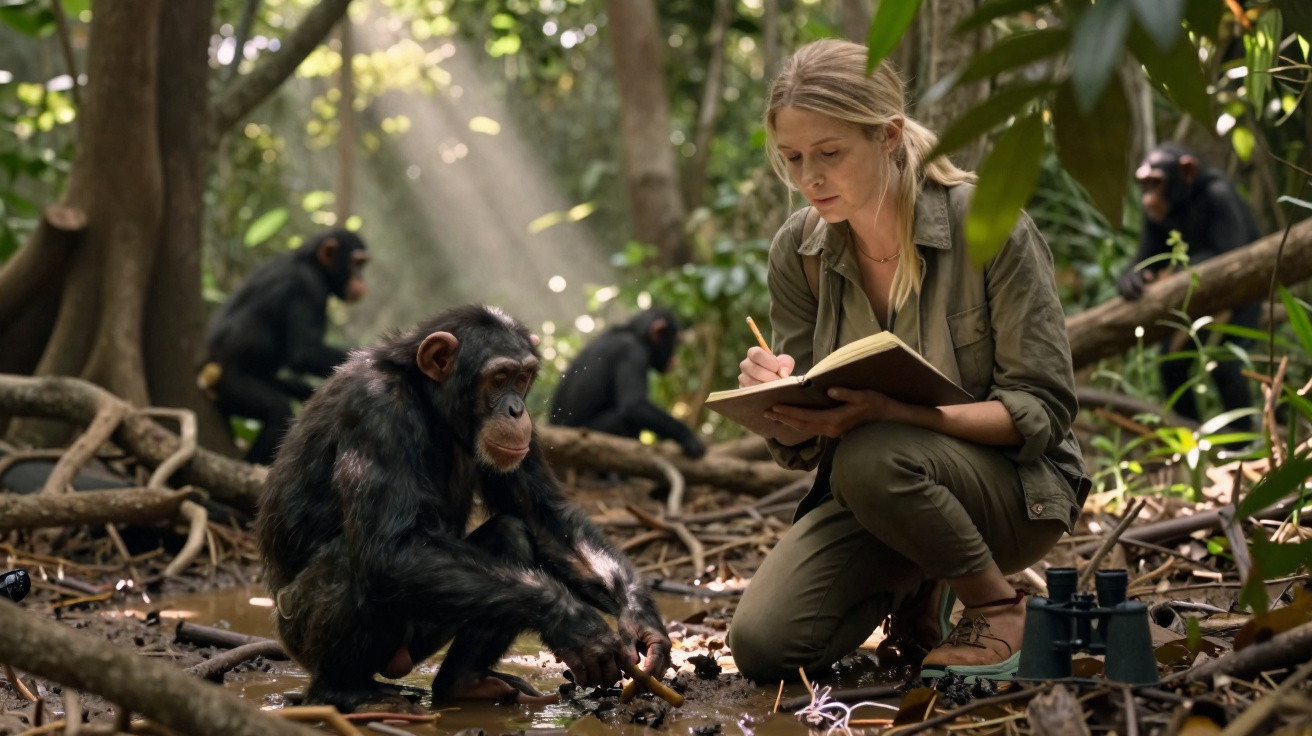
Jane Goodall, the world’s best-known primatologist, achieved something remarkable across her 91 years: she radically reshaped how the world understands what it is to be human.
When Goodall was only 26, she watched a chimpanzee (Pan troglodytes) in Gombe Stream National Park in northern Tanzania use a straw-like blade of grass to pull termites from a mound.
After she reported it to her supervisor, the palaeoanthropologist Louis Seymour Bazett Leakey, he responded: "Now we must redefine 'tool,' redefine 'man,' or accept chimpanzees as humans."
Over the course of one woman’s life, research into animal tool use has expanded from one blade of grass to a whole array of practical objects. These are used by monkeys, crows, dolphins, orcas, humpback whales, and even bees and other insects.
Jane Goodall and chimpanzee tool use
Using tools is no longer regarded as an exclusively human characteristic, and neither is passing culture between generations.
During decades of work by Goodall and other primatologists across Africa’s forests, researchers have found that chimpanzee communities use tools extensively. Their customs also vary between groups and from one region to another.
Among the chimpanzees of Gombe, Goodall saw animals use sticks, stalks, stems and twigs to fish for termites. They also used leaves as ‘napkins’ and ‘drinking tools’.
In Gabon, by contrast, scientists recorded chimpanzees using sticks to obtain honey instead of termites. Meanwhile, chimpanzees in Guinea were observed during the 1980s using stone hammers and anvils to break open nuts.
For many years, primatologists including Goodall strongly believed adult chimpanzees taught younger animals to use sticks and stones in ways suited to their particular environments. More conclusive evidence, however, did not emerge until 2016.
That year, scientists in the Republic of Congo watched and filmed chimpanzees teaching their young to use tools while foraging for food, a significant first.
This finding combined two of Goodall’s most important contributions to the discipline: tool use and the close relationship between mothers and their offspring.
It points to teaching and learning having deep evolutionary origins in primates, while indicating that cultural transmission across generations is not solely human.
Chimpanzee culture, communication and behaviour
Nor is this cultural behaviour limited to feeding.
Scientists recently saw members of certain chimpanzee cultures putting grass in their ears and bottoms, in a manner resembling a social fashion craze.
If neither tool use nor culture distinguishes humans, what does? In the wake of Goodall’s discovery, many researchers looked to language as humanity’s defining feature.
Yet chimpanzees continue to challenge that idea too. They possess a complex system of vocal communication, and their hoots, hollers, grunts, lip smacks and physical gestures show strange parallels with human languages. They can also be trained to say certain genuine human words, suggesting that they possess basic neural foundations for speech.
At a nature reserve in Guinea-Bissau, chimpanzees use the forest as though it were a drum kit, throwing stones at wood to make rhythmic thumping sounds. This may be a tool-assisted form of communication over long distances.
The late primatologist Frans de Waal did not even believe morality separated people from other animals. De Waal, renowned for his research on the world’s largest captive chimpanzee colony, found in the early 2000s that the animals showed evidence of deception and conflict resolution. He argued, controversially, that these primates possess qualities including empathy and ‘moral behavior’.
Care, medicine and the blurred line between humans and apes
In 2019, specialists studying primates in Gabon’s forests identified behaviour supporting de Waal’s arguments. A female chimpanzee called Suzee held what appeared to be a small insect in her mouth before applying it to a wound on her son’s foot. Once researchers had noticed it, they began to observe the practice regularly within the community.
By reviewing historical records, scientists have subsequently counted many examples of chimpanzees tending other animals’ injuries with insects, leaves or chewed materials.
"Our research helps illuminate the evolutionary roots of human medicine and healthcare systems," said University of Oxford primatologist Elodie Freymann earlier this year.
In a 2012 interview, de Waal said that "Over the years the dividing line between humans, certainly between humans and the apes, has sort of become fuzzy under the influence of field work, such as the work by Jane Goodall… which has shown all sorts of capacities that we had not suspected in the apes."
One of de Waal’s final books before his death was called Are We Smart Enough to Know How Smart Animals Are?
Goodall may well have been. Her work ensured that the study of animal intelligence would never again be the same.





Comments
No comments yet. Be the first to comment!
Leave a Comment