
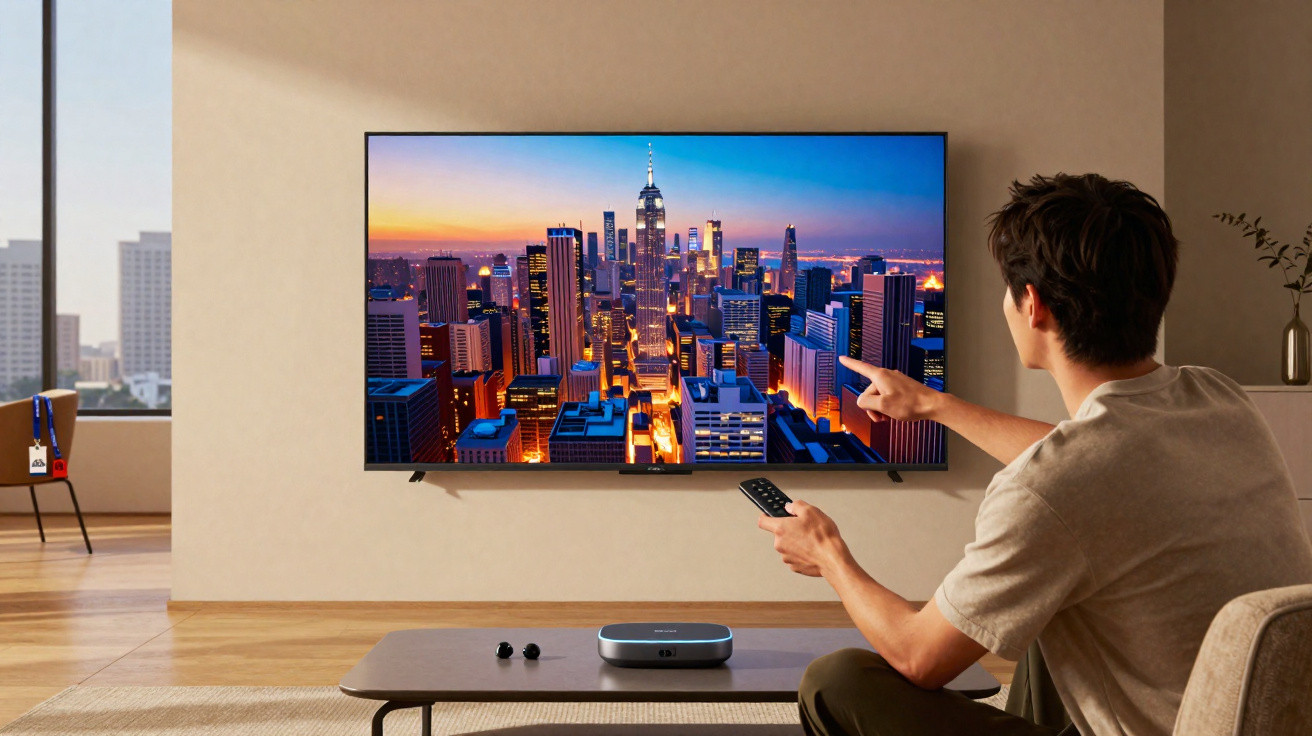
Las Vegas returns to the spotlight in 2026, and this time the contest is not only about spectacle, but also about absolute colour accuracy.
With CES 2026 approaching, the major TV manufacturers are preparing a change of direction that could reshape the display market. Following the widespread adoption of OLED and the recent Mini-LED wave, a new acronym is set to confuse – and attract – consumers: Micro RGB.
What changes with Micro RGB displays
Micro RGB displays arrive at CES 2026 as brands’ major bet for renewing public interest in premium televisions. The proposition is easy to grasp: greater colour fidelity, higher brightness, less trailing in fast-moving scenes and the promise of longer durability.
The distinction begins with the way light is produced. Rather than using a panel with white backlighting that passes through colour filters, every tiny illuminated point on the screen directly incorporates red, green and blue LEDs.
Micro RGB is a system in which microscopic LEDs already emit the three primary colours, removing the need for filtered white light and increasing colour accuracy.
According to LG and Samsung, these LEDs measure less than 100 micrometres. This scale is where the term “Micro” comes from. Such miniaturisation enables much finer image control, which should benefit contrast, brightness in specific areas and smoother colour gradients.
Why this could revolutionise displays
By removing reliance on white or blue background light, the display reduces interference and losses on the path to the viewer’s eyes. The anticipated result is a wider, more faithful colour palette, particularly with high dynamic range (HDR) content.
The LEDs’ faster response is another important factor. So-called “motion reproduction” becomes smoother because trailing – common on some LCD panels – should be reduced. This is directly relevant for people watching sport, action films and, above all, playing on the latest-generation consoles.
Fast games, sporting scenes and action-heavy films should benefit from a noticeable reduction in motion blur.
A naming war could confuse consumers
While the technology takes shape, brands appear to have chosen a different route: confusing terminology. The same Micro RGB concept is presented under different labels by each manufacturer.
- LG and Samsung: Micro RGB
- Sony: True RGB
- Hisense: Mini-LED RGB
For people who do not follow the sector closely, this creates ideal conditions for misunderstanding. The term “Mini-LED RGB”, for instance, used by Hisense, resembles the Mini-LED name already familiar in the market, even though the proposition is not exactly the same.
Micro RGB is not Micro LED
There is another, more significant source of confusion: Micro RGB is not Micro LED, despite the similar names. Micro LED panels emerged as a promised direct replacement for OLED, aiming to provide virtually perfect contrast, extremely high brightness and no burn-in risk.
Micro LED’s problem has been cost. Large-scale production has remained expensive and complex, restricting these televisions from reaching the average consumer’s home. They have been limited to a small number of enormous models with prohibitive price tags.
Micro RGB aims to occupy a middle ground: offering a step up in colour quality and brightness while keeping manufacturing closer to the levels already seen in advanced LCD production, which could, in theory, help contain prices.
| Technology | Main strength | Main challenge |
|---|---|---|
| OLED | Deep blacks and high contrast | Risk of burn-in and limited brightness |
| Mini-LED | High brightness and good value for money | Blooming in bright areas against dark backgrounds |
| Micro LED | Near-ideal quality with absolute blacks | Very high cost and complex production |
| Micro RGB | More accurate colours and microscopic RGB LEDs | Confusing names and an as-yet unknown price |
TVs that become artwork: design as a differentiator
CES 2026 is unlikely to be defined solely by what is inside the displays. Manufacturers also want to change the way a TV occupies the living room. The aim is for the television to stop looking like a switched-off black block on the wall.
Models designed to resemble framed artwork are gaining prominence. LG’s Gallery TV, for example, is presented as a kind of digital frame that can show around 4,500 works of art when it is not being used conventionally.
The television begins competing for space with decorative artwork, taking on an aesthetic role even when it is switched off.
This development responds to a trend already visible in recent years: slimmer TVs, narrower bezels and standby modes that display photographs, paintings or subtle information rather than a black screen.
Wireless connectivity and an AI presence
Simplifying installation is another area of innovation. Wireless video transmission systems are presented as a way to cut down on cables hanging behind the TV unit or concealed in the wall. The goal is to get closer to the experience of “hanging a picture”, without requiring major renovation work.
Artificial intelligence is also becoming part of the standard package for new launches. It appears in two main areas:
- Content recommendations based on the household’s viewing habits.
- Automatic picture and sound adjustments that account for ambient light, noise and the type of content.
In theory, users will need to spend less time adjusting controls and menus. The TV adapts to the household routine, changing brightness, contrast and even sound mode according to the time of day, the amount of light coming through the window or what is being shown.
Price, adoption and the risk of disappointment
The biggest unknown surrounding Micro RGB TVs is price. Manufacturers are avoiding firm figures during this pre-CES stage, creating a degree of déjà vu around Micro LED’s commercial failure.
If the final price sits close to premium OLED models, the new technology could appeal to more demanding buyers, especially those seeking high colour fidelity for home cinema and gaming. If the gap is substantial, it risks remaining confined to luxury niches.
Confusing communication is another risk. Terms such as Micro RGB, True RGB and Mini-LED RGB make direct comparisons difficult. Some buyers may believe they are purchasing something very close to Micro LED or OLED when, in reality, it is a highly advanced LCD.
The more similar the names are, the greater the chance that consumers will take home a product without knowing exactly what distinguishes it from current options.
Concepts worth understanding before buying
Anyone considering replacing their TV in the next few years is likely to encounter technical terms in shops. Some deserve particular attention:
- Micro RGB: microscopic LEDs that already emit red, green and blue, without relying on white background light.
- Micro LED: pixels made up of independent LEDs, offering extreme contrast but still at a very high price.
- Mini-LED: a reduced version of traditional LED technology that improves local dimming control.
- Burn-in: a permanent screen mark caused by prolonged display of static images, something associated with OLED.
Mentally mapping out everyday use helps cut through the marketing. Those who play a lot of games or watch plenty of sport are more likely to benefit from the faster response and lower image persistence. People who prioritise films in a dark room, meanwhile, may be more sensitive to black depth and overall contrast.
One possible scenario for 2026 and 2027 is that these technologies coexist: OLED remains strong in the premium segment, Mini-LED continues as a high-brightness option at a more competitive price, while Micro RGB attempts to position itself as the “next step” in colour and design. How brands price and communicate these distinctions is likely to determine whether the promised visual revolution becomes reality in the living room or remains limited to the brightly lit halls of CES in Las Vegas.





Comments
No comments yet. Be the first to comment!
Leave a Comment