
A dense, snarled barrier of thorny vines; plastic bags caught among its branches; scarcely a sound beyond far-off traffic. Then somebody noticed a narrow green shoot emerging through the woven stems. It was a native sedge, tentatively reaching into the open air where an invasive shrub had been removed only months earlier.
Look more closely and the picture shifts. Beetles move through the earth. A wren flits between newly established saplings. Ground that had been eroding for years is wet enough to retain water again. Nobody designed or planted a picture-perfect woodland. The only intervention was to remove the plants that did not belong.
Somehow, everything else began to unfold by itself.
When you stop battling nature and make space instead
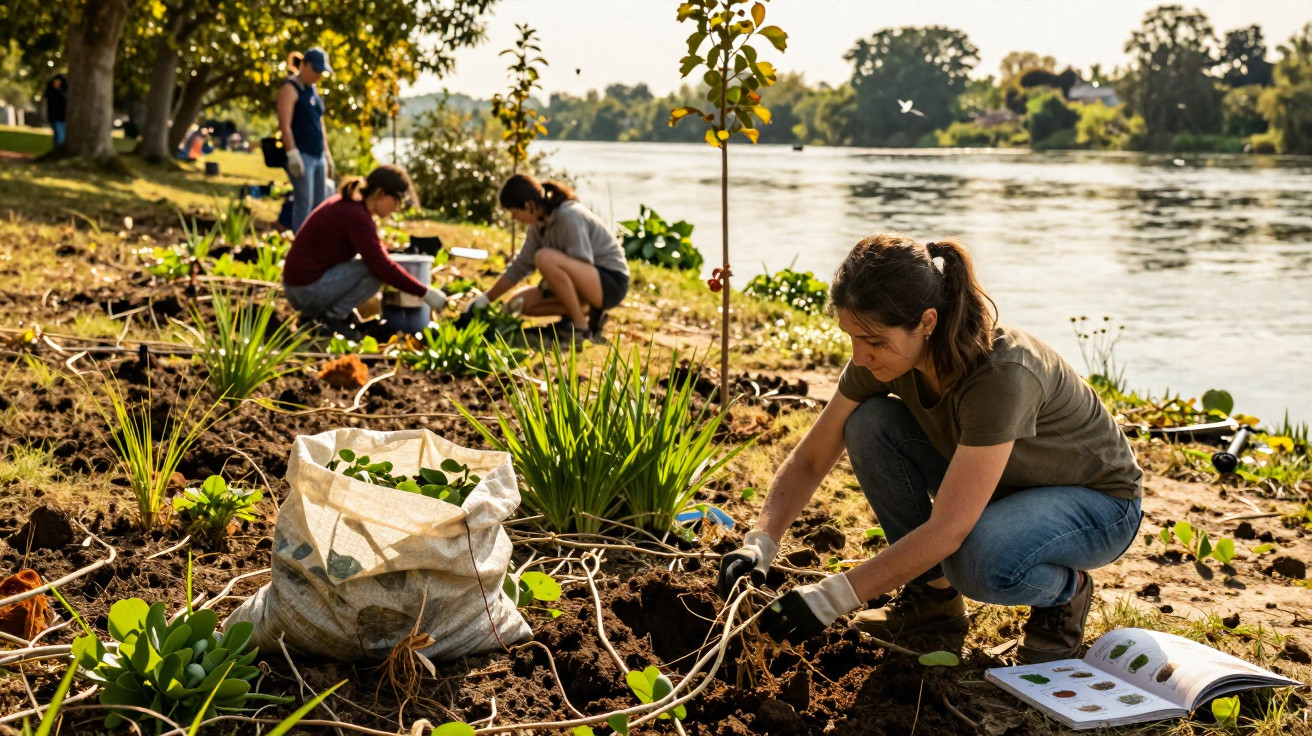
On a mild spring morning in a modest river valley, volunteers form a line with their hands gripping knotweed stems taller than themselves. Their task can seem futile: lorryloads of invasive growth are pulled out, piled up and taken away, yet fresh shoots return within weeks. The ecologist overseeing the work is unexpectedly relaxed. His attention is fixed on sunlight reaching bare patches of ground that have not seen the sky for two decades.
Those openings are what matter most. In the weeks following the first major clearance, seeds carried from neighbouring woodland begin to settle there. Native seeds that had lain dormant in the soil emerge after years without light. Once the rain comes, the muddy disturbed ground is scattered with recognisable plants: oak saplings, goldenrod and milkweed. What was a green monoculture becomes an unruly mosaic. It may look untidy and untamed, but that is precisely the aim.
Conservation teams on a coastal island in New Zealand made a bold bet on this same idea. For years, they cleared invasive shrubs and predators from a wind-lashed landscape that resembled a weed plantation more than a sanctuary. They did not set out neat lines of native trees. Instead, they largely halted the invasion and gave the land time. Within ten years, satellite imagery revealed an entirely transformed island. A thick native forest had returned, connected by seeds dispersed by birds that had at last come back.
Comparable accounts can be heard from the Everglades to the Scottish Highlands. On a Texas prairie formerly overwhelmed by Chinese tallow trees, researchers discovered that, following intensive removal, more than 80% of new vegetation consisted of native species already held in the soil seed bank. There was no complex replanting scheme: only room, daylight and patience. As one restoration worker put it with a laugh: “We basically got out of the way, and the prairie rushed back in like it had been waiting at the door.”
Why can this happen? Ecologists describe “ecological memory” - the latent capacity retained in soil, roots, seed banks and nearby fragments of wild habitat. Landscapes that appear ruined commonly still contain remnants of the ecosystem that existed before: a handful of resilient native grasses, a group of mature trees or an undamaged wetland upstream. Invasive plants do not wipe out that memory; they simply suppress it.
Taking away the invader does not mean building nature anew. It sets off a sequence that is already embedded in the site. Light can once again reach the soil, altering moisture and temperature. Native seeds finally receive the conditions required to germinate. Insects, birds and fungi then return alongside the plants with which they evolved. The ecosystem starts repairing itself, sometimes more rapidly than any human-led design could achieve. It is not so much gardening as pressing play on a story that has been paused for years.
How ordinary people are quietly triggering wild recoveries
This process becomes most tangible through small, targeted efforts. One particularly effective approach is remarkably straightforward: choose a single invasive species in one clearly marked place, then remove it completely and repeatedly. This may involve cutting English ivy at tree bases and peeling it back like a carpet. It could mean excavating the root crowns of Japanese knotweed and sealing every piece in bags as though it were hazardous waste.
It is not the work of one triumphant weekend. It requires selecting a “front line” and coming back to it again and again. Each shoot removed reduces the invader’s hold on the ground. Every cleared patch lets sunlight reach native plants nearby. Across successive seasons, those small liberated areas connect like pixels, changing the whole image. You are doing more than weeding: you are allowing an older community to make itself heard once more.
Residents on an urban hillside in Portland followed exactly this approach with Himalayan blackberry. Initially, the slope was so thickly covered that they could scarcely remain standing. After three years of regular volunteer sessions, an unexpected change occurred: they no longer needed to bring in native plants. Sword ferns spread from adjacent woodland. Bigleaf maple saplings emerged beneath the canopy of mature trees. Snowberry appeared in places where nobody could recall seeing it before. One volunteer compared it to “cleaning out a squatters’ house and watching the original owners move back in.”
Those taking part in such work soon encounter the same obstacles: exhaustion, uncertainty and the sense that roots are winning. The errors are deeply human. People attempt too much too quickly, clearing a vast space once and then failing to return. They pull up everything, natives included, because it all appears to be just “green stuff”. Or they see the invasive species surge back for the first time and conclude that the effort “didn’t take”.
It is better to measure progress in seasons rather than days. Notice the smallest successes: a lone oak seedling spotted the next spring, or the first butterfly settling on a flower that nobody planted. Join forces with neighbours instead of working alone; shared snacks and weary humour sustain long-term restoration more effectively than any flawless plan. Let’s be honest: nobody really does this every day. But once a month, with gloves, friends and a flask of coffee? That is how whole valleys are quietly transformed.
At a more fundamental level, this work changes the way people understand land.
“The turning point,” one restoration volunteer told me, “was when I stopped asking ‘What should we plant?’ and started asking ‘What’s already trying to come back if we just stop smothering it?’”
The emotional force lies in that move from control towards attention. In practical terms, several patterns repeatedly appear where ecosystems recover most strongly:
- Prioritise boundaries: work where native and invasive vegetation meet, allowing the “good guys” to spread swiftly into newly cleared ground.
- Safeguard survivors: mark and retain every native seedling or shrub, including the straggly-looking ones. They are your strongest allies.
- Keep disturbance light: do not strip the soil or rely on heavy machinery unless necessary. The goal is to eliminate the invader, not remove the stage itself.
We have all noticed that corner of a park or garden that seems completely overrun. These accounts suggest that beneath the brambles and tangled stems, a place may be far less damaged than it appears. There is a particular generosity in removing what does not belong, then waiting to discover what comes forward. Nature does not rebound like an elastic band. Yet, more often than we tend to acknowledge, it does move towards repair.
What happens when ecosystems are allowed to shape their own comeback
At dusk in a restored wetland, the air seems denser. Frogs call among reeds that were absent five years earlier. Dragonflies move along unseen routes overhead. At the edge of a pool, a heron disappears into the shade. None of this arrived from a catalogue. People removed invasive reeds that had reduced the marsh to an inert wall, then rain and time took over. The result is not flawless: plastic bottles still lie in the mud. But life has choices again.
Those choices are more important than any one celebrated species. Invasive plants simplify everything when they take over: one root structure, one type of flower and one form of shade. Their removal restores the system’s capacity to choose - determining where a plant grows, which bloom an insect finds and which insect a bird follows. This is not the curation of a museum display. It is the restoration of a conversation between earth, water, light and every living thing that responds to them.
Here, the story extends beyond specialists and field ecologists. If a slope, garden or roadside ditch can begin to recover when we no longer smother it, what might this imply for larger places? For rivers forced into straight channels, forests cut into fragments and cities paved right up to every stream? The message is not that we should merely “do nothing” and expect miracles. Rather, it is that subtraction, rather than addition, may sometimes be our most powerful action. Remove the invasive species, lift the pressure and look for the subtle evidence of return.
| Key point | Detail | Why it matters to the reader |
|---|---|---|
| Targeted removal of invasive plants | Focus efforts repeatedly on one species in one defined area | Makes it possible to act locally without being an expert, while creating a genuine benefit for biodiversity |
| The “ecological memory” of places | Native seeds and roots often remain in place, ready to grow again | Offers hope: even a “lost” site can regenerate when the pressure is removed |
| The strength of small groups | Neighbours, local organisations and regular work sessions rather than one-off bursts of effort | Shows how anyone can join or start a nearby restoration movement |
FAQ:
- How can I tell whether a plant in my garden is invasive? Begin locally. Consult your regional invasive species list, often available through government or NGO websites, and compare images. If you remain unsure, take a clear photograph and ask a local native plant group or gardening forum; responses are usually quick.
- Will removing invasive plants leave bare soil vulnerable to erosion? In the short term, cleared areas can appear exposed. That is why small, phased clearances and work during cooler, wetter conditions are helpful. In many situations, native groundcover and seedlings emerge within a season once light returns.
- Must I always plant native species afterwards? No. Where intact habitat is nearby, native plants often recolonise without help. In isolated or severely degraded locations, introducing a small number of carefully selected natives can accelerate recovery.
- Can this work in a very small urban garden or on a balcony? Yes. Even removing invasive ornamental plants from one courtyard and replacing them with natives provides food and shelter for insects and birds, while reducing the spread of troublesome species into nearby wild places.
- Is chemical herbicide ever needed for invasive plant removal? Some species with deep roots or the ability to resprout are exceptionally difficult to manage by hand alone. Many projects combine mechanical removal with carefully targeted herbicide, following local best practice to minimise unintended harm.






Comments
No comments yet. Be the first to comment!
Leave a Comment