
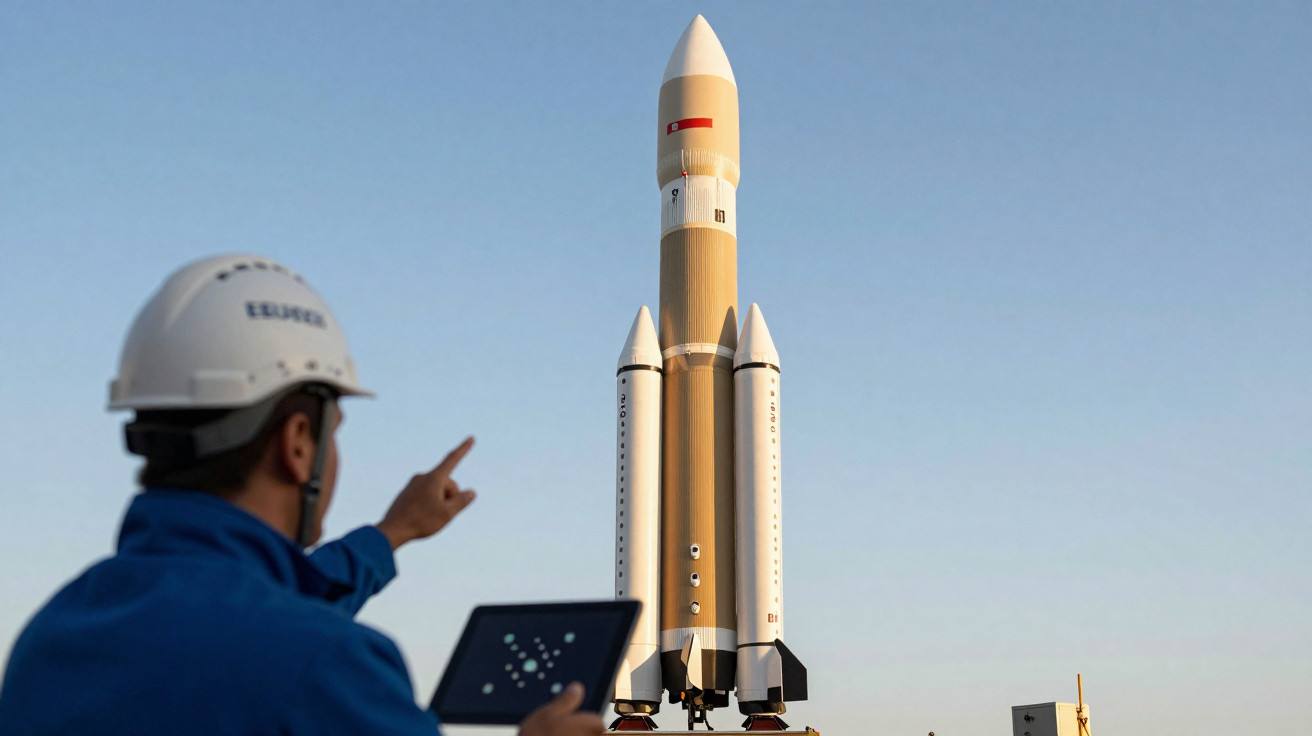
The forthcoming Ariane 6 mission, planned for 12 February 2026, is not simply another satellite deployment. It marks the point at which Europe’s heavy-lift launcher must show it can compete once more in a sector led by reusable American heavyweights, while carrying a particularly demanding payload for Amazon’s future broadband system.
A taller, heavier Ariane for a more demanding contest
Known as VA267, the mission will be the first to fly the Ariane 64 variant. It uses four solid rocket boosters attached to a central core stage, doubling the two boosters fitted to the Ariane 62 missions flown previously.
The change transforms both the appearance and performance of Europe’s new rocket. Equipped with its extended fairing, it will stand about 62 metres tall, comparable with a 20-storey building. Previous commercial Ariane 6 launches reached approximately 56 metres.
The four‑booster Ariane 64 effectively doubles the payload of Ariane 62, pushing capacity in low Earth orbit from roughly 10 tonnes to about 20 tonnes.
This additional capability is essential because the launch will place 32 satellites into low Earth orbit for Amazon’s Kuiper-style “Amazon Leo” constellation. Amazon intends the network to compete with Starlink for satellite broadband, and the contract gives Ariane 6 an important position in one of the space economy’s fastest-moving markets.
Four boosters also provide substantially greater thrust at lift-off. As a result, the trajectory, steering rules and vibration environment during the opening minutes of ascent all differ. European teams have spent years modelling these factors to ensure the new “monster” performs exactly as intended when it leaves the launch tower.
A new payload adapter designed for the weight
Strengthened hardware at the highest-stress points
The boosters are the most obvious upgrade, but the revised payload adapter is equally vital. Referred to internally as the ACU, this ring-shaped component sits above the upper stage beneath the fairing, supporting the entire satellite stack through the harshest phases of flight.
For VA267, engineers have created a “heavy” version of the ACU. Important composite sections have been made thicker to withstand the bending and vibrations created by ascent with four boosters, as well as the weight of the 32 satellites above it.
Small structural tweaks to the payload adapter decide whether thousands of kilos of satellites ride smoothly to orbit or suffer damaging stresses on the way up.
Much like strengthening a load-bearing beam in a building, the extra composite layers leave the overall form unchanged while greatly increasing resistance to deformation. Any unforeseen flex during the boost phase could disrupt separation systems or pass shocks on to sensitive spacecraft.
Mission planners regard the reinforced adapter as a means of supporting an entire range of heavy multi-satellite missions, including broadband constellations and Earth-observation fleets.
The first use of the 20-metre fairing
Six additional metres that alter the flight profile
VA267 will also debut the extended fairing: a 20-metre protective enclosure that protects its payload from aerodynamic forces and acoustic noise during atmospheric ascent.
Adding six metres to the fairing does not merely create more internal space. It also moves the vehicle’s centre of gravity and affects the stack’s aerodynamic stability at high speed.
That demands another set of simulations and adjustments to flight controls. The guidance software has to account for the taller vehicle’s reaction to wind shear and dynamic pressure, particularly during “max-Q”, the point at which aerodynamic loads are greatest.
Mission control will order fairing separation only after the launcher reaches thinner air. Its panels open and detach, exposing the dispenser and the 32 satellites. This must happen at precisely the right time: an early release would expose the payload to heat and noise, whereas a late one would mean carrying unnecessary mass and using more fuel.
Coordinating 32 satellites without one collision
Safely deploying a single satellite is routine. Releasing 32 in sequence while keeping them on a safe, orderly path is considerably more difficult.
Every satellite separation alters the mass and balance of the upper stage. With each release, the stage becomes lighter and reacts differently to control commands. This changing behaviour has been incorporated into guidance algorithms developed at ArianeGroup’s facility in Les Mureaux, near Paris.
A modest but essential item of equipment helps maintain control: the auxiliary power unit, or APU. On Ariane 6, it can generate low, continuous thrust to stabilise the upper stage and preserve its orientation throughout deployment.
The APU’s barely visible push keeps the upper stage pointed correctly, so satellites drift apart instead of drifting into each other.
The Vinci engine, which powers the upper stage, will first burn soon after the core-stage separation to reach the planned orbit. It will then restart later to lower the stage for atmospheric re-entry and burn-up. This managed disposal reflects increasing pressure to reduce space debris in congested low Earth orbit.
Why the Ariane 6 mission matters so much to Europe
A launcher arriving late in a transformed market
Ariane 6 was originally expected to replace Ariane 5 around 2020. A combination of engineering decisions, political discussions and outside disruptions instead delayed its maiden flight until July 2024.
Progress was slowed by the construction of the ELA-4 launch pad in Kourou, certification of the restartable Vinci engine and the COVID-19 pandemic. Supply chains weakened just as major tests were scheduled, subsystems required further work and deadlines repeatedly moved back.
The outcome was a four-year difference between the initial target and the actual timetable. In that time, Europe lost the heavy-lift capability previously supplied by Ariane 5 and became more dependent on overseas launch providers. At the same time, rivals accumulated experience and lowered costs by launching more frequently.
When Ariane 6 entered commercial service in 2025, the international market had changed. Reusable launchers, mega-constellations and forceful pricing were now standard conditions rather than emerging developments. VA267 therefore represents not a gradual entry into the market, but a measure of whether Europe can still influence it.
A launch sector heading towards €56 billion annually
The wider market shows why the mission carries such weight. Analysts estimated the orbital launch market at roughly €15 billion in 2025. Existing forecasts indicate that it may surpass €56 billion per year by 2035, driven by fresh constellations, military requirements and commercial applications with growing data needs.
American private companies including SpaceX and Blue Origin, together with China’s Long March family, now hold a major share of launch opportunities. Smaller firms pursuing micro-launchers and dedicated rideshare offerings create additional competitive pressure.
Europe is responding by investing in sovereign space access through Ariane 6, Vega and a growing group of “New Space” start-ups in France, Germany and other member states. The objective is straightforward: preserve independent launch capability while remaining a credible option for commercial clients able to choose providers worldwide.
Snapshot of the competitive field in 2025:
| Actor / region | Main launcher | Orbital launches in 2025 | Market role |
|---|---|---|---|
| SpaceX (US) | Falcon 9 | 165 | Dominate commercial access, high cadence |
| China | Long March family | 92 | Rapidly expanding national and export offer |
| Russia | Soyuz | 17 | Stable institutional use, limited growth |
| Europe | Ariane 6, Vega | 8 | Gradual comeback, focus on autonomy |
| India | PSLV, LVM3 | 5 | Regional player, competitive for state missions |
| Japan | H‑IIA, H3 | 4 | Transition phase, industrial adjustment |
What distinguishes Ariane 64 from Ariane 62?
To readers familiar with rocket terminology, the move from “62” to “64” may appear slight. In reality, it changes the launcher’s purpose.
- Boosters: Ariane 62 uses two solid boosters, while Ariane 64 uses four.
- Payload: Ariane 62 can deliver around 10 tonnes to low Earth orbit; Ariane 64 can carry roughly 20 tonnes.
- Height: The short fairing allows a height of up to 56 m, while Ariane 64 reaches 62 m with the 20-m fairing.
- Target missions: Ariane 62 is aimed at institutional and medium-mass payloads; Ariane 64 targets heavy commercial constellations and dual-satellite government cargos.
Later in 2026, Ariane 6 is expected to gain upgraded solid boosters derived from the P160C motor. This development is essentially a more powerful form of the existing strap-on booster and should improve performance without requiring a complete vehicle redesign. It offers planners extra capacity for later payloads without starting an expensive new development programme.
Key terms shaping the mission
A number of technical terms recur in discussions of VA267. Knowing what they mean helps put the mission’s importance into context:
- Low Earth orbit (LEO): Usually an altitude of up to around 2,000 km. It is well suited to broadband constellations because signal latency is low.
- Constellation: A coordinated collection of satellites intended to operate together. The loss of one or two satellites seldom ends the service, although delays carry financial consequences.
- Desorbitation burn: An engine firing that intentionally lowers a rocket stage so that it re-enters the atmosphere and burns up, reducing debris.
- Fairing separation: The point at which the protective shell is discarded. If separation fails, the mission can be lost even when the engines operate perfectly.
Consider an APU failure during deployment. The upper stage could begin tumbling or drifting, and release timing might send satellites onto crossing trajectories. That would increase collision risk and generate debris in orbital lanes that are already busy. For this reason, redundant attitude control and detailed choreography matter as much to the mission as engine power.
Commercial risks are present too. Should Ariane 64 experience a major anomaly during this prominent mission, European customers could permanently move to overseas launchers and consortium members might challenge continued investment. Conversely, a successful on-time flight would improve Europe’s negotiating position with future constellation operators seeking several launch options.
The advantages extend beyond defence and telecommunications. Dependable heavy-lift access from European territory supports climate-monitoring spacecraft, navigation improvements and scientific missions. Every successful Ariane 6 launch, beginning with this 62-metre “monster” on 12 February, helps prevent those programmes from becoming dependent on political changes in Washington, Moscow or Beijing.


Comments
No comments yet. Be the first to comment!
Leave a Comment