
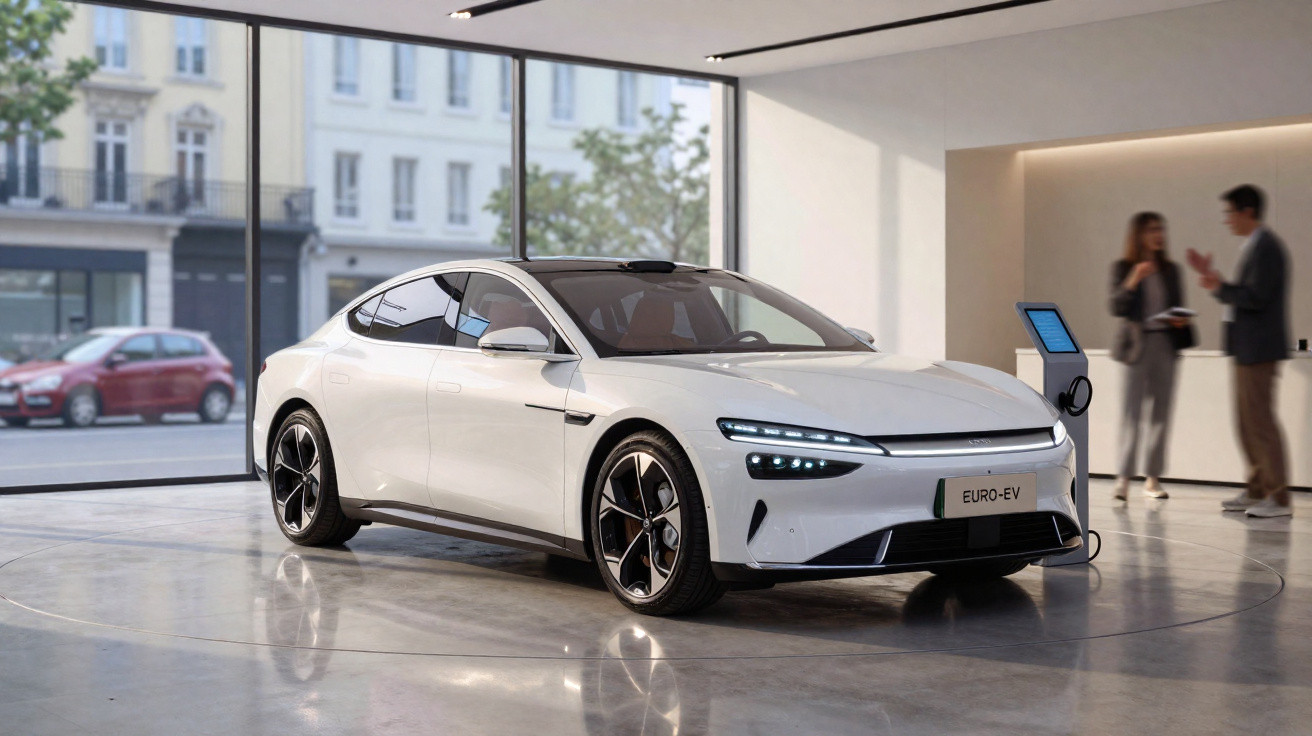
On a wet Tuesday morning in Lyon, with scooters whispering across rain-darkened tarmac, a small white BYD Seagull quietly pulled into a bay once occupied by a diesel Renault. Its driver, a 29-year-old nurse, climbed out holding coffee in one hand and her phone in the other. With a shrug, she said, “Honestly, it was this or no car at all.” A few metres away, two Renault employees watching during their break stood with their arms crossed. One shook his head and muttered, “That, is my job driving past me.”
Further along the same road, a green city councillor cycled past and smiled at the compact Chinese EV. Fewer fumes, less noise and another combustion-engine car removed from the streets.
One car. Three perspectives.
Who is right?
Cheap, quiet and suddenly everywhere
Walk around any major European city today and they are hard to miss: unfamiliar badges, crisp styling and almost ridiculously large interior screens. MG, BYD, Nio and Ora were names most Europeans barely recognised three years ago; now they appear in traffic as regularly as phone notifications. They pass ageing Volkswagens and Peugeots, looking brand new while often costing less on finance than a mid-range smartphone.
These vehicles have not entered Europe gradually. They are arriving in a surge, like a tide the continent assumed it had longer to prepare for. The roads themselves have become the scorecard.
In Valencia, Javier, a 43-year-old mechanic, says that much of his day is now spent telling customers why the Chinese EV they want costs less than a used Clio. “A family walks in,” he says, “they see a compact electric for under €20,000, and suddenly the old brands look like antiques.” He once repaired exhaust systems; now he fits home chargers and studies Chinese specification sheets in the back office.
Sales figures across Europe are being redrawn. Chinese-made EVs - including Western-brand models built in China - have gone from a niche presence to a meaningful market share within only a few years. A vast amount of metal is crossing the oceans, and the established manufacturers are blinking.
The explanation is, in part, brutally straightforward. Chinese makers invested years, billions and substantial state support in constructing a complete EV ecosystem from scratch: batteries, chips, software and entire “EV cities” built around scale. While Europe debated targets and deadlines, China built factories. That gap is now visible on price tags.
European manufacturers say they are constrained by higher pay, tougher environmental requirements and energy costs. They describe Beijing’s subsidies as unfair, while Brussels investigates the issue. Yet none of that complexity fits on a showroom window. What people see is this: a shiny electric car they can finally afford, and a local factory that feels a bit less safe than last year.
Jobs at risk, or CO₂ removed from the air?
Spend time with employees outside a Stellantis plant in Turin or a VW factory in Wolfsburg, and the anxiety feels tangible. Cigarettes disappear quickly, voices get louder, and every press statement on an “electrification strategy” sounds like another way of saying “we’ll need fewer of you.” An electric car has fewer moving components than a diesel vehicle. Once the move to EVs became fixed, many workers could already see what was coming. Add a wave of lower-cost Chinese EVs and the danger appears twice as great.
They are not merely competing with the future; they are competing with a future manufactured elsewhere.
Consider the Belgian port of Zeebrugge, now one of Europe’s principal arrival points for Chinese EVs. Areas once occupied mainly by EU-built vehicles now contain seemingly endless lines of Shanghai-made models awaiting distribution by lorry and rail across the continent. Dock workers describe an unsettling contradiction: trade is thriving and ships are larger, but the value created on European soil seems reduced.
Meanwhile, city authorities from Amsterdam to Milan point to air-quality data that is at last improving. Fewer schoolchildren coughing during winter. Fewer days when nitrogen dioxide makes the air feel suffocating. The influx of Chinese EVs contributes to those figures, whatever politicians think of their country of origin. In climate data, every combustion vehicle removed from the road has the same effect.
For environmental campaigners, this creates an awkward dilemma. They have spent years advocating the end of fossil-fuel engines by 2035. Now an affordable means of accelerating that change exists, but it comes from a country reliant on coal-heavy electricity, with opaque supply chains and a government that hardly leads human-rights rankings. Should they welcome lower tailpipe emissions while overlooking everything else? Or should they slow the transition to shield European industry and accept higher emissions for longer?
Politicians face the same conflict. Tariffs on Chinese imports could preserve some jobs, at least temporarily, but may slow EV uptake and invite retaliation. Allow the influx to continue, and climate targets may be met more quickly, but Beijing could gain enormous influence over European mobility. The blunt reality is that every option carries a cost, and no one wants to state plainly who should bear it.
What Europe can realistically do next
In private, industrial strategists keep returning to one message: catch up, or accept becoming a market rather than a manufacturer. The clearest route is not more speeches in Brussels but activity in workshops in places such as Douai, Tychy and Zwickau. Europe needs its own battery factories, its own affordable small EVs and software that does not feel five years behind a Shenzhen dashboard.
Some manufacturers have begun to understand the urgency. Renault is preparing a low-cost electric Twingo; VW has repeatedly promoted its €20,000 EV; and Stellantis is expanding its electric Fiat range. These are not prestige exercises. They are instruments of survival.
Policymakers often favour grand announcements, but quieter practical measures matter more. Regulations could favour cars genuinely built in Europe without completely closing the door to imports. Funding could retrain engine specialists as battery technicians rather than leaving them with slogans about “green growth”. Timetables need to be credible, rather than fantasy plans that unravel after every election.
We have all seen the point at which ambition overtakes reality and somebody must fill the gap. With EVs, that somebody includes mid-career factory employees, young buyers struggling with rent and small suppliers who never expected to learn about lithium refining. Let us be honest: nobody truly reads 300-page transition plans every day.
Within ministries, there is increasing recognition that the approach cannot simply be “ban petrol, let the market handle the rest.” One senior EU official, speaking privately, put it bluntly:
“The choice is not between Chinese EVs or no EVs. The choice is whether Europe shapes this transition or just pays the bill for it.”
To turn slogans into something workable, three priorities repeatedly emerge:
- Protect some space for homegrown models through intelligent, targeted trade measures rather than full-scale tariff wars.
- Pour real money into gigafactories, retraining and affordable urban EVs instead of endless pilot schemes.
- Tell the truth about the social cost of the transition, so workers do not learn about it only when their plant shuts.
It looks straightforward on paper. In politics, it is explosive.
A battle unfolding in driveways and ballot boxes
On a suburban street in Poland, France or Portugal on a Sunday morning, this conflict can be seen in miniature. There is the worker cleaning a ten-year-old diesel, worried it will soon be banned from city driving. There is the young couple proudly returning from the supermarket in a small imported EV that finally suits their budget. And there is the neighbour reading headlines about tariffs, climate deadlines and “strategic autonomy”, attempting to reconcile them with the bills on the kitchen table.
None of them use trade-policy language. They talk about months remaining on a loan, years until retirement and how their children’s lungs sound in winter.
China’s affordable electric cars have not simply arrived at Europe’s ports. They have sailed directly into Europe’s unresolved tensions: green commitments against industrial pride; open markets against fears of dependence; short-term relief at the charger against long-term leverage on the geopolitical chessboard. Each new registration is a small vote in that unspoken referendum.
The issue is not simply whether these cars destroy jobs or save the planet. It is who has the authority to define “job” and “planet” in the first place: a worker in Zaragoza, a planner in Beijing, a minister in Berlin or a nurse in Lyon signing a finance agreement on a rainy Tuesday.
The story is nowhere near finished. It is parked outside.
| Key point | Detail | Value for the reader |
|---|---|---|
| Chinese EVs undercut prices | State-supported scale and lower production costs allow brands such as BYD and MG to sell for less than many European competitors | Explains why these vehicles suddenly appear “too cheap to ignore” |
| Jobs feel directly threatened | Engine plants, suppliers and conventional factories view EVs and imports as a double blow | Shows why unions and workers respond with anger rather than only abstract concern |
| Climate gains are real but uneven | Cleaner urban air and lower CO₂ tailpipe emissions raise questions about batteries, coal power and supply chains | Offers a more honest view beyond simplistic “green” or “dirty” labels |
FAQ:
- Are Chinese electric cars really that much cheaper in Europe? Often, yes - particularly in the small and mid-sized segments. Lower labour costs, aggressive pricing and substantial state backing enable many Chinese brands to undercut European rivals by several thousand euros per car.
- Do these imports actually threaten European car jobs? They increase pressure on an industry already being disrupted by the EV transition. Engine plants, traditional suppliers and regions heavily reliant on a single major factory face the greatest risk.
- Are Chinese EVs worse for the environment overall? The picture is mixed. European tailpipe emissions fall sharply, but manufacturing often depends on more carbon-intensive electricity and supply chains that are more difficult to audit.
- Can European brands catch up on affordable EVs? Yes, although they require time, investment and political support. Several €20,000–€25,000 models are planned, but matching Chinese price–technology combinations remains a major challenge.
- What could change this balance in the next few years? EU tariffs or incentives, new European battery factories, tougher supply-chain rules and any slowdown or change in China’s own EV subsidies could all alter the landscape.






Comments
No comments yet. Be the first to comment!
Leave a Comment