
It hangs in the air, its roots suspended inside a mist-filled chamber no larger than a small fridge. Nutrient fog pulses around every white filament. Twelve metres above the road, in a converted warehouse at the edge of town, a farmer wearing trainers uses an app to alter pH with a swipe of a thumb. Beyond the building, the ground is cracked and dry after another month without meaningful rain. Indoors, cherry tomatoes redden under pink LEDs at 2 a.m., growing in a former tyre store.
Seeds are being reworked for precisely these conditions. They are designed to do without soil, germinating while held in foam, sponges or narrow vertical cartridges made from biodegradable mesh. Farming is gradually leaving open fields for towers, racks and glass-fronted shafts that resemble data centres more than conventional farms.
That transformation poses one unavoidable question for everyone involved.
When seeds no longer need soil
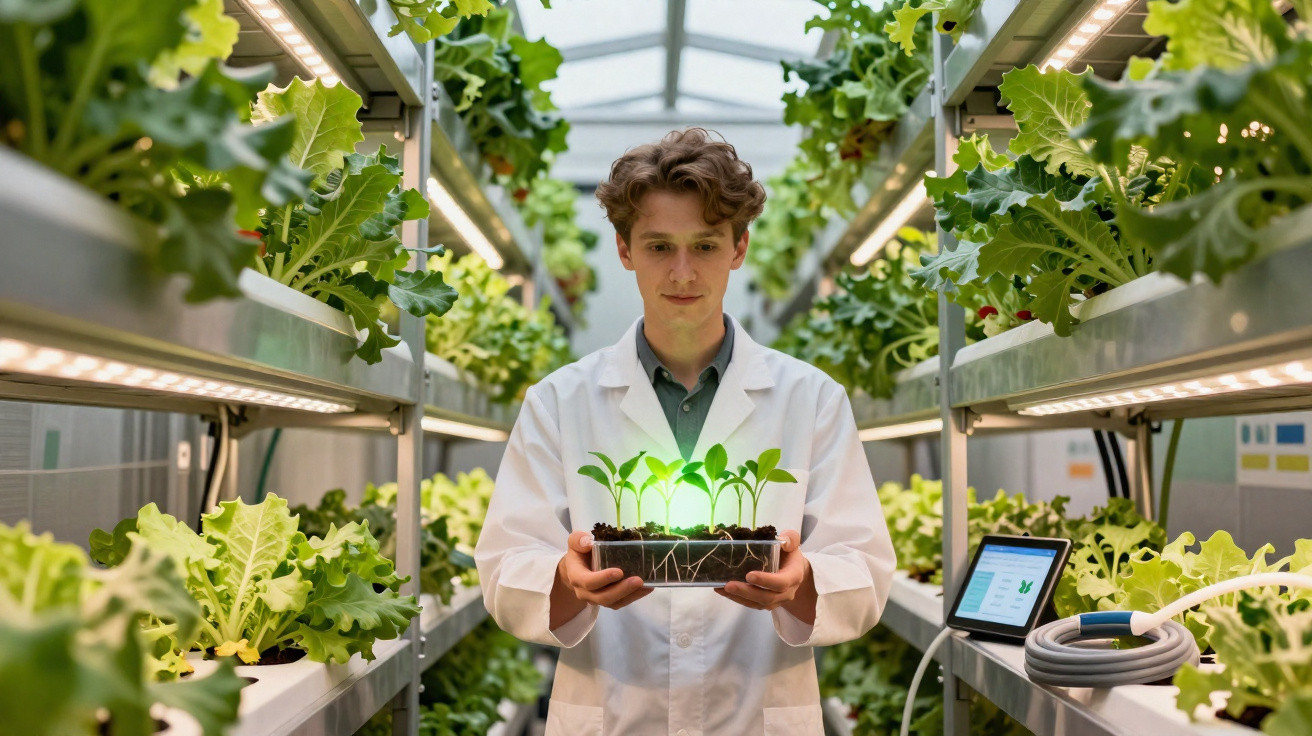
The silence is the first surprising thing about a vertical farm. There are no tractors, humming insects or boots disappearing into mud. Instead, fans produce a quiet drone while water hisses through pipes behind white plastic panels. Thousands of small openings in one panel contain engineered seeds set in slim plugs of inert material, forming something like a pixelated curtain of green.
These seeds have been chosen-and sometimes edited-to emerge quickly in low-gravity conditions and develop neat roots that do not spread far. Rather than needing a soil bed, they are bred to flourish with a fine nutrient mist or a measured drip of solution. A conventional seed may send roots in every direction; these plants act more like focused swimmers in a single lane, directed by sensors, pumps and software.
On an overcast morning in Singapore, that control appears unexpectedly personal. Lina, a technician at a sixteen-storey vertical farm, picks up a cartridge of basil seedlings as thin as a paperback. Every plant has the identical height. There are no empty spaces, yellowing leaves or weeds. She explains that the company’s software can forecast, almost to the hour, when each crop batch will be ready. Harvesting happens daily rather than by season. Rain, heatwaves and hungry birds no longer affect the crop.
Figures from industry bodies can sound implausible. Certain vertical farms say they use up to 95% less water than open-field agriculture while producing ten, twenty or even thirty times more leafy greens per square metre. A US start-up claims a warehouse small enough for a supermarket car park can substitute for a fifty-acre lettuce field. In Japan, another business grows strawberries for luxury patisseries in stacks five levels high, under gently lit panels calibrated to a “perfect sunrise” spectrum.
Those claims are easy to find impressive, and investors often do. Venture funding has flowed into tall farms equipped with robotic arms and AI-led climate controls operating around the clock. But a less visible development is taking place behind the glass: seeds are being adapted to this environment. Breeders trial lines that germinate consistently beneath LED lighting. Biologists adjust traits so crops remain compact, withstand fungal illnesses typical of enclosed systems and turn artificial light into sugars at unusual angles. Lettuce intended for open fields may collapse on a vertical rack, while a shelf-optimised variety may not tolerate wind.
This development brings questions that yield graphs cannot readily answer. As more food is grown in sealed facilities, who owns the software that nourishes it? What becomes of farmers unable to spend millions on equipment, and of rural communities centred on fields and barns? Soil is more than a medium for growing crops: it represents culture, memory and a way of living. Shifting farming into vertical buildings may offer resilience in a warming climate, yet it can also concentrate influence among firms that own patents, proteins and platforms.
Even so, the argument is stark in cities where land has disappeared and weather is unstable. Seeds that do not depend on soil allow food to be cultivated on the eleventh floor of an office building, inside an abandoned shopping centre or in a shipping container behind a restaurant. It is farming, though unlike anything previous generations knew.
How vertical seed farming works
Remove the neon glow and science-fiction imagery, and vertical farming with engineered seeds follows a straightforward sequence. A seed is coated or placed in a plug-made from foam, rockwool, coconut fibre or even 3D-printed biopolymers-which keeps it secure while allowing its roots to breathe. The plug is inserted into a vertical rail or panel, much like a book placed on a shelf. In place of rain and soil microbes, the roots receive a precisely balanced nutrient mix, sprayed or dripped at set intervals.
For this approach to succeed, seeds must behave reliably. Engineering is important for that reason. Scientists select characteristics that produce compact roots, limit “bolting” (when a plant flowers too quickly and becomes bitter), and make leaves more effective at using artificial light. Some laboratories are investigating seeds that detect nutrient shortages and alter their growth accordingly, alongside varieties that remain healthy even when grown densely together. The aim is not a super-plant so much as a dependable, well-mannered resident in a cramped vertical flat.
The process can feel almost homely when a crop is followed through a building. At a small Paris vertical unit, a chef removes a tray of radish microgreens from a line developed specifically for stacked growing systems. They travel from seed to plate in ten days, spending their entire existence in a column no wider than a wardrobe. There are no muddy delivery lorries or distant cold-storage journeys. The farm glows softly behind a glass wall at the back of the restaurant while guests dine.
In Dubai, where summer temperatures may reach 45°C, a large facility grows salad leaves from seeds selected for low transpiration, meaning the plants lose less water through their foliage. Shoppers can buy bags of spinach that have never been beneath a cloud, produced in a city where ordinary fields would be almost impossible. At a far smaller scale, enthusiasts fit suitcase-sized vertical systems into flats and use seeds marketed for “indoor rack growth”, with shorter stems and close spacing.
These examples can seem inspiring and almost effortless. However, anyone who has managed even a simple hydroponic system knows it can be temperamental. Pumps become blocked, algae appears and software fails. A London operator says they lost a whole crop after a sensor incorrectly measured water levels. Another acknowledges they had not anticipated how draining it would be to keep several systems accurately calibrated while running a business.
Technically, the trade-off is simple. Soil’s mess and uncertainty are exchanged for machine complexity and accuracy. Energy becomes crucial, since LEDs and climate systems can consume substantial electricity, particularly in older properties. Seeds developed to perform in low light and mature more quickly can reduce that expense. Their genetics form part of the energy calculation as much as the yield calculation.
There is a quieter ecological issue, too. Roots that never enter soil lose contact with an intricate microbial network that researchers are only starting to comprehend. Some vertical farms now test microbial “probiotics” in nutrient mixes, or apply seed coatings containing useful bacteria that replicate certain soil roles. The goal is not to leave biology behind, but to condense and redesign it for upright stacks beneath a roof.
What this means for everyday eaters and growers
If vertical farming seems remote and corporate, it is useful to consider smaller actions. A practical first step is selecting varieties that genuinely suit off-ground cultivation. Many seed suppliers now mark packets “hydroponic friendly” or “ideal for vertical systems”. These labels are not empty marketing: they indicate qualities including compact growth, dependable LED germination and shallow root systems.
Treat vertical growing space as a set of microclimates. Upper racks receive more warmth from rising air, whereas lower levels may be cooler and more humid. Placing the appropriate seed on the appropriate shelf-basil at the top, lettuce in the middle, delicate herbs lower down-can double success without altering any equipment. It may sound self-evident, but many people fill every shelf with one crop, then wonder why edge plants struggle as the centre thrives.
Small routines can also stop the technology feeling unfamiliar. One Berlin vertical grower spends ten minutes each evening walking past her racks carrying a notebook rather than a tablet. She records what she notices: leaf colour, unusual smells and minor drooping. This analogue practice identifies difficulties well before charts and alerts respond.
Early adopters frequently encounter the same setbacks, which can feel strangely isolating. They purchase an elegant vertical system, fill it with expensive engineered seeds and anticipate the plug-and-play ease seen in adverts. Then a nutrient imbalance occurs, mites arrive on a houseplant, or a week-long holiday disrupts the entire cycle. Let us be honest: nobody faithfully monitors humidity and pH graphs every day.
A sensible way to remain calm is to approach it as a kitchen rather than a laboratory. Begin with only one or two proven seed varieties-leaf lettuce, basil and perhaps kale-before attempting strawberries or dwarf tomatoes. Cycle crops through short “seasons” lasting four to six weeks, so an entire rack of poorly performing plants does not occupy the space for months. Allow yourself to fail visibly, too: share the photographs of wilted plants as well as polished harvest images.
On a dense city street, vertical growers often have no idea that neighbours on the next road are doing the same thing. Informal local conversations-online groups, shared spreadsheets and ingredient exchanges-can have a major effect. We have all seen a plant that looks wrong and been unsure whether to panic or wait another day.
“We used to trade seeds over fences,” says an urban farmer in Rotterdam. “Now we trade QR codes for nutrient recipes. But underneath, it’s the same conversation: how did you get yours to grow like that?”
That human connection prevents the whole transition from becoming purely industrial.
- Begin modestly: one system, a handful of dependable engineered varieties and brief crop cycles.
- Use your eyes and nose as well as sensors and charts.
- Exchange good and bad results with a local or online community.
- Combine engineered seeds with several traditional varieties to preserve diversity.
- Monitor energy use as carefully as yield; both will influence this model’s future.
A future where farms grow up, not out
Walk through any medium-sized city in early evening and look upwards. Behind unremarkable windows, illuminated racks occupy offices that once stood partly empty. Spinach grows on the third floor. Microgreens fill a stairwell. Herbs trail around a converted lift shaft. Seeds that might once have waited for spring rain now live entirely beneath programmable skies.
This vertical transformation will not replace rolling wheat fields or bee-filled orchards. It creates an additional layer: a safeguard in a climate that swings from drought to flooding, and a means of producing food closer to where people live when land is tightly constrained by concrete and glass. It also prompts difficult questions about who determines our crops, who owns their code and what is lost when roots are permanently raised from the earth.
There is a quiet contradiction here. The more controlled and digital these systems become, the more they require old-fashioned care: patient observation, shared advice and stories exchanged over coffee. Vertical farms can resemble servers, but they remain full of living organisms that sulk, surprise and refuse to follow a plan. As engineered seeds hold to their panels and stretch towards pink light, the rest of us must decide how much of our food should be grown in buildings we pass each day.
Some people will welcome lettuce harvested beside their flat, untouched by soil or storms. Others will miss mud on their boots. The discussion has barely begun, and it will influence not only what we eat but also how we define a farm.
| Key point | Detail | Why it matters to the reader |
|---|---|---|
| Seeds engineered for vertical growth | Traits tuned for compact roots, fast germination and LED efficiency | Understand why some varieties thrive on racks while others fail |
| Vertical structures as “indoor fields” | Towers, racks and panels replace horizontal soil beds | Visualise how farming moves into cities and buildings you know |
| Everyday practices for non-experts | Choosing the right seeds, starting small, sharing results | See practical ways to engage with this shift at home or in your community |
FAQ:
- Are vertically engineered seeds genetically modified? Some are, many are not. A lot of vertical-friendly varieties come from traditional breeding focused on traits like compact growth, while a smaller share are edited using modern biotech tools.
- Can any plant be grown in a vertical farm? Not yet. Leafy greens and herbs do best, strawberries and tomatoes are growing fast, but grains, root crops and large fruit trees are still far more efficient outdoors.
- Is vertical farming really more sustainable? Water use and pesticide use drop dramatically, but energy use rises. Sustainability depends heavily on the local electricity mix, system design and how well seeds are adapted to low-energy conditions.
- Will this replace traditional farmers? It’s more likely to complement them. Vertical farms excel at fresh, perishable produce near cities, while large-scale field agriculture will continue to dominate staples like wheat, corn and rice.
- Can individuals try this at home without huge costs? Yes. Small, shelf-sized vertical kits and seed varieties labelled for hydroponic or indoor growth make it possible to experiment in a flat corner or garage.





Comments
No comments yet. Be the first to comment!
Leave a Comment