
On a wet Tuesday morning, the 8:32 a.m. commuter train pulled away from the station only half full.
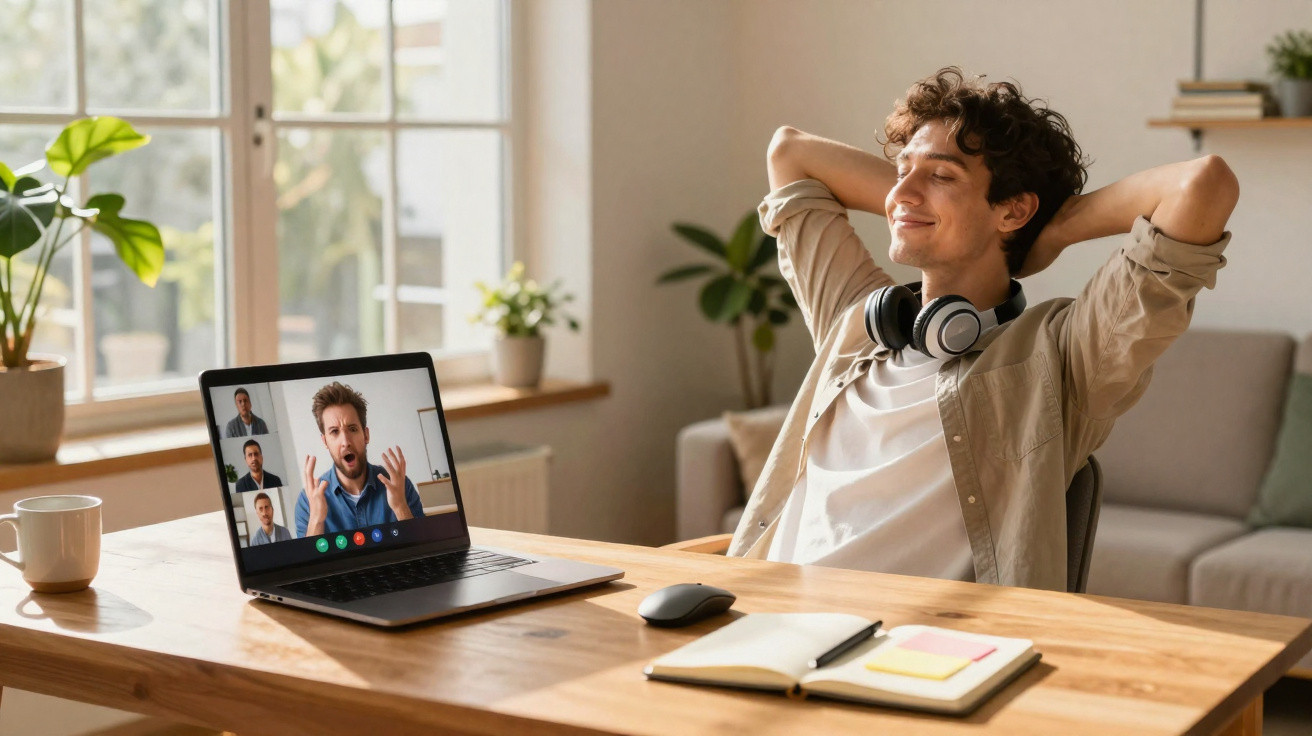
In flats beside the railway, people had already started work – wearing slippers, holding coffee mugs, with dogs by their feet and children colouring at one end of the kitchen table. The city was still buzzing, but at a lower pitch, as though someone had turned down the stress.
This has become everyday life for millions, four years after the vast global trial that nobody chose: working from home.
Some people have returned to the office, some never stopped going in, while others are battling to keep their desks in the living room.
That is because something changed in a way that cannot now be ignored.
Four years, thousands of workers, one clear result
When academics began monitoring remote work in 2020, managers repeatedly voiced the same concern: “Productivity will collapse.”
They therefore tracked it all: output, working hours, stress, sickness absence and even the frequency of smiles during the working week.
Their findings were not vague or inconclusive.
Across dozens of studies, employees working from home for at least part of the week said they were significantly happier than colleagues in the office full time.
They experienced less tiredness, slept more, faced fewer disruptions and felt more in charge of how their day unfolded.
The most unexpected finding?
Their work did not unravel. In a number of industries, performance quietly improved.
Consider the large Stanford research project involving a Chinese travel agency, which began before the pandemic and continued afterwards.
Volunteers working from home were 13% more productive than colleagues confined to the office. They had fewer breaks and sick days, while their satisfaction with their jobs rose sharply.
There are also the less visible figures that rarely become headline news.
Major surveys across the US and Europe repeatedly find that people offered flexible remote arrangements report greater life satisfaction, less burnout and improved mental health. They are also less likely to resign.
Speak to friends and the same modest examples emerge.
There is the father who takes his child to school at 8:15 and can still sign in at 8:30.
Or the designer who plans concentrated work for the time when her mind is genuinely alert, rather than when the open-plan office is at its noisiest.
Researchers are now relatively direct on the point: remote work, done right, increases well-being for a large share of workers.
Simply removing the commute returns an hour – and sometimes two – to people every day. That is not a minor benefit; it creates a different kind of life.
A less frantic routine can mean fewer disputes at home, fewer stress-driven impulse purchases and fewer evenings when you are too exhausted to speak.
Then there is the ability to control your surroundings – the lighting, sound, temperature and even lunch – which gives your nervous system a quiet reprieve.
There is another dimension as well.
Being trusted to arrange your own schedule sends a restrained but meaningful message: “We see you as an adult.”
Psychologists use the rather dry word autonomy, but most workers recognise it as respect.
Why managers want remote workers back at their desks
If working from home leaves people happier and often equally productive, why have “return to office” messages arrived in such force?
Talk to managers in private, and another explanation tends to surface.
They miss immediate visibility.
Walking along a corridor and being able to “see” people working feels reassuring. Screens and Slack messages do not provide the same comfort.
Many managers built their careers by reading a room, spotting problems in corridors and assessing performance through physical presence.
Remote work disrupts that learned instinct.
Managing through objectives and trust, rather than keeping people in chairs, is an ability that some never needed to develop. Now that gap is visible, and it can be uncomfortable.
The conflict appears in everyday moments.
There is the manager who starts arranging three “catch-up” video calls each week simply to regain a sense of control.
There is also the employee switching on their camera from a silent bedroom, laundry in the background, attempting to appear “busy enough” at 9:03 a.m.
At a global bank, employees were told they had to “rebuild culture” by returning to the office.
The same memo informed them that their allocated desks would disappear and that they would hot-desk three days each week. Apparently, culture meant being present rather than being comfortable.
Most people recognise that instant when it becomes clear that a policy is not about their well-being, but somebody else’s anxiety.
Financial pressures are involved too, and salaries are not the only issue.
Businesses committed to lengthy office leases when they assumed everyone would attend five days a week. Vacant floors cost money.
Accepting that so much space is no longer required also means accepting that the calculation was wrong.
Identity matters as well.
For decades, “serious work” was associated with suits, security-pass swipes and fluorescent lighting. To certain leaders, abandoning that image feels like surrendering status. A crowded reception area was their stage, while the corner office served as their armour.
Now that stage is a grid of small faces in boxes.
The audience is partly muted, sometimes dressed in hoodies and sometimes accompanied by a toddler in the background.
Not everyone is willing to adjust to that version of reality.
How to retain the benefits of remote work without burning out
Even if the research shows that remote life can make people happier, daily life still requires adjustment.
When your workplace is also your home, boundaries can blur in subtle ways, and no one was handed an instruction manual.
One straightforward practice can make a considerable difference: create a ritual for beginning and ending work.
It may sound insignificant, even slightly absurd, but it gives your mind an anchor.
Put on shoes at 8:45, walk around the block and then open your laptop. At 5:45, shut it down, close every tab and put the computer in a drawer or on a high shelf.
You are telling yourself: “Work lives here, my life lives there.”
Without these small markers, one day can merge into another long, grey stretch of screen time.
The greatest risk in remote work is not idleness. It is overwork.
People stay online for longer, reply later into the evening and feel uneasy whenever they are not permanently shown as “green”.
Set your own firm limits instead.
Keep Slack off your phone, stop checking email after a chosen time and take at least one break away from every screen.
Realistically, nobody manages this without fail every day.
Yet the days on which you do follow these rules feel profoundly different.
If your manager expects immediate replies at 10 p.m., it helps to state your boundaries early.
There is no need for a dramatic declaration; establish them through matter-of-fact habits: “I’m offline after 6:30 p.m., I’ll handle this first thing tomorrow.”
Respect is easier to secure when you demonstrate it towards yourself first.
“Remote work isn’t the end of culture, it’s the end of lazy culture,” a manager of a European tech firm told me.
“In the office, you could hide bad habits behind routine. Online, you have to be intentional about everything.”
- Set aside one small, protected area for work, even if it is only a table corner with the same lamp and notebook each day.
- Plan social interaction deliberately: have a weekly coffee with a colleague, take a brief walk with a friend or call somebody outside your team.
- Spend the time saved from commuting on life rather than extra work: pursue a hobby, have a nap, enjoy a slower breakfast or stretch to music.
- Agree clear “response hours” with colleagues, so that silence does not become a source of anxiety.
- Watch for early warning signals, including headaches, strained eyes, late-night scrolling and the indistinct sense of Sunday dread returning.
Happiness at home, panic at the top: what happens next
We are in an uneasy middle ground.
Workers have experienced a quieter, more humane pace and do not want to give it up.
Managers – particularly those shaped by open-plan offices and endless meetings – feel their hold on the former order weakening.
The evidence is increasingly concentrated on one side. Employees with real flexibility report better mental health, stronger family ties, and a clearer sense of meaning in their work.
Organisations that openly support hybrid working attract talent more quickly and retain it for longer. They also make understated savings on office expenditure, even if they do not often advertise the fact.
This tension is unlikely to be resolved by a single emphatic memo from a chief executive.
It will be settled one discussion and one contract at a time, through the quiet bargaining between “Can you be in on Wednesday?” and “Can we talk about outcomes rather than hours?”
Beneath every chart and study lies a more fundamental question:
What do we think work is for?
Is it to occupy a building, or to create a life that feels worth living?
| Key point | Detail | Value for the reader |
|---|---|---|
| Remote work increases happiness | Research shows greater life satisfaction, reduced burnout and more autonomy for people with flexible working-from-home options | Recognise why you may feel better at home and feel less guilty about wanting to retain that arrangement |
| Manager resistance is emotional and structural | Concerns about losing control, office leases and an identity linked to the physical workplace fuel the push back to the office | Understand the hidden drivers behind policies and make stronger arguments during negotiations |
| Small routines protect your well-being | Distinct start and finish rituals, boundaries and deliberate social contact help make remote work sustainable | Transform remote work from an indistinct, never-ending day into a steady, energising way to live |
FAQ:
- Does working from home really make people more productive? Many large studies report equal or greater productivity among remote workers, particularly in knowledge roles, provided that tasks and goals are properly defined.
- Why do some companies still force a full return to the office? Explanations include unused office leases, ingrained management habits and the belief that visibility demonstrates commitment, even where the data does not entirely support that view.
- Is full-time remote better than hybrid? This depends on your personality, the type of work you do and your home environment; many people say that two to three days at home and one to three in the office provides the ideal balance.
- What if my manager thinks remote workers are “less serious”? Concentrating on measurable results, reliable communication and agreed response times often changes that view more effectively than debating policy.
- How can I avoid feeling isolated while working from home? Arrange frequent in-person meetings, co-working days or video coffees, and maintain at least one non-work social activity in your weekly schedule.






Comments
No comments yet. Be the first to comment!
Leave a Comment