
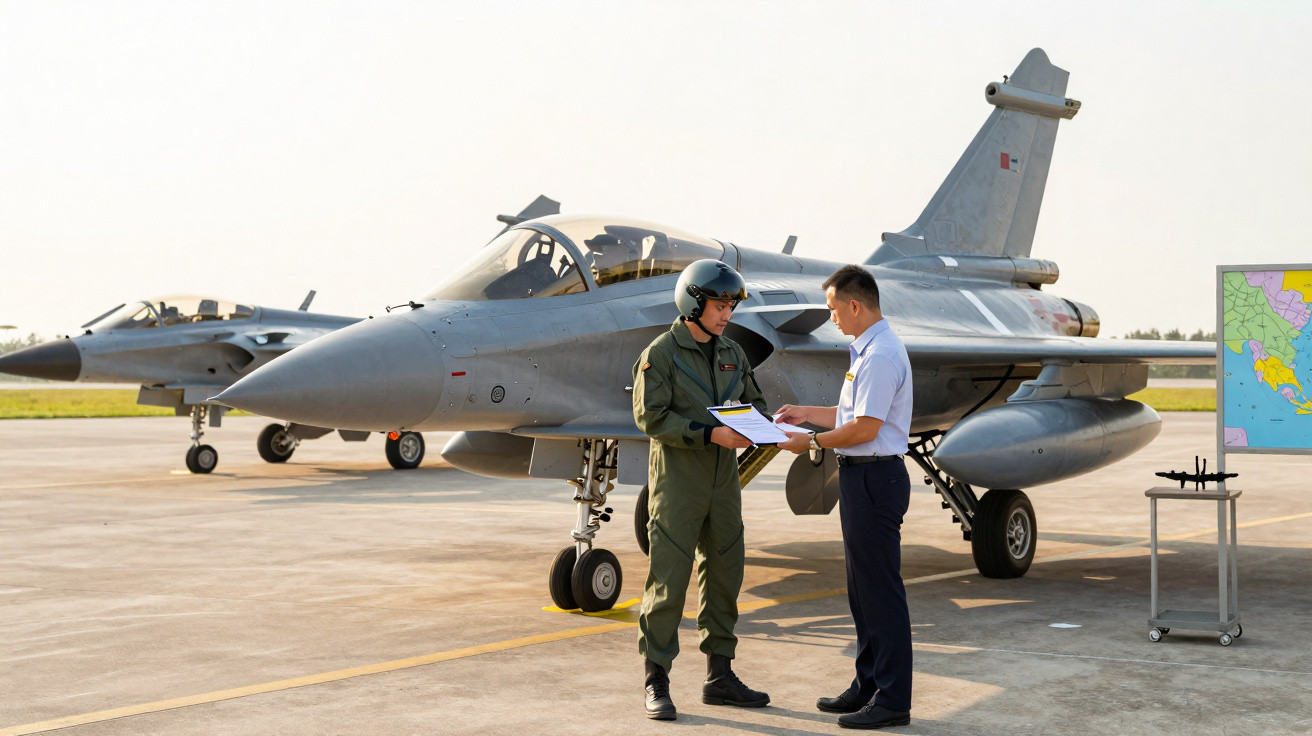
Vietnam is considering fresh options for its air force as tensions with China increase and its Russian-built jet fleet grows older. French, American and South Korean manufacturers are all seeking opportunities, while officials in Hanoi are cautiously indicating that they want wider choice – and greater bargaining power – in an Indo-Pacific that is changing quickly.
Vietnam’s air force faces a race against time
Vietnam equipped its armed forces through the Soviet Union, and subsequently Russia, for many decades. That heritage continues to shape its combat aviation. The Vietnamese People’s Air Force operates a combination of ageing Soviet aircraft and newer Russian models, with many now approaching obsolescence on a modern, technology-driven battlefield.
Recent open-source information indicates that Vietnam operates:
- 25 Su-22 Fitter strike aircraft, based on a Soviet design and refurbished between 2019 and 2024
- 10 Su-27 Flanker air-superiority fighters
- 35 Su-30MK2 multirole fighters, which form the core of the present fleet
The force remains capable of delivering considerable firepower, particularly near Vietnam’s territory. However, it is increasingly constrained when facing the modern radars, long-range missiles and electronic-warfare capabilities deployed by regional states.
Vietnam’s leaders know that keeping an ageing, Russia-heavy fleet is a strategic risk in a region defined by rapid military modernisation.
Rising tensions with China fuel defence spending
Modernisation is being driven by more than fleet age. Beijing’s territorial disputes with Hanoi in the South China Sea have become a major influence on Vietnamese security policy. Hanoi wants to strengthen deterrence while avoiding an overt confrontation.
Vietnam therefore intends to raise its defence budget by an average of 5.5% annually during this decade. It aims to spend roughly 10.5 billion US dollars per year on defence by the end of the 2020s. Air and maritime capabilities are expected to receive a substantial portion of those funds.
Diversification is a central element of this approach. Rather than continuing to depend almost entirely on Russian suppliers, the People’s Army of Vietnam is progressively opening procurement to alternative partners. The reasoning is political and diplomatic as well as technical.
First steps away from Russian kit
Vietnam has already indicated this change in its land forces. In August 2024, Hanoi placed an order with South Korea’s Hanwha Aerospace for 20 K9 Thunder self-propelled howitzers. The tracked artillery vehicles will replace some Soviet-era guns, providing the army with more mobile and accurate fire support.
Diversification in the air has so far focused on less sensitive aircraft types. The air force has acquired European transport aircraft and helicopters, including Casa C-295s, Super Puma helicopters and AW189s. Rather than front-line air-combat roles, these platforms support logistics, transport, and search-and-rescue operations.
Vietnam has also recently taken delivery of 12 T-6 Texan II training aircraft manufactured by the American firm Beechcraft. These turboprops are standard trainers for several Western air forces and may represent an initial move towards closer cooperation with Washington.
The real question now: will Vietnam apply the same diversification logic to its combat aircraft, the sharp end of its air power?
Rafale rumours: discreet flights and quiet diplomacy
French weekly publication L’Express recently suggested that the answer could be affirmative. Its report said the Dassault Rafale had attracted the interest of the Vietnamese air force. It even claimed that a Vietnamese pilot had flown the French aircraft “discreetly”, although it provided no technical or diplomatic details.
The Rafale is a twin-engined multirole fighter operated extensively by France and exported to states including India, Egypt and Greece. Its radar, electronic-warfare suite and weapons provide strong capabilities for air defence, maritime strike and deep attack – missions of clear importance to Vietnam in the South China Sea.
French aircraft have previously flown in Vietnamese airspace. Three Rafale fighters from the French Air and Space Force stopped in Hanoi during the 2018 PEGASE (Projection of a Large Air Device in Southeast Asia) deployment. The stopover was partly symbolic, intended to raise France’s regional profile and develop relationships with Vietnamese officials.
At that time, the mission commander, General Patrick Charaix, said the purpose was to demonstrate French experience while strengthening links with local authorities and Vietnam’s French community. He emphasised Vietnam’s interest in these contacts, indicating a mutual willingness to pursue future cooperation.
Defence ties with France deepen, but no Rafale deal yet
Paris and Hanoi have expanded their defence relationship since the 2018 visit. The two countries have discussed industrial collaboration and possible “structuring projects” within defence. Such discussions extend beyond straightforward purchases, encompassing local maintenance, co-production and technology partnerships.
On a visit to Paris in October 2024, Vietnamese president Tô Lâm met senior figures from Airbus and Safran, two leading French aerospace and defence companies. The talks may have covered areas ranging from military transport and helicopters to engines, avionics and support services.
Notably, no meeting with Rafale builder Dassault Aviation was publicised. While this does not exclude discreet discussions, it illustrates how cautiously Hanoi manages its messaging on combat-aircraft procurement.
Vietnam wants advanced technology and stronger partnerships, yet it must avoid binding itself too closely to any single supplier.
Why analysts remain cautious about the Rafale story
Specialist publication Vietnam Defence II has called for caution over the Rafale reports. It notes that Hanoi has often been connected with Western systems that were ultimately never acquired.
Reports in 2015 indicated that Vietnam was negotiating to buy 108 French CAESAR truck-mounted artillery systems. More than a decade later, no agreement has emerged. Similarly, serious discussion in the 1990s concerned the purchase of 24 Mirage 2000 fighters to replace ageing MiG-21s. Those negotiations failed because the United States then maintained an embargo on selling lethal weapons to Vietnam.
| Year | Reported project | Outcome |
|---|---|---|
| 1990s | 24 Mirage 2000 fighters | Abandoned due to US arms embargo |
| 2015 | 108 CAESAR artillery systems | No contract signed to date |
| 2024–2025 | Interest in Rafale | Unconfirmed, at rumour stage |
These earlier cases help explain why some analysts view the Rafale claims as no more than tentative. Hanoi regularly examines Western alternatives, at times in considerable depth, but may withdraw if the financial or political price appears excessive.
The F-16 “Viper” emerges as a competing candidate
Rafale is not the sole Western fighter being considered by Vietnam. Hanoi has also been linked with the F-16 Block 70, known as the “Viper”, as a possible option.
Built by American aerospace giant Lockheed Martin, the Block 70 is the newest and most advanced version of the long-serving F-16. It combines a modern AESA radar, improved avionics and compatibility with a broad selection of American and NATO-standard weapons. Air forces in Southeast Asia, including Singapore and Indonesia, already operate or have ordered F-16 variants.
In September 2023, a US official indicated that Vietnam was interested in American systems for maritime surveillance, transport and possibly further platform types. Although the official did not identify the F-16, the remarks added weight to speculation that Washington could discuss fighter sales if political conditions remain favourable.
Choosing the F‑16 would deepen ties with the US, while selecting the Rafale would reinforce links with Europe and maintain a degree of strategic ambiguity.
What shapes Vietnam’s fighter choice behind the scenes
Hanoi’s eventual choice of combat aircraft will be influenced by several practical considerations beyond performance specifications.
- Cost and financing: Rafale is generally more costly per aircraft than the F-16, particularly after support and infrastructure costs are added. Financing arrangements, loans and offsets will be important factors.
- Training and transition: Shifting from Russian aircraft to Western systems demands extensive pilot instruction, new simulators, English-language technical documentation and a change in maintenance culture.
- Weapons compatibility: American-made fighters generally depend on US missile and bomb inventories, which are controlled by export restrictions. Rafale can use a range of European weapons, potentially creating different operational and political trade-offs.
- Supply chain resilience: Vietnam must assess which suppliers can ensure spare parts and modernisation support across several decades, including during geopolitical changes.
Hanoi must also preserve its balance with Moscow and Beijing. A sudden move towards Western arms could be interpreted by Moscow as a rebuff and by Beijing as a hostile gesture. A gradual and discreet transition involving small initial purchases would lower those risks.
What “multirole fighter” and “Block 70” really mean
The debate repeatedly features two terms: “multirole fighter” and “Block 70”. Although both sound technical, they have a direct impact on how air forces prepare for the future.
A multirole fighter is designed for numerous mission types rather than being specialised for one. Both Rafale and F-16 can undertake air defence, ground attack, anti-ship strikes and reconnaissance, frequently during the same sortie.
This versatility is particularly useful for a country such as Vietnam. It allows Hanoi to operate fewer aircraft rather than separate fleets for each task, while still covering most mission requirements, provided crews receive suitable training and the aircraft carry the correct sensors and weapons.
“Block 70” identifies a particular F-16 standard. Every “block” groups upgrades including more powerful computers, new radars, advanced cockpit displays and enhanced self-protection equipment. The Block 70/72 family is effectively the F-16’s top-tier export configuration, intended for air forces seeking current capability without entering the F-35’s political and financial category.
Possible future scenarios for Vietnam’s air combat fleet
The Vietnamese air force could follow several credible routes during the next decade. None is certain, and Hanoi could combine aspects of multiple options.
Under one scenario, Vietnam would make a limited first purchase of Western fighters, perhaps a squadron of Rafales or F-16 Block 70s. The new aircraft would fly alongside modernised Su-30MK2s, creating a mixed fleet. Western jets would probably undertake the most demanding tasks, including maritime patrol and long-range strike missions, as Russian types progressively move into secondary duties.
A second route would see an extended assessment period, with priority given to air-defence systems, drones and maritime-patrol aircraft instead of new fighters. In this case, the key fighter decision could be delayed until nearer the 2030s, when more sixth-generation programmes and loyal-wingman drones reach the market.
A regional ripple effect is also possible. A Vietnamese Rafale order could prompt neighbouring countries, particularly those already operating or considering Western fighters, to strengthen their own procurement plans. An F-16 purchase could have similar effects, while connecting Hanoi more closely to US-led Indo-Pacific training networks and exercises.
Regardless of Hanoi’s choice, the main direction is evident: the period in which its air force was shaped almost entirely by Soviet and Russian technology is receding. Rafale speculation, F-16 reports, and the expanding number of European and Korean agreements all indicate a more varied and strategically adaptable future for Vietnam’s air power.






Comments
No comments yet. Be the first to comment!
Leave a Comment