
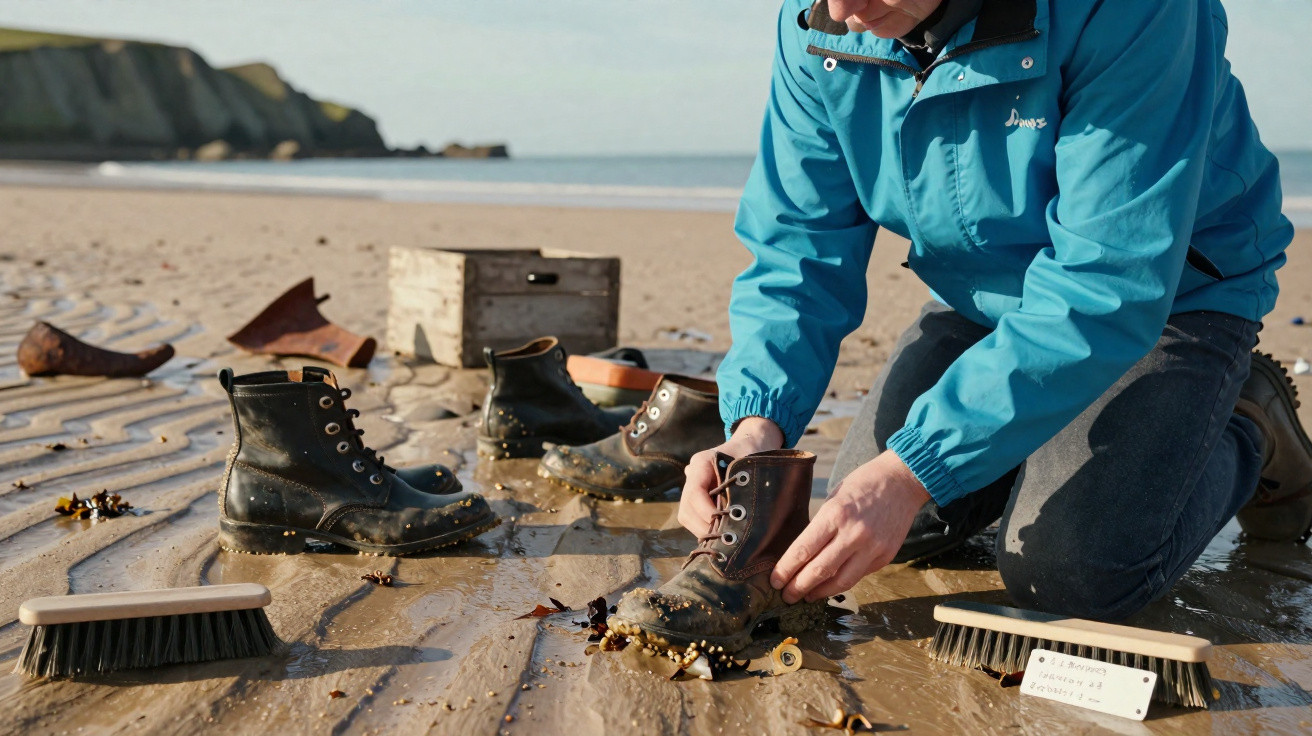
Volunteers searching sand and rock pools have begun uncovering hundreds of old black leather shoes, pointing to a possible tragedy off the coast more than a century ago.
A Victorian shoe mystery on a Welsh beach
The discoveries are focused on Ogmore-by-Sea, a wild section of the South Wales coast facing the Bristol Channel. Rather than the usual plastic bottles and driftwood, volunteers with the local education organisation Beach Academy have been retrieving Victorian-style shoes from gaps between the rocks.
The first group of shoes emerged in late summer, and their numbers subsequently increased. In some weeks, just one or two appear; following rough weather, however, dozens can surface along a short length of beach. Many have been found embedded in tidal pools or tightly wedged in crevices, apparently held there for years.
Dozens of intact leather shoes, with nailed soles typical of the 19th century, are sliding out of the eroding coastline like evidence in a long-cold case.
Their state of preservation makes the finds particularly remarkable. While some shoes are distorted or split, others still show their original shape, stitching and heels. A number remain as matching pairs. Despite prolonged contact with seawater and sand, volunteers say some look as though they could nearly be cleaned and worn.
Sizes range from footwear for small children to larger men's shoes. Their slim, formal designs fit Victorian styles rather than contemporary fashion. The soles and insoles show no modern brands, only heavy leather and rough patterns of nails.
Why these shoes look Victorian
Historians and archaeologists who have inspected the footwear identify several features that date it clearly to the 1800s:
- Nailed soles: Iron nails stud or edge the soles, reflecting a method of construction widely used in the 19th century.
- Thick leather uppers: Their substantial, rigid leather and narrow fit contrast with most mass-market shoes made in the 20th and 21st centuries.
- Absence of modern materials: They contain no rubber, plastic or foam cushioning, materials that became common at a later date.
- Range of sizes: The combination of men's and children's sizes suggests a commercial consignment, rather than personal baggage.
Local people say that isolated, unusual shoes have washed up on this coast for many years, especially after storms. The recent change is the volume being found. That sharp rise has led specialists to reconsider a long-standing maritime explanation.
A 19th-century cargo shipwreck back from the deep
As more shoes appeared, focus shifted out to sea towards Tusker Rock, a dangerous reef familiar to sailors on this stretch of Welsh coastline. Shallow and jagged, and frequently surrounded by turbulent water, it has wrecked many vessels since the sailing era.
Maritime researchers and enthusiasts increasingly believe the shoes were cargo from a 19th-century merchant vessel, possibly an Italian freighter travelling to markets across the British Isles. Historic accounts refer to a cargo ship hitting Tusker Rock around 150 years ago and losing much of its load into the sea.
Storms, erosion and shifting sands may be slowly emptying a Victorian ship’s hold onto a Welsh beach, piece by piece.
According to the theory, crates containing the shoes either burst when the ship struck the reef or gradually disintegrated on the seabed. Bristol Channel currents then carried the footwear towards the River Ogmore estuary, where it slowly accumulated in mud and sandbanks. It remained buried for decades.
In some areas of the UK, coastal erosion has intensified because of storms, changing sea levels and shifting river sediment. Whenever storms remove another layer of sand, concealed objects can return to view. At Ogmore-by-Sea, those objects happen to be Victorian shoes.
How nature slowly reveals a shipwreck
The distribution of the shoes is consistent with coastal science. Dense items including leather footwear generally sink before becoming locked into sediment. Across time, three combined processes can expose them:
| Process | Effect on buried cargo |
|---|---|
| Storm waves | Strip away sand and cobbles, revealing deeper deposits in which objects have settled. |
| River flow | Moves channels and sandbanks, transporting objects towards the coast. |
| Coastal erosion | Slowly wears down cliffs and dunes, freeing material that had been buried. |
Consequently, shoes may continue to emerge for years after the wreck itself has broken down beyond easy identification. Divers could potentially locate dispersed iron fittings or hull fragments near Tusker Rock, but organic cargo such as leather can travel much further.
From litter to evidence: how volunteers became investigators
The discovery began during a routine beach clean. Beach Academy, which provides educational sessions for families and school groups, regularly arranges litter picks on the coast. Volunteers were initially puzzled to repeatedly pull out the same unfamiliar objects: heavy old shoes coated in mud and barnacles.
Rather than immediately putting them into rubbish sacks, they began arranging the shoes, photographing them and sending images to historians and archaeologists. That straightforward choice transformed a local oddity into a substantial historical clue.
Community volunteers, trained to look for plastic waste, ended up curating an accidental open-air museum of Victorian footwear.
The organisation now makes simple notes of when and where every shoe is discovered. This basic mapping enables researchers to spot patterns related to tides, storms and areas prone to erosion. It also prompts visitors to inspect what they find more carefully, instead of treating every item as recent litter.
Why old shoes matter for maritime history
At first glance, the shoes are ordinary objects. They were probably inexpensive mass-produced goods intended for shop displays and working-class wardrobes. But it is precisely this everyday character that interests historians.
Most clothing surviving from the 19th century belonged to wealthier people: tailored pieces that were carefully kept and handed down. Daily items used by workers, sailors and children seldom endure. A wreck carrying basic footwear provides a view of what ordinary Europeans wore and traded.
Researchers can examine:
- The construction and nailing of the soles
- The types of leather and tanning techniques used
- The sizes most frequently included in consignments
- Whether regional designs or features are present
Such evidence informs wider questions about 19th-century industry, including where the shoes were made, the ports receiving them and the effect of mass production on European clothing markets.
Other lost shoes that washed back into history
The Welsh discovery joins a small but expanding collection of coastal finds that alter the way the past is understood. Across Europe, low tides and storms continue to reveal footwear from earlier periods: Roman sandals on former military routes, medieval shoes near historic ports and boots from fishing settlements that have long disappeared.
Ogmore-by-Sea stands out because so many objects are concentrated in one small area. Rather than a few separate finds, residents are seeing an entire cargo gradually spread over the foreshore. This scale makes it more plausible to associate the shoes with a particular wreck, rather than with random lost belongings.
For coastal communities, these objects connect them with stories that could otherwise disappear from collective memory. They lend substance to old accounts of storms and shipwrecks, demonstrating that the sea's status as a graveyard for vessels still leaves tangible traces.
How the sea preserves – and damages – leather
Leather may appear unlikely to survive for over a century in saltwater, but it can last remarkably well in the right circumstances. When deeply buried in oxygen-poor sand or mud, bacterial activity slows considerably. Tannins used to make 19th-century leather provide further protection.
Once the shoes are uncovered, however, deterioration begins. As they dry in sunlight and air, they can contract, crack and fall apart. This is why local groups are conflicted between leaving the objects for people to encounter and gathering them for conservation before they disintegrate.
Conservators working with waterlogged leather commonly use gradual desalination baths and carefully controlled drying to avoid swift damage. Volunteers on a public beach cannot provide that standard of treatment, meaning some shoes will unavoidably be lost as curiosities handled by visitors.
What beachcombers should know
As interest in coastal archaeology grows, more people are visiting shorelines with a keen eye for unusual objects. Finds such as the Victorian shoes raise an important question: what should someone do when they encounter something that seems historic, rather than merely old rubbish?
In the UK, the broad advice is simple:
- Take photographs of objects where they lie before moving them.
- Record the precise location, preferably using GPS or a map app.
- Notify local heritage organisations or coastal ranger services about important finds.
- Do not prise objects from cliffs or delicate rock faces, as this can worsen erosion.
Objects clearly associated with wrecks may need to be reported under salvage and heritage legislation. One shoe is unlikely to involve complicated requirements, but a group of matching items could be part of a single archaeological site.
This Welsh beach, scattered with Victorian heels and soles, illustrates how an ordinary walk along the shore can bring people into contact with concealed history. A single storm or exceptionally low tide can reveal a 19th-century cargo, reminding local people that the sea does not only remove stories. Sometimes it returns them.





Comments
No comments yet. Be the first to comment!
Leave a Comment