
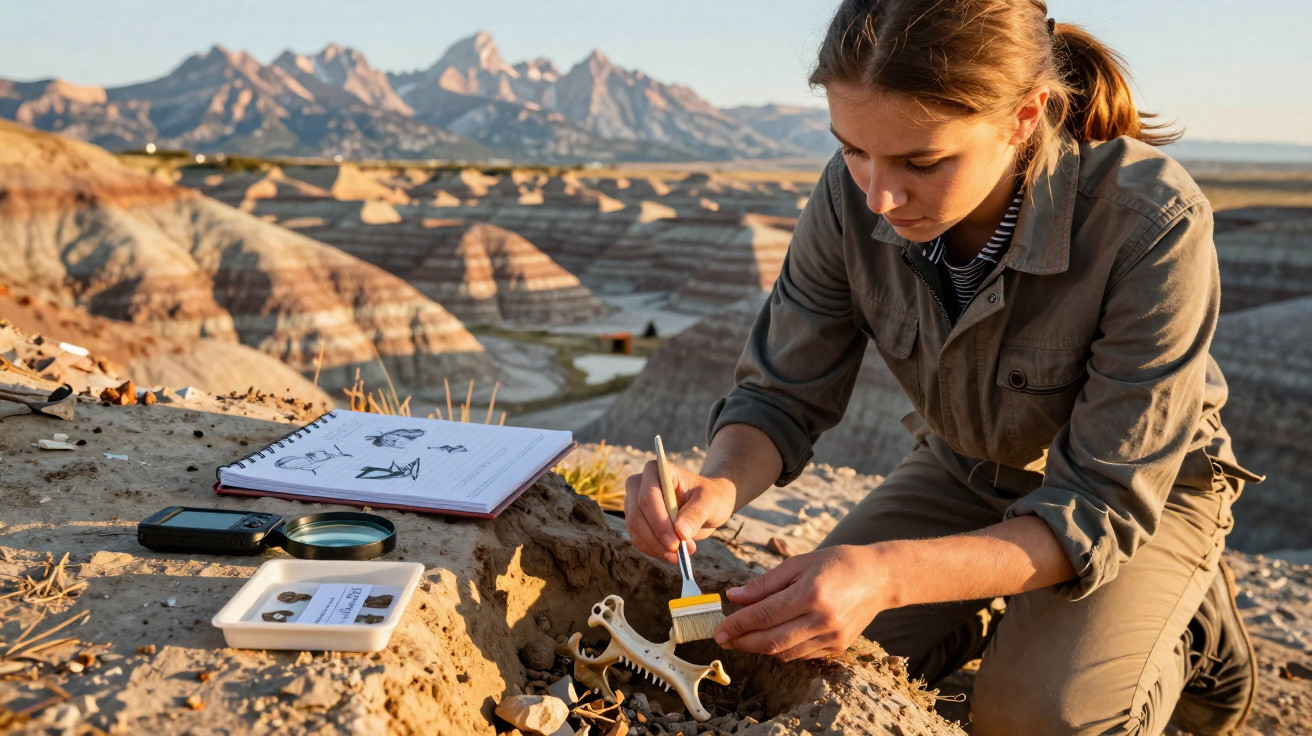
Some almost microscopic teeth unearthed in Wyoming are forcing scientists to reconsider an evolutionary account accepted for decades. The fossils belong to Tetonius varleyorum, a primate dating from around 50 million years ago whose anatomy does not fit neatly into the proposed evolutionary sequence for its group.
What kind of animal was this primate found in Wyoming?
Tetonius varleyorum was an omomyid, a small, large-eyed primate that lived in North America during the Eocene. Roughly the size of a modern mouse lemur, it belonged to an extinct lineage positioned close to a major split in the primate evolutionary tree.
According to Parker Rhinehart, a researcher at the University of Kansas Biodiversity Institute and Natural History Museum, omomyids were true primates. They lived around the time when lemur-related lineages began diverging from those later associated with monkeys, apes and humans.
How were such tiny fossils discovered?
The researchers recovered dozens of teeth and jaw fragments from a sandstone formation called Tim's Confession, within the Smiley Draw fauna of the Great Divide Basin. Delicate remains from the rest of the body are usually lost to erosion, making teeth vital evidence for identifying these animals.
- The primate lived in what is now Wyoming around 50 million years ago.
- Dozens of teeth and jaw fragments made it possible to identify the new species.
- Nearly 1,000 jaw fragments from different mammals have already been recovered from the same site.
- The fossils extend the known record beyond the traditional Bighorn Basin.
Rhinehart explains that locating ancient primates in the field requires close attention to minute structures, as teeth and jaws are the parts best able to withstand geological time. The name Tetonius varleyorum honours the Varley family, who run a post near the camp and supported the researchers during their expeditions.
Why did the Tetonius varleyorum site attract scientists' attention?
The newly identified species was not alone. At the same location, the team found fossils of Arapahovius gazini and Anemorhysis savage, two rare omomyid species. The researchers say these finds represent only the second and third known occurrences of these animals in the fossil record.
Most unusually, three different omomyid species had never previously been recorded together at one Early Eocene site. A fourth member of the group, which has not yet been formally described, was also found at Smiley Draw, indicating greater diversity than previously thought for that period.
Watch the video shared by the YouTube channel Jurasica Produxiones showing the small primate that is changing the history of evolution.
How does the fossil challenge an old evolutionary theory?
Since 1987, a study by palaeontologists Thomas Bown and Kenneth Rose had shaped interpretations of Tetonius evolution. Drawing on fossils from the Bighorn Basin, they proposed a gradual sequence known as anagenesis, a process in which one species progressively changes into another without splitting into parallel lineages.
The Smiley Draw fossils, however, do not match that arrangement. Published in the Journal of Human Evolution, the new analysis shows that Tetonius varleyorum disrupts the sequence proposed previously. This suggests that the genus may have involved greater regional diversity or evolutionary branching that remains poorly understood.
What does this discovery change about early primates?
The central lesson is that an evolutionary history built from fossils in just one region may appear simpler than it truly was. By including specimens discovered outside the Bighorn Basin, researchers are beginning to see a more complex picture, in which several species may have coexisted and followed different evolutionary paths.
This small fossil demonstrates how a single collection of teeth can change decades of scientific interpretation. Further excavations and analyses of older collections may uncover other overlooked primates. These discoveries are worth following now, because every fragment recovered could redraw an important part of evolutionary history.





Comments
No comments yet. Be the first to comment!
Leave a Comment