
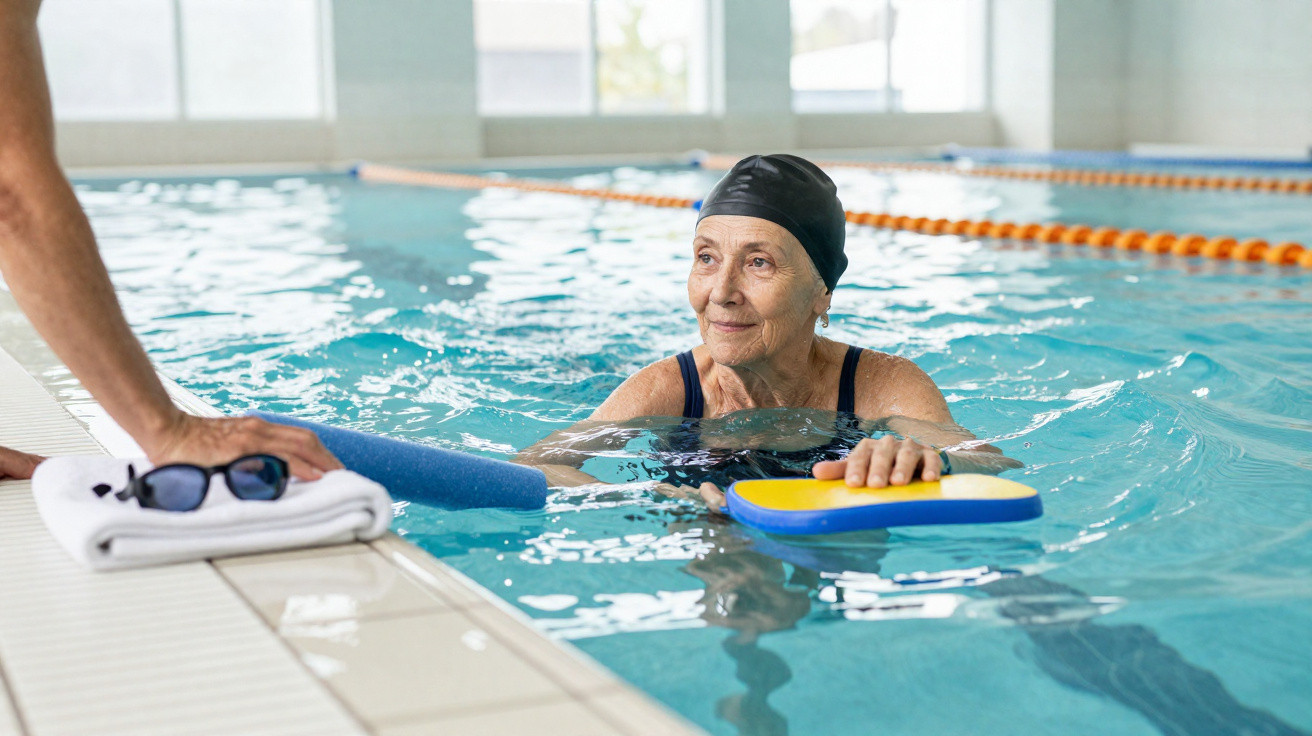
At 76, she has silver hair combed neatly back and a watch on her wrist that records every movement. Children splash nearby, while a young triathlete powers through sprint sets in lane three. She begins to swim breaststroke, calmly and steadily. With every stroke, her face becomes more relaxed. It is clear that this is no longer about setting records. It is about something more personal: freedom in her own body, and dignity at an age when many people assume their sporting days are long behind them.
After 20 minutes, she stops at the poolside and gives a quiet laugh. “A year ago, I was out of breath just climbing the stairs.” Now she counts lengths rather than steps. Suddenly, the scene feels like a small revolution.
Why swimming at 76 can be so powerful
Anyone visiting a busy indoor pool early in the morning will notice a quiet reality: the lanes are no longer reserved for the young. There are plenty of faces aged over 70, nearly all wearing the same blend of focus and relief. Water reduces the strain on joints, but it can also lighten the mind. After a few minutes in the pool, the body feels less “old” and more “well used, but dependable”. That shift in perspective changes everything. Sport suddenly stops being a battle against ageing and becomes a partnership with it.
A study by the German Sport University Cologne shows that regular swimming can increase endurance by up to 15 per cent in people over 70, within only three months. That may sound rather abstract until you see it in practice. Mr K., 76, once a bricklayer and now living with mild osteoarthritis, could initially manage only two consecutive lengths, breathing heavily. Three months later, he swims ten, takes a break, then completes another five. “I thought my best years were over,” he says. “Now I feel as if my body has given me extra time.” Comments like this are heard regularly at the pool, spoken quietly and almost apologetically.
There is sound physiological reasoning behind it. In water, buoyancy supports up to 90 per cent of body weight, easing pressure on the joints while muscles work against the resistance of the water. It is like gentle, full-body strength training, without the harsh impact of jogging or jumping. The heart and lungs have to work harder because every movement requires more effort, which helps build endurance. Let us be honest: hardly anyone does it every day. But swimming two or three times a week can be enough to maintain muscle, extend how far you can walk in everyday life and restore that feeling: I can still do this.
How to start swimming at 76 without doing too much
Getting started is not about a stopwatch. It begins with a plan that feels realistic. For many people, a simple routine of three 10-minute stages works well. Spend the first 10 minutes gently getting used to the water: perhaps walking in the shallow pool, or swimming very slow breaststroke with long, unhurried strokes. Follow this with 10 minutes of “working time”: swim one length, then take one length’s break at the poolside or by walking in shallow water. Finish with 10 minutes of winding down, returning to a slow, almost meditative pace. This turns the vague thought of “I should do more” into a clear structure that does not feel daunting even on tired days.
Small adjustments can make a bigger difference than many people expect. Choose goggles that do not pinch. Wear a swimsuit or swim shorts in which you do not feel self-conscious. Set a regular time, perhaps 8 am every Tuesday and Friday, when the pool’s “early swimmers aged 70+” group is there. New swimmers are often tempted to overdo it out of pride: going too fast and doing too much because they fear that otherwise “it will not count”. Then their shoulders and neck complain the following day, and the sofa starts to look more appealing than the swimming lane. A better approach is to leave the water feeling as though you still had a little energy left.
Coaches at many pools tell similar stories. Most swimmers over 70 do not arrive with ambitious targets; they come because they are afraid of losing mobility. They continue because they discover how much they are still capable of doing.
“At 76, it is not about how fast you swim,” says one instructor, “but about still being able to walk up the stairs to your flat independently next year.”
- Start gently: during the first two weeks, do not stay in the water for more than 30 minutes.
- Choose routine over perfection: two fixed swimming days a week have more effect than five sessions done “if it suits”.
- Check your technique: a short course or one session with an instructor can prevent unnecessary strain.
- Keep strength in mind: add simple water-aerobics exercises once a week to complement your swimming style.
- Listen to your body: mild muscle soreness is fine, but sharp pain is a clear sign to stop.
What water really does for confidence and daily life
People who swim regularly rarely notice the change in the mirror first; they notice it in daily life. Shopping bags feel lighter. You can still catch the bus even when it is already waiting at the stop. The step outside the front door becomes less intimidating. Muscles are not simply visible; above all, they are noticeable. At 76, building muscle means greater confidence on wet ground, less fear of falling and a wider personal range. Swimming works the core, legs and arms, strengthening the modest but essential ability to carry yourself through life every day.
What is often overlooked is that the endurance built in the water also carries over into the mind. People who complete their lengths every week develop a quiet discipline that begins to appear elsewhere too. A 20-minute walk suddenly no longer feels like a challenge, but like a welcome addition. The day is planned differently; errands are no longer handed over to someone else, but managed independently again. A fitness routine becomes something like a personal reserve of freedom. And yes, there will be days when inner reluctance wins. That is part of life, not only at 76.
Between the smell of chlorine and the muffled noise of an indoor pool, something else happens that no study can properly measure: community. A nod to the woman in the next lane, a brief chat in the changing area, a “See you again on Friday?” These are small anchors that create structure. Some people eventually stop coming merely “to swim” and come instead to feel that they belong. The water becomes a place where age does not need to be explained or excused. It is simply there, alongside wrinkles, swimming caps and the pride that follows 20 lengths.
| Key point | Detail | Reader benefit |
|---|---|---|
| Gentle muscle building | Buoyancy takes pressure off joints, while resistance strengthens all major muscle groups at the same time | Understand why swimming remains effective and safe exercise at 76 |
| A structured start | A 30-minute model with warm-up, working phase and wind-down for beginners | A practical plan rather than vague intentions, making it easier to get started |
| Greater independence in everyday life | Improved endurance, better balance and more confidence when walking and climbing stairs | A direct link to daily life, rather than only abstract fitness goals |
FAQ:
- Question 1: How often should I swim each week at 76 to feel an effect? For most people, two to three sessions a week of 30–40 minutes are enough, at a pace where you could still talk comfortably.
- Question 2: Is breaststroke problematic for the knees and back? Traditional “head-above-water” breaststroke can put strain on the neck and back. A calm breaststroke with occasional submersion, or alternating with backstroke, is better.
- Question 3: Can I benefit from water exercise even without “proper” swimming technique? Yes. Walking, gentle exercises and short swims in shallow water all strengthen muscles and endurance, especially when you attend regularly.
- Question 4: What if I get out of breath quickly? Make rests part of the session: swim one length, then walk one length by the side while continuing to breathe calmly. Over time, the swimming sections will become longer.
- Question 5: Am I not “too old” to start swimming at 76? As long as your doctor gives the go-ahead, you are not too old. Many people start only after 70 and report feeling younger after a few months than they did at 65.





Comments
No comments yet. Be the first to comment!
Leave a Comment