
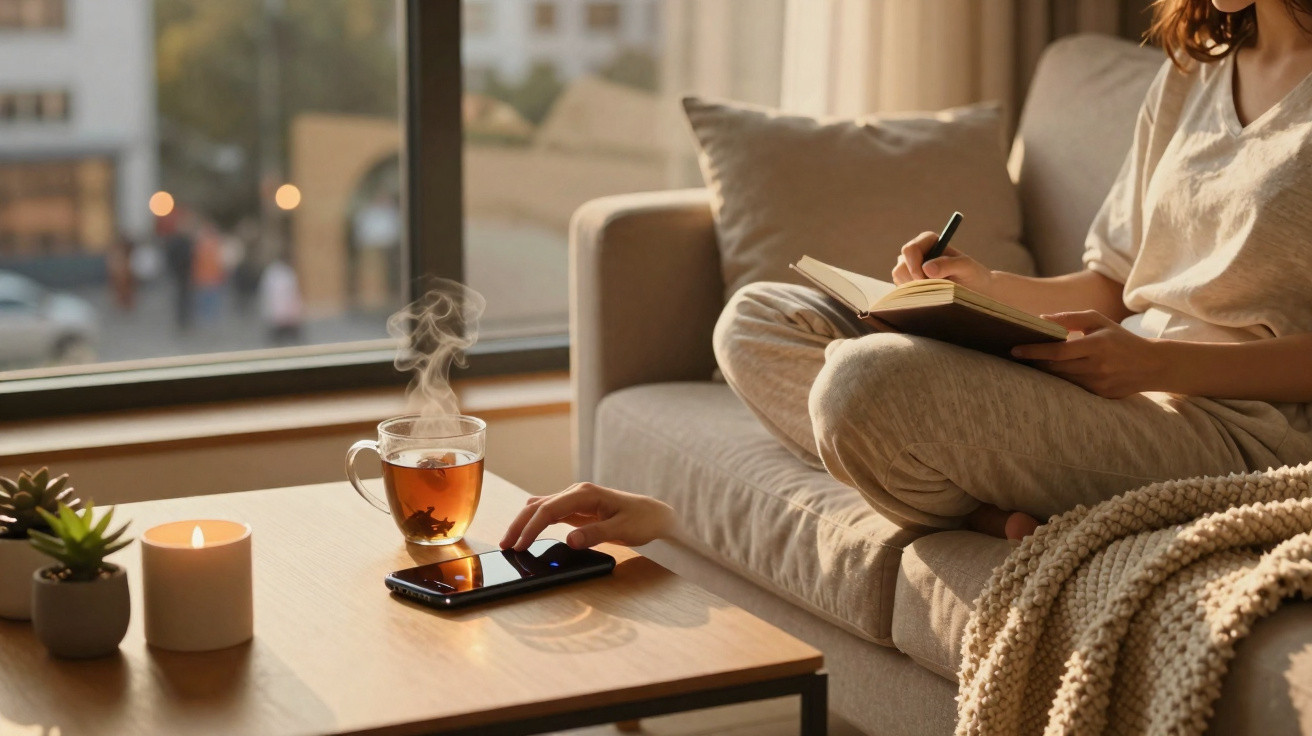
People who routinely turn down invitations to go out and would rather spend the evening alone on the sofa are quickly labelled odd, antisocial or “boring”. Psychologists, however, paint a very different picture: deliberately opting for a quiet evening at home can reveal a great deal about personality, needs and inner resilience – and is often far more about self-care than loneliness.
What it really means when you prefer to stay at home
Many people enjoy meeting others in restaurants, bars or at the cinema as a way to unwind. For some, though, precisely these activities feel like another obligation. After a day packed with meetings, conversations and small talk, their energy is simply depleted. Having to be sociable and pleasant all over again can feel almost unbearable.
Psychological research shows that people who deliberately choose their own company do not automatically have a social problem – it is often a healthy protective mechanism.
A study published in the academic journal Scientific Reports found that people who voluntarily spend time alone report lower stress levels and a stronger sense of inner freedom. Rather than viewing these moments as a flaw, they see them as a valuable resource for reconnecting with themselves.
Chosen calm rather than distressing loneliness
For a long time, being alone was widely considered a warning sign: anyone who was not constantly around other people must be lonely or socially insecure – or so the stereotype went. Research is now correcting this assumption. What matters is whether the quiet is wanted or imposed.
The lead psychologist behind the study stresses that there is no “ideal” level of sociability that everyone should aspire to. Some people flourish in large groups, while others quickly reach their limits in them. Both can be healthy, provided a lifestyle matches a person’s own needs.
There is no universal amount of social contact that makes everyone happy – what matters is how voluntary and appropriate your own social life feels.
Interestingly, people who consciously choose quieter periods often say they feel least lonely at those times. They experience themselves as autonomous, mentally clear and “grounded”, whereas groups can make them feel they need to adapt and simply perform.
What quiet hours alone can give you
Research identifies several psychological benefits when people set aside time for themselves after a busy day:
- Relaxation: The body can leave its state of alert, while heart rate and stress levels fall.
- Self-reflection: Thoughts can drift without interruption, allowing experiences to be sorted through and assessed.
- Creativity: New ideas and solutions to problems can emerge without external noise.
- Autonomy: When alone, you decide the pace, subjects and activities for yourself.
Many people use this time to read, watch a series, cook or simply lie on the bed and do nothing at all. Psychologically, these are not “lazy” moments; they are small islands of recovery where the nervous system can recuperate.
Typical signs that solo time benefits you
Not everyone who often declines invitations automatically gains from being alone. It is worth taking an honest look at your own experience. The following points often suggest that time out is genuinely helping you:
- You feel refreshed, rather than drained, after an evening alone.
- Your mood becomes more stable instead of worsening.
- You have more patience with other people afterwards.
- Your creativity or ability to make decisions improves.
If several of these apply, withdrawing is more likely to be a useful psychological release valve than a warning sign.
When calm can become a risk
The evidence also makes one point clear: time alone is constructive only when two conditions are met – and that is the crucial distinction.
| Criterion | Positive effect | Problematic effect |
|---|---|---|
| Voluntariness | You consciously choose peace and quiet, and could meet people whenever you wanted. | You would like to socialise more, but do not dare to or have nobody to contact. |
| Duration | Periods alone are limited in time and framed by social contact. | Prolonged inactivity, continuing withdrawal and almost no remaining social anchors. |
Long-term, enforced isolation affects people very differently from a quiet Friday evening on the sofa. Experiences during the lockdowns of 2020 and 2021 show just how severely months of restricted contact can affect both mind and body – especially for young people whose social networks are still developing.
Short, deliberately chosen breaks from the outside world can nourish you – prolonged withdrawals imposed from outside can undermine mental health.
Signs that the balance may be shifting include cancelling plans out of fear, losing everyday structure, or increasingly experiencing contact with others as threatening or pointless. In that case, it is worth speaking early on to people you trust or seeking professional support.
Introverted, exhausted or simply honest with yourself?
Anyone who enjoys being alone is quickly given the label “introvert”. Sometimes that is accurate, but not always. Many naturally outgoing people enjoy working in a team during the day and deliberately switching off in the evening. This is less about fixed personality types than about managing energy.
Some social interactions recharge you, while others drain you. If you feel that a party after an already demanding week would only exhaust you further, you are simply listening to your body. That is not a lack of loyalty; it is self-protection.
Healthy self-care can be recognised by the fact that people may say no more often while still nurturing their relationships – just more selectively. They make time for a few people with real intention instead of cramming an event into every free space in the diary.
Finding your personal balance
The key question is: how much contact feels right for you? Three small steps can help you establish your own boundaries:
- Keep a journal: For one or two weeks, briefly note how you feel after social plans – energised or empty.
- Test your boundaries: Decline a meeting you are already hesitant about, then honestly consider whether relief or guilt is stronger.
- Create rituals: Schedule regular solo time, such as one quiet evening a week that is non-negotiable.
This creates a daily life in which neither constant solitude nor non-stop activity takes over, but where there is flexible movement between the two according to your stage of life and how demanding each week is.
Navigating social expectations when friends keep pushing
The conflict often arises not internally, but from the response of those around you. People who cancel frequently soon hear comments such as “Don’t be so difficult” or “You only live once”. Such remarks overlook the fact that people have different social thresholds and limits on what they can manage.
It can help to say openly: “I like you, but I need some peace today so I do not overwhelm myself.” Communicating this way shows appreciation without sacrificing your own needs. Over time, your social circle naturally sorts itself out: people who respect that remain close, while others move somewhat into the background.
Psychologically, this behaviour demonstrates a degree of inner stability. People who know and express their limits reduce their long-term risk of exhaustion symptoms, sleep problems and an irritable mood.
How to use time alone to support your mental health
Time alone becomes especially valuable when it is shaped deliberately. It does not require an elaborate plan; small routines are enough:
- read a chapter of a favourite book instead of scrolling mindlessly
- write in a journal for ten minutes to organise your emotions
- listen to music while cooking and genuinely savour what is on your plate
- take a short walk without your phone to slow racing thoughts
Micro-rituals like these reinforce the sense that you are actively looking after your own mental wellbeing. Even if the day has been chaotic, they create a moment in which you are consciously directing yourself again rather than merely reacting.
Ultimately, a quiet evening at home does not mean “There is something wrong with me”; more often, it means: “I know my limits and respect them.” Once you understand that, the next “Are you coming today?” is less likely to be guided by guilt – and more by a clear inner compass.




Comments
No comments yet. Be the first to comment!
Leave a Comment