
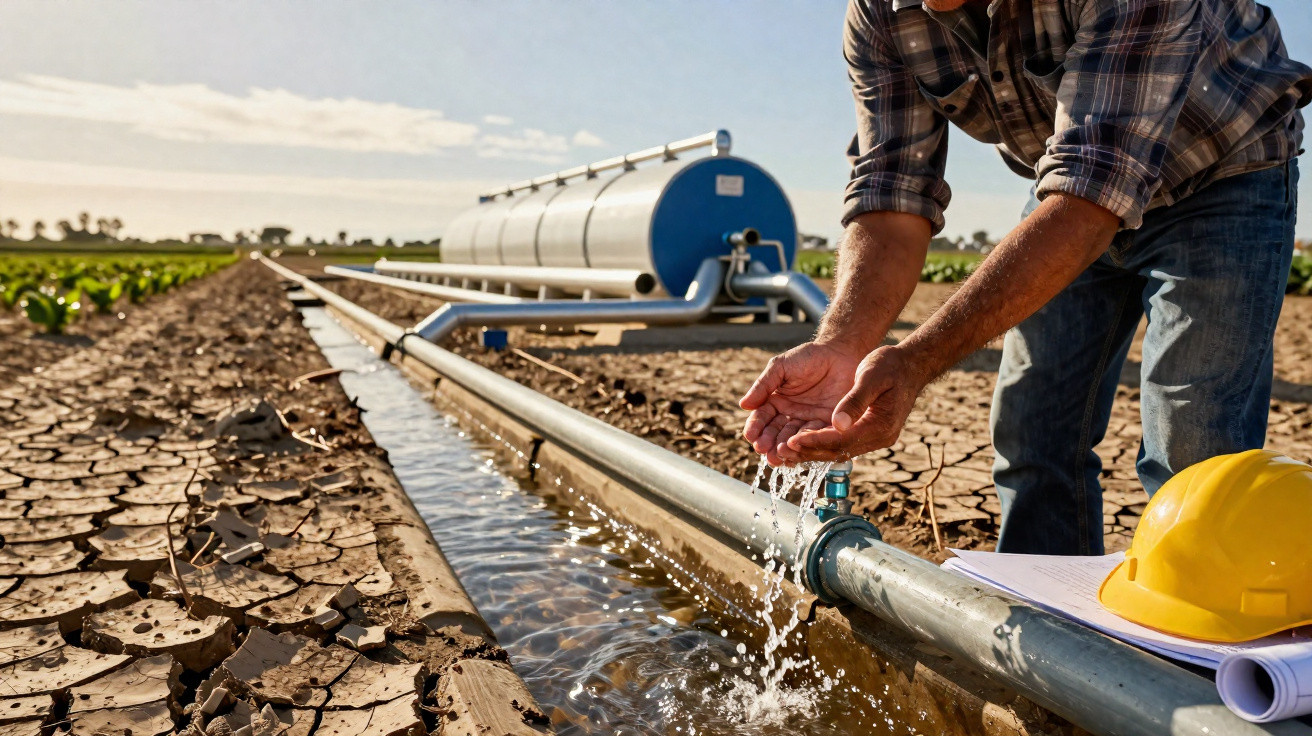
It glints in the sunlight like any agricultural canal, yet lean closer and there is a slight chemical smell, along with an out-of-place trace of sea air. A worker wearing a faded baseball cap inspects a flow meter before wiping sweat - and something else - from his brow. “This?” he mutters. “This is what saving California looks like now.”
In a state built around the promise of plenty, growers are using mixtures of seawater and treated sewage to keep their trees alive for a few more weeks. Pipes that once transported pure Sierra snowmelt now deliver a cocktail of “recycled” water to farms, golf courses and even urban fringes. The choice is stark: use whatever can pass for water, or watch crops - and communities - dry up.
Nobody wants to voice it, but the question lingers in the sweltering air.
When the taps flow but the rivers do not
On a July afternoon in the Central Valley, the scenery seems strangely wrong. Above, the sky is an unbroken blue and the road ripples with heat, while canals that ought to be brimming sit nearly empty, their banks fissured like ageing paint. Yet sprinklers still click away across the fields, casting silvery arcs over lettuce, almonds and grapes. The unseen trick is a careful blend of heavily treated wastewater and brackish groundwater, sufficient to stop the plants dying this season.
Everyone is acting as though this is ordinary. It is not.
California’s water crisis did not arrive overnight. It is the drawn-out collision of a drying climate with decades of promises that could not be kept. For years, the state fashioned both a way of life - and a global food system - around rivers and aquifers treated as limitless bank accounts. Cities expanded. Lawns multiplied. Water-hungry crops, including almonds and pistachios, spread over land formerly used for dryland grains. With snowpacks diminishing and reservoirs reduced to bathtub-like rings of brown, the reckoning has come. Increasingly, the price is salt.
The emerging water economy is visible in places such as East Porterville and Kettleman City. These small communities were already coping with failing wells when the most recent drought arrived. As groundwater levels fell, what remained became richer in minerals and contamination. Local authorities hurried to mix in treated wastewater from larger cities, desalinated brackish water from nearby facilities and even stormwater filtered through vast basins. One inland district proudly presented a pilot scheme in which water piped from the coast - lightly desalinated seawater combined with reused effluent - irrigated table grapes destined for Chicago and Tokyo.
The figures tell the tale with none of the romance. State data show that agricultural and landscaping use of recycled water has reached hundreds of billions of gallons annually, and there are plans to double it. Groundwater extraction - farms’ discreet lifeline - has exceeded natural replenishment for so long that some communities have subsided by several feet. Every additional acre of permanent crops creates future water demand regardless of whether reservoirs recover. Water managers therefore become inventive with the supply still available. Seawater, once unimaginable for such uses, is passed through membranes, mixed with other sources and sent into drip-irrigation lines and municipal pipes.
In theory, the technology appears heroic: reverse osmosis, advanced treatment and “toilet-to-tap” schemes repackaged as “pure water initiatives”. On the ground, it resembles improvising at the cliff edge.
The science behind the bet is misleadingly simple. Crops largely do not care about water’s origin; what matters is its contents. Salinity, trace metals and nitrate concentrations can determine whether a tree flourishes or gradually suffocates. Desalination plants remove much, though not every trace, of the salt in seawater. Modern wastewater works can produce water that is technically cleaner than many rivers. Mixing these supplies with freshwater, when freshwater is available, stretches every possible drop.
The deeper strain lies below the surface. Whenever a grower takes delivery of recycled water, or a city authorises a larger desalination plant, it is doing more than addressing the present year’s emergency. It is entrenching a system in which California permanently lives on the margin, reliant on machinery to compensate for its damaged relationship with its rivers and aquifers. The drought, many argue, isn’t just about low rainfall; it’s about decades of looking away.
How California is learning to drink its own past
Head west towards the coast and the answer takes another form, though it feels no less unsettling. At Carlsbad, Huntington Beach and proposed locations along the shoreline, desalination works stand like science-fiction factories, drawing in Pacific water and producing something marketed as security. Within them, immense pressure forces seawater through tightly packed membranes, leaving concentrated brine behind and, in theory, offering a clearer future to parched cities and farms.
This is the sharp end of California’s latest water wager: rapidly turning the ocean and sewage into routine supply.
The process is at once straightforward and astonishing. Cities gather wastewater from showers, toilets and industry. Rather than discharging it to rivers or the sea after primary and secondary treatment, they put it through advanced purification using microfiltration, reverse osmosis, ultraviolet light and peroxide. The resulting water can be close to laboratory pure. In certain places, it is injected into aquifers to blend and “age”; elsewhere, it is channelled directly towards drinking-water systems or agricultural canals. At the same time, coastal desalination plants take in raw seawater, remove sufficient salt to satisfy standards and pump the result inland. It is an engineering achievement powered by money and electricity.
For ordinary Californians, however, the emotional calculation is more complicated. “Toilet-to-tap” still occupies the public imagination without paying rent. Residents worry about traces of pharmaceuticals, microplastics and unknown substances that do not sit tidily on a laboratory report. There is also a quiet, persistent concern that accepting water once flushed away gives leaders licence to continue building and making promises while avoiding the crisis at its source.
During a scorching afternoon in Orange County, a water official guides visitors around an immaculate treatment works of stainless steel and humming filters. “Try this,” he says, offering a transparent plastic cup. The water, honestly, tastes of nothing. It is cleaner than most bottled brands. He smiles, though there is tension behind it. “We’re out of easy options,” he admits.
That is the limitation of high-tech remedies: they work - up to a point. Cities can greatly reduce imports from overstretched rivers. Growers can preserve valuable orchards with blends adjusted crop by crop. But these projects also cost billions and commit the state to huge energy bills, maintenance demands and complicated risks. A desalination plant running through a heatwave draws heavily on an electricity grid already close to its limits. An aquifer replenished with purified wastewater gains drought protection, but only if its chemistry, pumps and politics are monitored for decades.
“We’re trying to engineer our way out of something we planned ourselves into,” a retired state hydrologist tells me, staring at a map of the Central Valley colored in red for overdrafted basins. “The drought didn’t come out of nowhere. The surprise is that we acted surprised.”
The human consequences seldom feature in glossy promotional brochures. There is the farmworker whose shifts were reduced after a local grower left half their land fallow, even as neighbouring orchards watered with recycled supplies remained green. There is the suburban household that replaced its lawn with gravel and native plants, only to see a new development with artificial lakes rise nearby. At a kitchen table late at night, water is not a policy conundrum; it is a bill, a brown lawn and a subdued anxiety over what emerges from the tap.
- What is actually being applied to fields?
In many districts, it is a mixture of treated municipal wastewater, lightly desalinated seawater and mineral-heavy local groundwater. - Is it safe to eat food grown with it?
Regulators say it is, provided treatment meets the required standards. The long-term effects on soil and health are still under study. - Why not simply use less water?
Reductions are under way, but decades of planting permanent crops mean demand cannot fall quickly without severe economic damage. - Who is paying for this?
Regular residents through higher water charges, state and federal taxpayers, and in some cases private investors wagering on scarcity. - Could it have been prevented?
Many scientists and local communities believe that slower, more candid growth could have kept California away from this brink.
What this drought says about us
The uncomfortable reality behind California’s water experiment is that it concerns more than pipes and pumps. It asks what a society will exchange for convenience and habit. The drought that “should never have been allowed to happen” is not merely a lack of rainfall; it is also the result of choices. For decade after decade, planners approved new suburbs beyond dependable water supplies, regulators allowed groundwater pumping to continue, and everyone - from coastal technology centres to rural farming towns - enjoyed the illusion that taps would always flow.
Now that seawater and sewage travel through networks once supplied by mountain snow, that illusion is beginning to fracture.
There is an almost guilty, shared awareness of this. On a hot Fresno evening, a woman sees her neighbour’s sprinklers misting a patchy lawn before looking at the plastic bucket in her shower, where she collects greywater for her roses. In one sense, she knows her efforts are tiny within a system designed badly at scale. Even so, they mean something to her. At policy level, California is attempting comparable small but significant actions: compensating farmers for leaving land fallow, steering cities towards water recycling and encouraging people to regard brown lawns as a badge rather than a failure.
Let’s be honest: nobody really does that every day. No one gets up keen to consider where their flush ends up or how many virtual gallons are contained in their morning almond milk. Yet this drought has made that personal calculation harder to escape. Researchers call it “water literacy”. Residents might put it more plainly: understanding the kind of story in which they live. Is California somewhere that forced nature until it broke, then attempted to use technology to escape the consequences? Or can it choose a slower, less glossy and more grounded course?
The irony is severe. The state that markets an endless-summer dream has become a global case study in what happens when a wealthy, innovative society encounters physical limits. Others are paying attention. From Spain to Australia, and from the Middle East to the American Midwest, regions confronting their own dry futures are observing California’s hazardous mix of desalination, wastewater reuse and political denial. There is no tidy heroic story here and no quick turn towards hope. Instead, there is a stark experiment still unfolding in what people will do - and quietly tolerate - to keep water running a little longer.
| Key point | Detail | Why it matters to the reader |
|---|---|---|
| Recycled and desalinated water on fields | Growers are irrigating crops with blends of treated sewage, brackish groundwater and partially desalinated seawater to keep them alive. | It helps explain what lies behind supermarket produce and rising food prices. |
| The toilet-to-tap reality | Cities are increasingly purifying wastewater to drinking-water standards before injecting it into aquifers or sending it into supply systems. | It clarifies what may already be in your glass and why utilities are promoting these schemes. |
| Drought as a policy failure | Decades of over-allocation and excessive groundwater pumping transformed a natural dry cycle into a structural crisis. | It prompts readers to question how growth is planned where they live, rather than only in California. |
FAQ:
- Is California really using sewage water on food crops? Yes. Following advanced treatment, many districts combine highly treated wastewater with other sources to irrigate orchards, vineyards and some vegetables under strict quality standards.
- Can you get sick from eating food grown with recycled or desalinated water? Current research and monitoring indicate that the risk is very low when treatment is properly carried out, although long-term effects on soils and ecosystems are still being monitored.
- Why doesn’t California just build more dams instead of desal plants? Many suitable dam sites have already been used, climate change makes snowpack less dependable for filling them, and new dams are politically and environmentally contentious. Attention has therefore moved towards reuse and desalination.
- Is desalination the ultimate solution to drought? No. Desalination is costly, energy-intensive and produces brine waste. It can be a useful part of the solution near the coast, but it does not resolve overuse or inland groundwater depletion.
- What can ordinary people do that actually matters? In addition to reducing personal waste, putting pressure on local leaders, backing groundwater reforms and challenging water-intensive development schemes may have greater impact than taking one shorter shower ever will.





Comments
No comments yet. Be the first to comment!
Leave a Comment