
Payments that continue after an undeclared death, lost or forged “life certificates”, inconsistent administrative exchanges. Behind the figures are real lives, bereavements and flawed procedures. One pressing question remains: how can checks be strengthened without damaging the relationship with pensioners who worked in France and now live abroad, whether for sunshine or necessity, far from French service counters?
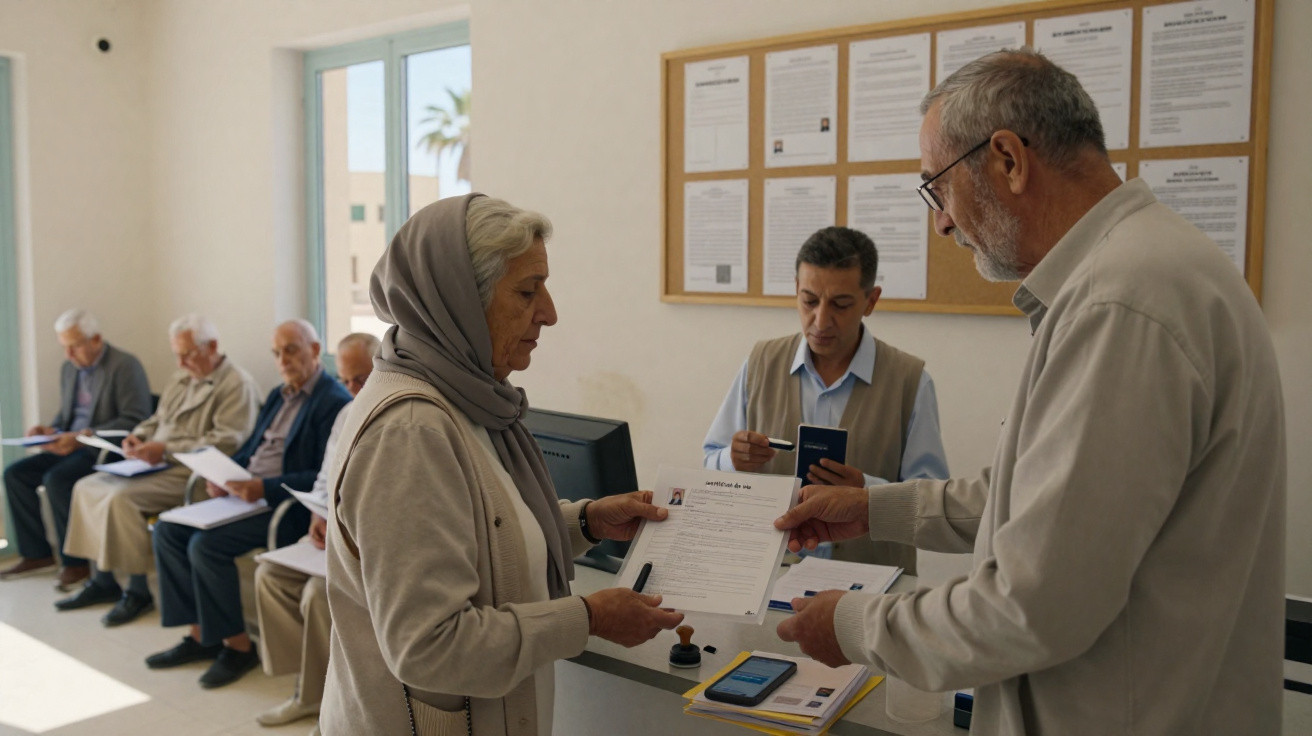
In the morning, outside the consulate, smiles sit alongside bulging folders. A man in a beige jacket clutches his “life certificate”, its stamp still fresh, as carefully as a valuable bus ticket. We have all known the moment when a piece of paper seems to carry more weight than words. The queue moves forward in courteous silence; only the bell from a nearby bakery suggests that ordinary life is continuing. Then comes the quiet but persistent worry: what if a delayed letter suddenly stops this month’s pension, like a snapped thread? Sometimes the weakness lies in nothing more than a stamp.
Fraud concerns and a weakened system: what the Court of Accounts reveals
At the centre of the issue is an apparently straightforward administrative document: the life certificate. Every year, pensioners living in Morocco and Algeria must confirm that they are alive in order to keep receiving their French pension. The Court of Accounts describes a fragile process in which postal delays, varied authentication routes and imperfect civil-status exchanges create loopholes. Relatives can sometimes collect payments without entitlement long after a death. Meanwhile, French pension funds struggle to cross-check everything promptly.
One example is often mentioned in the corridors of the Regional Pension and Occupational Health Funds (CARSAT): a pensioner expected at the village counter no longer appears; rumours say that they have gone “back home”, then died there without an official declaration. The bank account remains open, the transfer arrives and nobody reports it. Month after month, the overpayment grows-quietly, almost routinely. According to the financial magistrates, such situations are not the norm, but their cumulative cost is high. They also undermine the confidence of people who work hard to comply with every requirement.
Why does the process go wrong? First, it relies on lengthy paper trails that can be outdated, as well as civil-status systems that are not always connected to France. Between the office of a moqaddem, a local notary and a French pension fund, proof travels slowly. Databases struggle to communicate, or do so poorly. The Court recommends more systematic cross-checks and secure digital channels. The technology is available; the challenge is making it work in everyday life without being heavy-handed.
What is changing for pensioners in Morocco and Algeria - and how to manage it
The most practical route is the digitisation of the life certificate. Several pension funds are rolling out portals that allow users to download, complete and return the document online, sometimes with a digital signature and certification. A recent identity photograph, automated matching and validation by a pre-registered local authority can make the process easier. It is not a miracle solution, but it reduces lost documents and missing stamps. The Court supports this approach, relying on secure links with local registers.
One simple action can have a major effect: keep contact details current and check bank statements every month. Let us be honest: nobody truly does that every day. When life becomes hectic, a form can easily be overlooked. If someone dies, notifying the pension fund quickly prevents the family from facing a substantial debt. There is no shame in asking a consulate, an expatriate association or a relative more comfortable with digital tools for help. Errors often begin with silence.
The Court also stresses the need to track unofficial intermediaries. Be wary of paid services that promise express certificates. Effective checks protect the system as much as they protect the overwhelming majority of pensioners acting in good faith.
“The aim is not to hunt people down; it is to stop the shadow of a dead person making the living pay.”
- Send the life certificate as soon as it arrives, rather than waiting until the final day.
- Update your postal address and email address with every pension fund.
- Report a death immediately to prevent overpayments that can be difficult to repay.
- Use official channels first: pension-fund portals, the consulate and recognised notaries.
- Keep both a digital and paper copy of every submission, including its posting date.
Checks without stigma: finding the right balance
This is the real tension: safeguarding public finances without casting suspicion on pensioners who paid contributions throughout their working lives in France and have chosen-or needed-to settle in Tangier, Oran or Tizi Ouzou. The word “fraud” lands harshly and can feel offensive. Yet the financial magistrates refer to a high risk, rather than a wave of scammers. That risk comes from the accumulation of minor failures and long distances. The answer is trust supported by effective tools, not blanket suspicion.
Smoother bilateral co-operation with Morocco and Algeria could transform the situation: faster civil-status exchanges, secure access to registers and a shared timetable. The arrangement becomes workable when pensioners experience simpler procedures and pension funds gain greater certainty. This lingering doubt is exhausting. A clear system is reassuring. And yes, it often begins with one well-designed click replacing a stamp that can fade.
| Key point | Detail | Why it matters to the reader |
|---|---|---|
| Countries concerned | Morocco and Algeria have been highlighted for control weaknesses and recurring overpayments | Understand where efforts are focused and why |
| Life certificate | Moving towards digitisation and secure exchanges with local authorities | Save time, avoid payment suspensions and prevent lost post |
| Good practice | Report changes quickly-address, death or bank account-and use official channels | Prevent difficulties rather than having to resolve them later |
FAQ:
- Which Maghreb countries are covered by the Court of Accounts warnings? Morocco and Algeria account for a significant share of pensions paid abroad and have control weaknesses identified by the financial magistrates.
- What disrupts the overseas pension system? Late or lost life certificates, incomplete civil-status exchanges, undeclared deaths and unofficial intermediaries that make cases harder to trace.
- Can a life certificate be completed online? Yes. Digitisation is advancing through pension-fund portals. Depending on your fund, you may be able to download, validate and return the document digitally, using recognised local certification.
- What happens if a death is not reported quickly? The pension continues to be paid incorrectly and becomes an overpayment that must be repaid, sometimes in a substantial amount. Reporting it promptly avoids a debt and closes the case properly.
- How can I avoid a pension suspension while living in Morocco or Algeria? Return the life certificate as soon as it is received, keep your details up to date, use the pension funds’ official channels and, if you encounter difficulties, contact the consulate or an expatriate association.






Comments
No comments yet. Be the first to comment!
Leave a Comment