
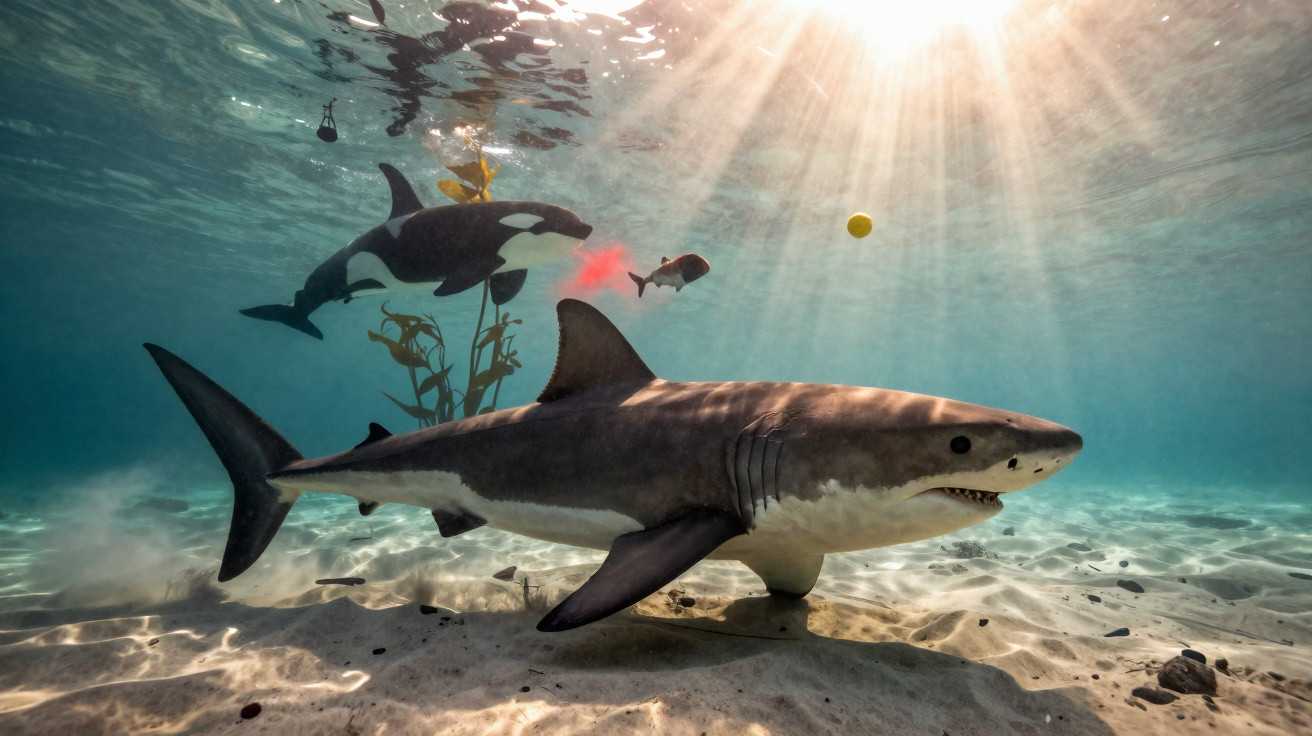
No marine animal provokes as much fear-deservedly or otherwise-as the white shark.
Built for pursuit with a streamlined frame and knife-like teeth, the ‘great’ white (Carcharodon carcharias) is commonly seen as one of the sea’s leading predators, despite its rather unfair reputation for liking human flesh.
That assessment is accurate-but even great white sharks have something to fear.
Watch the video below for an overview of research identifying a predator that other predators avoid:
Orcas drive great white sharks from South African waters
Since 2017, scientists have recorded an extreme drop in shark numbers off South Africa’s coast, where great whites would normally gather. At first, researchers suspected human causes, including overfishing, were behind the unusual absence.
A 2022 study, however, set out the real cause in detail: two orcas (Orcinus orca). Known as Port and Starboard because of the distinctive bends in their dorsal fins, they hunt the sharks and consume their tasty, nourishing, vitamin-rich livers.
The coastal fishing town of Gansbaai was once a destination for shark-watchers. Predators were so plentiful there that nearby Dyer Island became known as the great white shark capital of the world.
In recent years, though, great white sightings in the area have declined.
Since 2017, moreover, at least nine great white sharks have come ashore at Gansbaai. Several lacked livers, while some were also missing their hearts-injuries that are characteristic of an orca attack.
Great whites are not their only victims. Port and Starboard have also been linked to a killing spree involving broadnose sevengill sharks, with at least 17 killed in one day.
The injuries found on those sharks are distinctive and have been connected to the same two orcas. Scientists think the pair may well be responsible for many further great white deaths involving carcasses that never reached the shore.
Other studies have already shown that orcas can very effectively force great white sharks to leave an area.
Research published in 2020 found that great whites consistently flee their favoured hunting grounds off San Francisco whenever an orca appears locally.
Using long-term observations and tracking information from tagged sharks, a research team led by Dyer Island Conservation Trust marine biologist Alison Towner established in 2022 that orcas were causing sharks to shun places they had previously favoured.
"Initially, following an orca attack in Gansbaai, individual great white sharks did not appear for weeks or months," Towner explained.
"What we seem to be witnessing though is a large-scale avoidance (rather than a fine-scale) strategy, mirroring what we see used by wild dogs in the Serengeti in Tanzania, in response to increased lion presence. The more the orcas frequent these sites, the longer the great white sharks stay away."
Tracking the sharks’ unprecedented disappearance
Across five years, the researchers followed 14 GPS-tagged sharks as they left the region when orcas were around. Great white shark sightings have also fallen markedly in several bays.
This is significant. Since records began, great white sharks had been reported missing from Gansbaai for a week or longer on only two earlier occasions: for one week in 2007 and for three weeks in 2017.
According to the researchers, these more recent disappearances are without precedent-and they are continuing. In a 2024 paper, Towner and colleagues recorded two occasions on which Port and Starboard were seen attacking sharks and eating their livers.
Ecosystem effects of orcas hunting sharks
Alarmingly, the attacks are reshaping the ecosystem.
With great white sharks absent, copper sharks (Carcharhinus brachyurus) are arriving to occupy the open ecological niche. Great whites prey on these sharks; without great whites present, the orcas have turned to hunting copper sharks instead.
The researchers noted that the orcas do this with the expertise of predators experienced in pursuing large sharks.
"However, balance is crucial in marine ecosystems, for example, with no great white sharks restricting Cape fur seal behavior, the seals can predate on critically endangered African penguins, or compete for the small pelagic fish they eat," Towner said.
"That's a top-down impact; we also have 'bottom-up' trophic pressures from extensive removal of abalone, which graze the kelp forests these species are all connected through.
"To put it simply, although this is a hypothesis for now, there is only so much pressure an ecosystem can take, and the impacts of orcas removing sharks, are likely far wider-reaching."
It is also important to consider why the orcas could be hunting sharks. Shark livers provide an abundant nutritional resource: they are large and rich in the fats and oils sharks rely on to power their vast ocean migrations.
It remains unknown, however, how the orcas learned this or why they may favour shark livers as a food source.
Some orcas may be adapting to target sharks preferentially, potentially because their usual prey is becoming less abundant. A separate pod in the Gulf of California has likewise developed specialised methods for hunting whale sharks.
Yet, as great white numbers are declining globally, the extra pressure imposed by such an effective predator is concerning.
"The orcas are targeting subadult great white sharks, which can further impact an already vulnerable shark population owing to their slow growth and late-maturing life-history strategy," Towner said.
"Increased vigilance using citizen science (e.g. fishers' reports, tourism vessels), as well as continued tracking studies, will aid in collecting more information on how these predations may impact the long-term ecological balance in these complex coastal seascapes."
The team’s research appeared in the African Journal of Marine Science, here and here.
An earlier version of this story was published in July 2022.





Comments
No comments yet. Be the first to comment!
Leave a Comment