
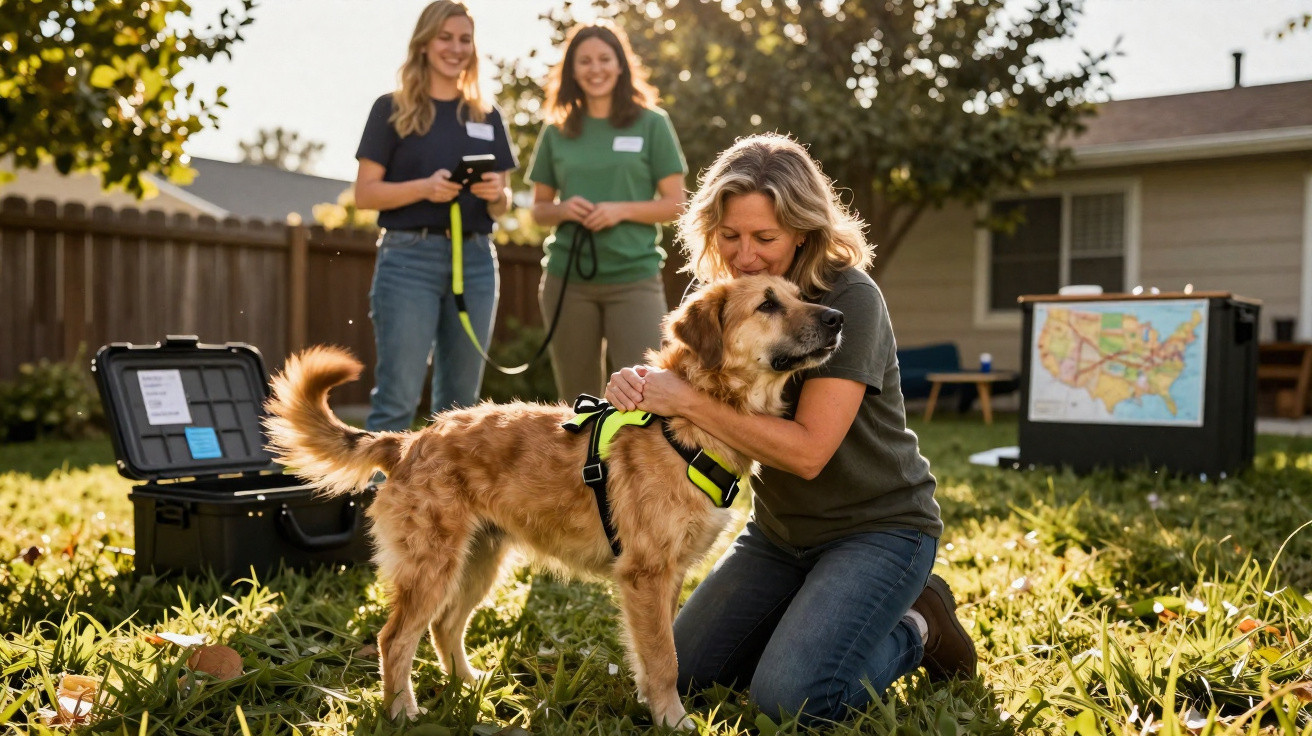
At a small animal shelter in Michigan, volunteers turned up one morning to discover a dog waiting quietly beside the fence.
There was no message and no sign of an owner: only a short-legged brown dog fastened to the wire mesh, seemingly left there from nowhere. Within hours, a microchip check would uncover a tale spanning 3,700 kilometres, four missing years and an unlikely reunion.
A mystery dog at the fence
Early that day, the dog was found outside a small shelter in Lincoln Park, a working-class town in Michigan’s Detroit area. Staff saw that he had been firmly tied to the fence rather than left in a field or abandoned from a vehicle, suggesting that somebody had at least attempted to leave him in a safe place.
The crossbreed, which had a distinctly Dachshund-like appearance, was wary but showed no aggression. He took treats, wagged his tail and let volunteers attach a lead. There was nothing to indicate either what he had endured or the distance he had covered.
Only a quick scan with a microchip reader turned a routine intake into a cross-country mystery.
The shelter team switched on the scanner, passed it carefully over the dog’s back and heard the familiar beep. A number came up. That sequence of digits connected to a database, which in turn led to an owner who had believed her dog was lost forever.
A call that changed everything
The registered owner was not anywhere near Michigan. Patricia lived at the address recorded against the microchip, in Antelope, a Sacramento suburb in California. It is approximately 2,300 miles away, or nearly 3,700 kilometres by road.
When the shelter contacted her, Patricia initially assumed there had been an error. Her dog, Choco, whom she had adopted in 2016, had disappeared in 2021. She had searched for him, shared posts online, contacted veterinary practices and shelters, and carried the persistent pain known to anyone who has lost a pet. Eventually, her hope began to disappear.
Then, without warning, someone she did not know was telling her that Choco had been found alive and safe at the opposite end of the country.
Choco had crossed time zones, vanished from all radars for four years, and somehow ended up tied to a fence outside a small Midwestern refuge.
Exactly how he arrived there is still unknown. Shelter workers and Patricia can only speculate. Had someone taken him before abandoning him? Had he moved between households? Did he get lost during a road journey? Nobody, including Choco, can provide the answer.
From Detroit to California: a long journey home
After the first tears and shock, one practical problem remained: how could a medium-sized dog be returned safely and promptly from Michigan to California?
Lincoln Park shelter shared Choco’s story on social media, both to report the extraordinary discovery and to seek assistance arranging his journey. Helping Paws and Claws, a small animal charity in Loomis, California, saw the online appeal.
A rescue network mobilises
Helping Paws and Claws responded almost straight away. Volunteers knew that travelling by road would involve several days, numerous handovers and added stress for a dog who was already unsettled. Instead, they set their sights on an airline ticket.
The charity created a fundraising pot to meet the travel expenses. Donations came in quickly, with small online contributions mounting up sooner than expected. One woman made an even greater contribution by giving her airline miles, substantially reducing the ticket cost.
A handful of strangers, spread across two states, turned a bureaucratic microchip hit into a real reunion.
Two people then offered to manage the arrangements and Choco’s hands-on transport:
- Aco Blair, an animal control officer from South Gate, Michigan, volunteered to accompany Choco from the Midwest end of the journey.
- Penny Scott, a volunteer living near Antelope, California, offered to meet him and organise the final journey home.
Together with airline staff and rescue supporters, they put together a travel plan for a dog who had already gone far too far by unknown routes.
The reunion Patricia thought she would never see
When Choco eventually arrived in California, there was no grand media occasion. Instead, he was welcomed by calm, attentive people who had spent weeks planning each stage. He then travelled by car from the airport to Antelope, where Patricia was waiting for him.
Those present said that Choco paused briefly before recognising her voice and scent. His manner changed instantly: his tail rose, he jumped eagerly and sniffed frantically, displaying the blend of delight and uncertainty dogs show when two worlds collide - the life they once knew and the life they believed had vanished.
For Patricia, the dog she adopted eight years earlier was no longer a framed photo or a memory; he was back on her sofa.
Veterinary examinations were arranged to evaluate his health, bring his vaccinations up to date and check that the long, unrecorded years had not caused any concealed harm. Initial indications suggested that he had been fed and housed for at least some of that period.
How a tiny microchip changed everything
Choco’s story demonstrates how a straightforward microchip can reunite pets with their owners, even after years apart and across enormous distances.
A pet microchip is a device about the size of a grain of rice, inserted beneath the skin, most commonly between the shoulder blades. It contains an individual ID number linked to an online database run by approved firms or organisations.
When a veterinary professional, shelter worker or animal control officer finds a missing animal, they use a scanner across its body. If it has a chip, the reader identifies the number and staff can access the owner’s contact information.
| Step | What happens |
|---|---|
| 1. Implantation | Vet inserts microchip under the pet’s skin, usually once in a lifetime. |
| 2. Registration | Owner’s address, phone and email are entered into a secure database. |
| 3. Scan | Shelter or vet uses a reader to pick up the unique ID from the chip. |
| 4. Contact | Database provides details so the finder can call or email the owner. |
Without the microchip, Choco would have been one more unidentified stray. Because he had one, volunteers were able to link a dog in Michigan with a Californian phone number and set in motion the events that returned him home.
Why so many pets stay “lost” even when found
Cases such as this prompt an obvious question: if microchips are effective, why do so many animals fail to return to their original families?
Shelter reports repeatedly identify several issues:
- Chips are never registered, meaning the number has no owner information attached to it.
- Telephone numbers or addresses are no longer current after a house move or a change of provider.
- Owners believe collars and tags alone are sufficient, although they are no help when a collar goes missing.
- Rescued animals are swiftly rehomed without being scanned, particularly through informal arrangements.
Choco’s owner had maintained his registration information, so the shelter found an active telephone number when it checked his microchip. That basic action can be the difference between being reunited and facing a lifelong unanswered question.
What Choco’s odyssey shows about community rescue
The case also shows how the different parts of the animal welfare system can work together. A small municipal shelter carried out a standard scan. A grassroots organisation in another state followed social media and offered support. Volunteers gave their own time, while one airline passenger chose to donate miles that might otherwise have paid for a holiday.
A lost dog came home not because of one hero, but because a chain of small decisions leaned toward compassion.
For pet owners, Choco’s experience points to several practical actions:
- Microchip pets, then confirm that their registration details are complete and up to date.
- Retain clear photographs of animals, including facial features and markings on both sides.
- Tell nearby veterinary practices and shelters at once when a pet disappears, and provide updates after moving home.
- Help local rescue groups and transport networks; the organisation supported today could be the one that returns your own pet in future.
Nobody yet knows what Choco experienced between 2021 and the day he was tied to the Michigan fence. What is known is that a tiny chip, a few online clicks and a network of strangers pieced those absent years back into a life in which a dog once again sleeps at the foot of his owner’s bed.





Comments
No comments yet. Be the first to comment!
Leave a Comment