
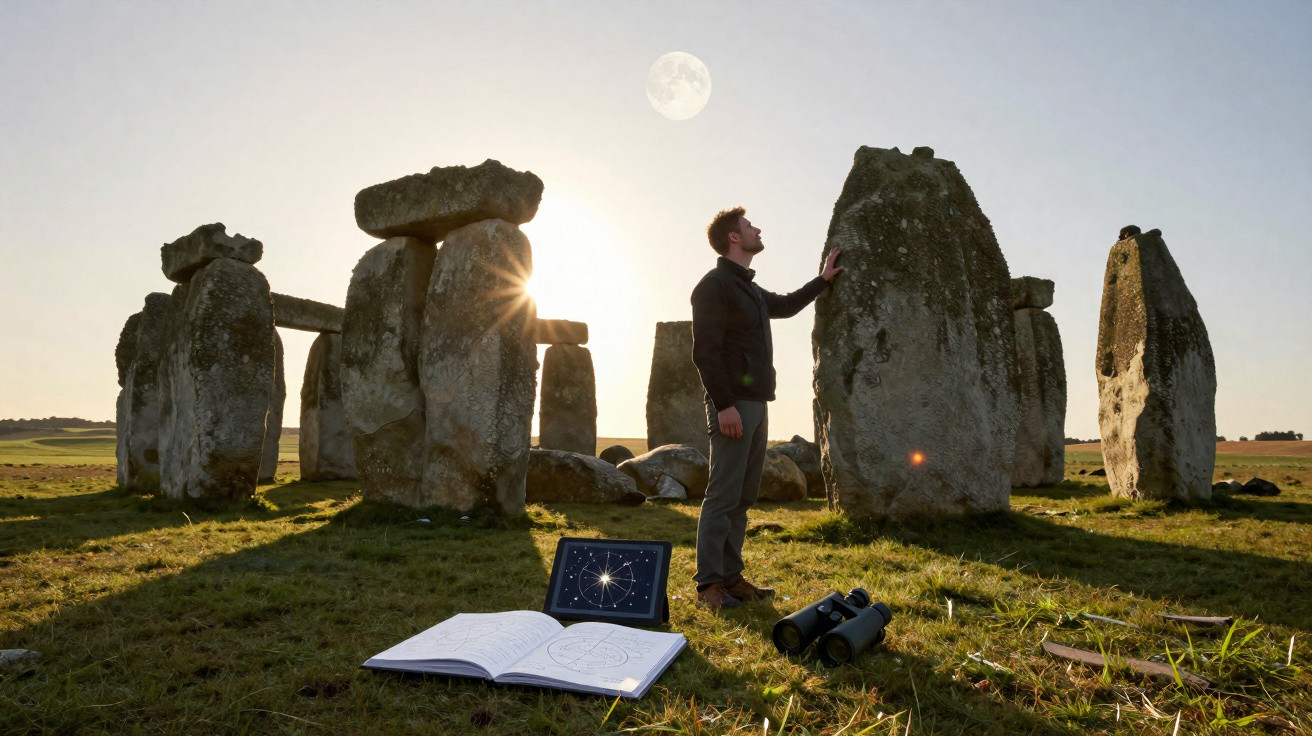
Stonehenge is most widely associated with celestial alignments involving the Sun.
On every midsummer night, tens of thousands of visitors assemble at Stonehenge to mark the Sun rising in line with the Heel Stone, which stands beyond the circle. Half a year later, a more modest gathering meets near the Heel Stone to watch the midwinter Sun set inside the stone circle.
Yet for 60 years, researchers have proposed that part of Stonehenge is also aligned with the Moon’s rising and setting points during a major lunar standstill. While links between the positioning of particular stones and the major lunar standstill have been recognised for decades, nobody has previously carried out a systematic programme of observation and recording at Stonehenge.
Our project aims to change that. It brings together archaeologists, astronomers and photographers from English Heritage, the universities of Oxford, Leicester and Bournemouth, and the Royal Astronomical Society.
Stonehenge solar alignments and its design
There is now substantial archaeological evidence suggesting that solar alignment formed part of Stonehenge’s intended architectural design. Around 2500 BC, the people who erected the great stones and cut an avenue through the chalk appear to have incorporated the solstice axis into the monument’s structure.
Findings from nearby Durrington Walls, where researchers believe people visiting Stonehenge lived, suggest that the midwinter solstice – rather than the summer event – attracted the greater number of people.
However, Stonehenge contains further features: 56 circularly arranged pits, an earthwork bank and ditch, and smaller elements including the four station stones. Made from sarsen, a silicified sandstone commonly found in Wiltshire, these four stones were deliberately positioned in an almost perfect rectangle around the stone circle.
Just two survive today. At less than a metre tall, they are insignificant beside their much larger counterparts. What, then, was their function?
Lunar standstill
The rectangle made by the station stones is distinctive rather than arbitrary. Its shorter sides run parallel with the stone circle’s principal axis, which may offer a clue to its role, while its longer sides pass around the outer edge of the circle.
These longer edges are thought to correspond with the major lunar standstill. If you plotted the Moon’s rising, or setting, location during a month, it would be seen to travel between two horizon points. The northern and southern limits of moonrise, or moonset, shift over an 18.6-year cycle, moving between the smallest and largest ranges: the minor and major lunar standstills respectively.
A major lunar standstill lasts roughly one and a half to two years, when the northernmost and southernmost moonrises, or moonsets, are at their widest separation. At this time, the Moon rises and sets beyond the range of the Sun’s rising and setting positions, potentially giving this celestial event particular meaning and importance.
Major lunar standstill evidence at Chimney Rock
The clearest evidence for people marking the major lunar standstill is found in the south-western US. The Great House of Chimney Rock is a multi-level complex constructed by ancestral Pueblo people more than 1,000 years ago in Colorado’s San Juan National Forest.
It stands on a ridge ending in a natural pair of rock pillars, a location of cultural importance to more than 26 Native American tribal nations. Viewed from the Great House, the Sun never rises through the gap separating the pillars.
During a major standstill, though, the Moon rises dramatically between them. Excavations recovered preserved timber, enabling researchers to date individual phases of building work at the Great House to particular years.
Of six tree-cutting dates, four match major lunar standstill years between AD1018 and AD1093. This suggests that the site was restored, cared for or enlarged during successive major standstills.
Back in southern England, archaeologists believe the major lunar standstill may be connected with Stonehenge’s earliest building phase, from 3000-2500 BC, before the sarsen stones arrived.
Several groups of cremated human remains dating to this construction phase were discovered in the monument’s south-eastern area, broadly in the direction of the southernmost major standstill moonrise. Three timber posts had also been placed in the bank there. Stonehenge may therefore have had an early association with the Moon, later reinforced by the construction of the station stone rectangle.
Even so, the major lunar standstill hypothesis poses more questions than it resolves. We do not know whether the station stones’ lunar alignments were symbolic, or whether people were expected to view the Moon through them. Nor is it clear which lunar phases would have provided the most striking spectacle.
A search for answers
Our forthcoming work will seek answers to the questions raised by the major lunar standstill hypothesis. It remains uncertain whether the Moon was bright enough to create shadows, and how any shadows may have interacted with the other stones. We must also establish whether the alignments remain visible today, or whether woodland, traffic and other obstructions conceal them.
From about February 2024 until November 2025, the Moon will align with the station stone rectangle twice each month. This will provide ample opportunities to examine the phenomenon across different seasons and lunar phases.
To make the research accessible, English Heritage will livestream the southernmost moonrise in June 2024. It will also hold events throughout the year, including talks, a pop-up planetarium, stargazing and storytelling sessions.
On the other side of the Atlantic, our collaborators at the US Forest Service are preparing educational resources about the major lunar standstill at Chimney Rock National Monument. The partnership will lead to events presenting and discussing the lunar alignments at both Stonehenge and Chimney Rock.
Fabio Silva, Senior Lecturer in Archaeological Modelling, Bournemouth University; Amanda Chadburn, Member of Kellogg College, University of Oxford and Visiting Fellow in Archaeology, Bournemouth University, and Erica Ellingson, Professor in Astrophysics, Emeritus, University of Colorado Boulder
This article is republished from The Conversation under a Creative Commons licence. Read the original article.





Comments
No comments yet. Be the first to comment!
Leave a Comment