
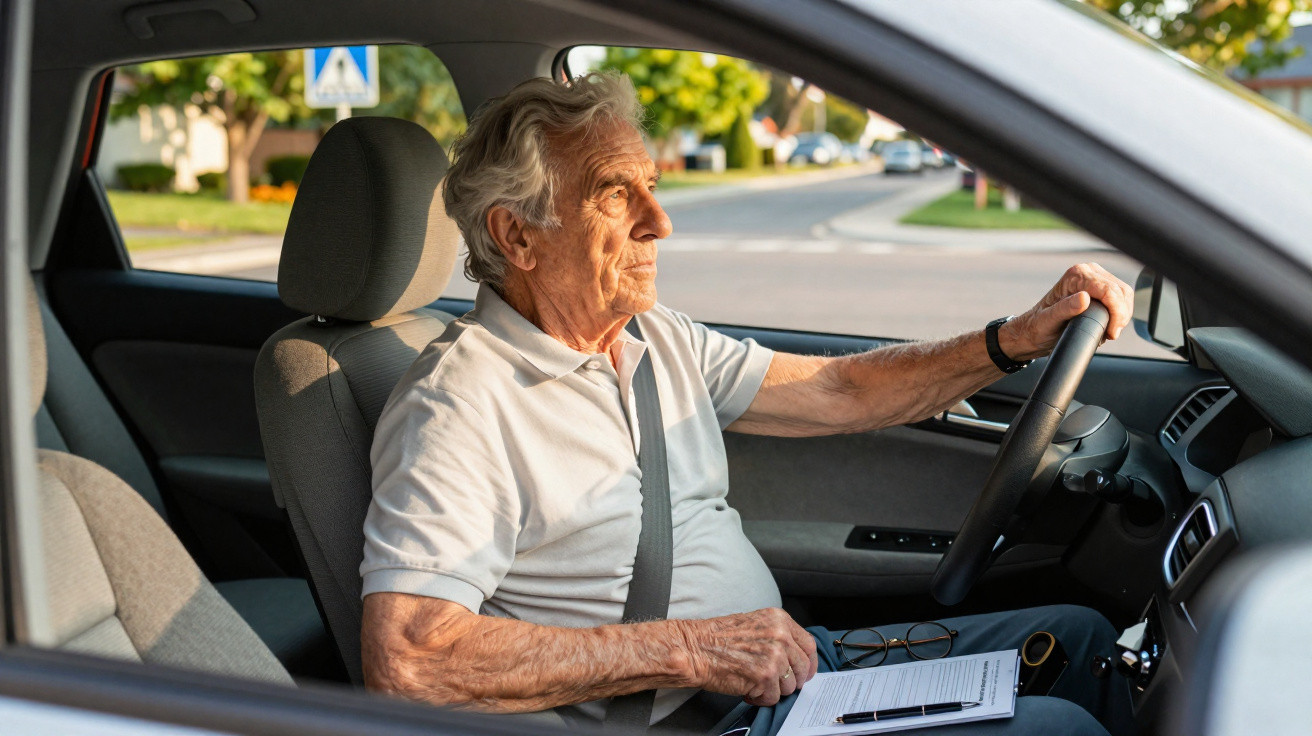
Not as an abstract idea, but when the driver is your father, your neighbour or yourself. For years, figures such as 65 and 75 have been repeated as though one particular birthday suddenly makes every driver a road risk. The Highway Code takes a more definite position in this discussion than many people appreciate. Yet the true age limit for driving is not what most assume.
The supermarket car park was nearly deserted when I noticed him: a man in his late seventies, perhaps 80, methodically folding his walking stick before getting into a small silver hatchback. For a while, he remained still with both hands resting on the steering wheel, taking slow breaths as though preparing to go on stage. He then reversed from the bay with an accuracy that plenty of 25-year-olds might envy.
As he joined the main road, I was reminded of the disputes families regularly have over precisely this situation. Is he too old? Is he still safe? Who makes that judgement, and on what grounds? A few days later, I looked into what the Highway Code actually says about age and found an answer that reframes the debate. It begins with a number, but ends with an attitude.
The real age limit isn’t what you think
First, the misconception needs clearing up: the Highway Code does not state that you have to stop driving at 65 or 75. Its only firm age threshold concerns when you may begin driving, rather than when you must give up. In the UK, you may legally retain a licence into your eighties, nineties and even beyond 100, provided you satisfy the medical and eyesight requirements.
The ages 65 and 75 get mentioned because they sound tidy and plausible. They align with the cultural picture many people have of what being “old” means. However, the rules rely on something much more individual than a birthday: ability. Ability does not change according to the calendar.
Consider the DVLA requirements underpinning the Highway Code. Once you reach your 70th birthday, your licence must be renewed every three years. There remains no upper age limit. The reasoning is straightforward: age alone is not the problem; undeclared health conditions are. Slower reactions, deteriorating vision, medication side effects and early cognitive decline can affect someone at 58 or 88. For that reason, the “real age limit” keeps moving and is reassessed repeatedly, rather than forming a hard barrier at 75.
The figures reveal a complicated and very human pattern. Younger motorists remain significantly over-represented in serious collisions, particularly men under 25. At the other end, the risk trend rises again for drivers over 80. Between 60 and 75, though, the reality is less alarming than headlines often imply.
One frequently quoted UK statistic shows that drivers aged 70–79 generally have fewer accidents per mile than people in their late twenties. They commonly travel more slowly, stay off the road at night and stick to routes they know. When the data is examined closely, the familiar image of the “dangerous older driver” does not always stand up.
The danger increases markedly among the oldest drivers, especially where medical problems are overlooked or concealed. This is the quiet tipping point that the Highway Code seeks to identify indirectly. Rather than prohibiting driving at 75, it requires regular licence renewals from 70 and obliges drivers to disclose medical conditions that may compromise safety.
The thinking behind these rules is deeply practical, almost painfully so. The law recognises that certain 72-year-olds are more alert than motorists half their age, while some 58-year-olds may already need to consider alternatives to driving. Instead of setting an upper age cap, the Highway Code depends on medical standards and disclosure. Drivers are trusted, to a degree, to acknowledge when their vision, memory or mobility no longer meets the demands of driving.
That trust carries a risk. People do not always want to admit that their abilities are declining. Families may also avoid the matter, because taking away the keys can mean removing independence. A fixed age ban, however, would unfairly penalise thousands of people who remain safe at the wheel. The system favours judgement over a convenient number, even when that makes discussions at home more difficult.
How to know when it’s really time to stop
Where the Highway Code does not place a red line at 65 or 75, somebody else must do so. Very often, that person is the driver. A straightforward approach used quietly by many older motorists is to carry out a personal safety review on every birthday after 70. It is not an official assessment, but a private review of the previous year’s driving.
Have you become lost on a route you know well? Failed to notice a red light? Judged a junction badly and then felt your heart racing? These are the minor but uncomfortable signs that official forms cannot entirely reveal. Recording them truthfully once each year can build a stark but valuable picture. When the list grows longer, the decision may already be there, simply not yet said aloud.
Doctors and opticians play an important but unobtrusive role in this situation. They observe changes in eyesight, new medication and early indications of dementia or diabetic complications. The Highway Code relies on medical professionals to raise concerns where a licence is no longer safe. But they cannot witness what happens at the busy roundabout outside your town. That is where families have a part to play.
Most of us know the moment when an adult child grips the passenger door slightly too hard while a parent is driving. They spot the delayed braking, uncertainty at traffic lights or the wing mirror that is never checked. Those observations are not merely anxiety; they are evidence that the older driver may be too proud, or too frightened, to acknowledge.
Discussions about giving up driving are seldom relaxed at the outset. Some older drivers feel they are being blamed, while others feel overlooked, as if a world moving too quickly is forcing them aside. The most constructive conversations begin well before a genuine emergency. “One day, when driving feels harder, how will we know?” sounds very different from “Dad, you’re dangerous and need to stop now.”
By emphasising self-declaration, the Highway Code quietly encourages those early conversations. Every three years after 70, motorists confirm that they remain fit to drive. That simple tick-box can invite honesty, or enable denial. Families that treat it as a joint review rather than an individual decision often manage the change with far less conflict.
“There is no official birthday when you become an unsafe driver. There is only the day your driving no longer matches the demands of the road – and the courage to admit it.”
For people nearing that point, a few practical steps can make the uncertainty feel less severe:
- Begin cutting back on demanding journeys, including night driving, motorways and rush-hour travel.
- Arrange regular eye tests, and tell the optician that you still drive.
- Consider a voluntary driving assessment with an instructor who understands older drivers.
- Discuss alternative transport with family before it becomes necessary.
- Decide what “retiring from driving” would mean in day-to-day life.
Living with a limit that moves
What is unusual about the Highway Code’s true age limit is that it exists as much in our minds as it does in the rules. There is no single number, only an evolving combination of health, confidence, reflexes and honesty. Consequently, the end of a person’s driving life is less like reaching a birthday and more like facing a succession of small tests on ordinary days, whether they are passed or failed.
Some people will hold on to their keys long after their ability has diminished, driven by fear or stubbornness. Others will stop sooner, unsettled by one frightening incident on a wet night. The Code remains in the background: strict about medical requirements, but silent about feelings. It leaves the most difficult decisions to those most affected by them.
For many families, the key change happens when they ask a different question. Rather than “What’s the legal age limit?”, they ask: “What does safe, dignified independence look like at 70, 80, 90?” Public transport, community lifts and ride-sharing with friends may feel like poor replacements at first. In time, they can sometimes open the door to a different sort of freedom.
There is a quiet reality beneath all this: no one thinks they’re the dangerous one. It is always the other older driver who is the problem, never us. This is why carefully sharing experiences, rather than simply reciting rules, matters so much. Think of the neighbour who stopped driving and discovered he walked more, spoke with more people and felt less confined; or the aunt who delayed too long, then had a minor collision that unsettled the whole family.
In legal terms, the road remains open much longer than most people expect. In moral terms, the exit appears at a different time for each person. Between those two points lies the real “age limit” for driving: a boundary not printed in the Highway Code, but drawn by how we observe ourselves and one another behind the wheel.
| Key point | Detail | Why it matters to the reader |
|---|---|---|
| No fixed upper age limit | The Highway Code sets renewal requirements after 70, rather than a ban at 65 or 75 | Corrects widespread myths and reduces unnecessary worry |
| Health over birthdays | Medical fitness, eyesight and cognition are what truly determine fitness to drive | Helps readers concentrate on what they can monitor and discuss |
| Shared responsibility | Drivers, families and doctors each have a role in deciding when driving should stop | Provides a practical framework for difficult conversations |
FAQ:
- Is there a legal age when you must stop driving? No. There is no maximum age in the UK. From 70 onwards, you must renew your licence every three years and meet the medical standards.
- Why do people say 65 or 75 is the limit? These ages stem from pension and retirement culture, not the Highway Code. They are social reference points, not legal rules or strict safety thresholds.
- Can an older driver be forced to give up their licence? Yes, where the DVLA decides they no longer meet medical standards, or if a serious condition is reported by a doctor, the police or, in some cases, a concerned third party.
- What are warning signs that someone should stop driving? Becoming lost on familiar routes, near misses, confusion at junctions, damage to the vehicle or frightened passengers are all significant signs that should be taken seriously.
- Do many older drivers give up driving voluntarily? Quite a few do. Many decide to stop following a health scare, a minor collision or an honest discussion with family or their GP. Let’s be honest: nobody finds that decision easy, but planning ahead makes the impact less harsh.






Comments
No comments yet. Be the first to comment!
Leave a Comment