
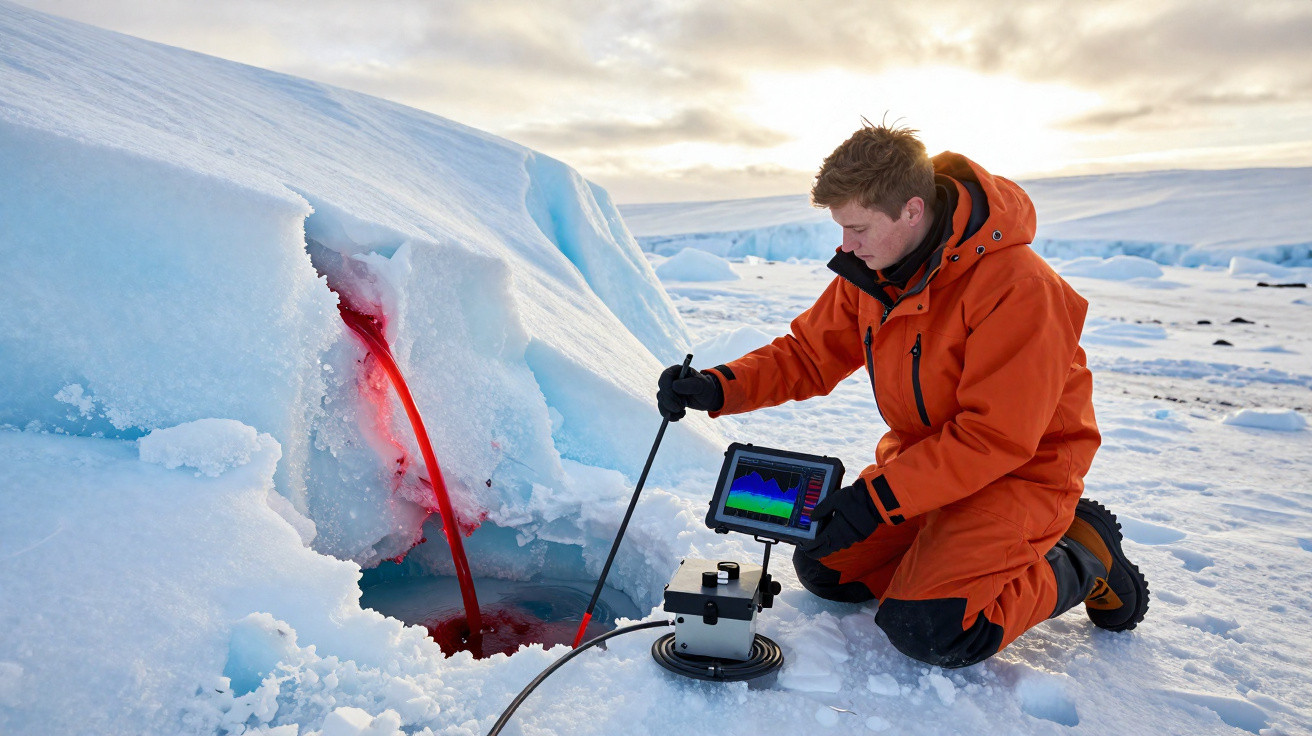
Blood Falls is a seep of iron-rich, hypersaline water emerging from beneath Taylor Glacier in Antarctica’s McMurdo Dry Valleys. Its vivid red hue results from iron oxides that form when this ancient, oxygen-free brine reaches the air.
Scientists have linked an abrupt surge of rust-coloured water at Antarctica’s Blood Falls with a measurable lowering of the glacier above it.
The relationship indicates that the red outflow is more than a surface mark: it provides visible evidence of shifting pressure and concealed water movement far below the ice.
“Blood Falls” Antarctica
In September 2018, an instrument on Taylor Glacier - the huge river of ice that passes through Antarctica’s McMurdo Dry Valleys - registered a fall in elevation while a camera recorded Blood Falls beginning to flow.
Peter T. Doran, a geoscientist at Louisiana State University (LSU), correlated the drop with the outflow and connected it with reduced pressure.
Across several weeks, his team observed the surface subside before returning to its previous level, pointing to a brief drainage episode beneath the glacier.
Because monitoring coverage was limited, the record contains gaps; future observations will need to cover more locations to establish how frequently the glacier releases water.
Pressure beneath Taylor Glacier
Pressure accumulates as the weight of the ice confines salty water below it, but the glacier cannot withstand that compression indefinitely.
At Blood Falls, the water originates in subglacial channels beneath the glacier, isolated from air and capable of opening as the ice moves.
The ice’s weight and gradual flow can force the saline mixture towards fractures, allowing it to emerge in abrupt pulses.
These pulses remain difficult to forecast, as slight shifts in stress or obstructions may postpone an outflow for months.
Salt keeps the water moving
Salt converts ordinary water into a chemical solution that can avoid freezing even while air temperatures remain well below zero.
Researchers refer to this salt-rich water as brine, which stays liquid in intense cold and is brought into daylight by Blood Falls.
Repeated freezing over hundreds or even thousands of years can concentrate the salts, producing liquid that continues to travel through the ice.
The salts probably originate from concealed rock and deposits, while their chemistry provides clues to conditions beneath Taylor Glacier.
Iron gives Blood Falls its red colour
Explorers recorded the red seepage at the glacier’s face in 1911, and the location remains protected under an Antarctic conservation plan.
When the water comes into contact with air, oxidation - the reaction of iron with oxygen that creates a rust-red colour - alters it within minutes.
Minute iron particles develop in the saline water underground and subsequently colour the ice as the flow spreads downhill.
Because this colour shift happens so quickly, each discharge is readily visible, helping researchers identify when the hidden system opens.
Sensors record the event
Daily camera images near Lake Bonney, an Antarctic lake covered by ice, revealed fresh staining from 19 September 2018, with the stained area growing afterwards.
At the same time, a thermistor in the lake - a small device that measures temperature variation - recorded a temperature fall at depth during the discharge.
The authors said in their report that the chance recording across three separate datasets produced an unusual, consistent signal of a subglacial brine drainage event.
The record covered only a brief period, but it showed how swiftly the system may alter once activity begins.
The ice slows and subsides
The glacier surface fell by 1.5 cm while its forward movement slowed by nearly 10%. As water drains away, pressure at the base declines, causing the ice to press more firmly against rock and move less freely.
“These observations demonstrate that an extended brine discharge event, characterized by episodic pulses of brine sourced from beneath Taylor Glacier over one month, reduces subglacial water pressure, which lowers the surface and reduces ice velocity,” wrote Doran.
Measurements taken later indicated that the ice remained slightly slower than before, although longer records are required to establish whether the change persists.
Lake layers are disrupted
At a depth of about 18 metres, lake water cooled by as much as 1.5°C during the same weeks.
Dense brine can enter the lake at the depth at which its density matches that of the surrounding water, before spreading outwards.
This inflow disturbed stratification - the stable layers that prevent lake water from mixing - and probably shifted nutrients sideways.
Organisms in the lakes of Antarctica’s Dry Valleys occupy narrow zones, so even minor disturbances can alter which life receives food and energy.
Mapping concealed brine
An airborne instrument identified deeply buried saline water below the valley floor, far from any meltwater.
Readings from the equipment indicated groundwater routes at least 4.8 kilometres long, showing that brine can move through rock before reaching the ice.
Subsequent research used ice-penetrating radar to follow brine channels within the glacier across several kilometres of ice.
These maps clarified why water can emerge at one fracture while other brine enters the lake without notice.
Life without oxygen
Microbes deep within the brine persisted through iron and sulphur chemistry despite extended isolation under the ice.
Rather than using oxygen for respiration, many probably drew energy from dissolved minerals, sustaining the system in darkness.
Geologists estimate that the reservoir was sealed off between three and five million years ago, placing it among the oldest liquids in the valley.
Strict regulations restrict entry and keep most sampling under close control, as external material could contaminate such an enclosed habitat.
What happens next
Blood Falls now appears less like an unusual stain and more like a pressure-release outlet connecting ice, rock and lake.
Future field seasons could introduce broader sensor networks, allowing LSU to assess whether warming trends affect how often the system releases brine.





Comments
No comments yet. Be the first to comment!
Leave a Comment