
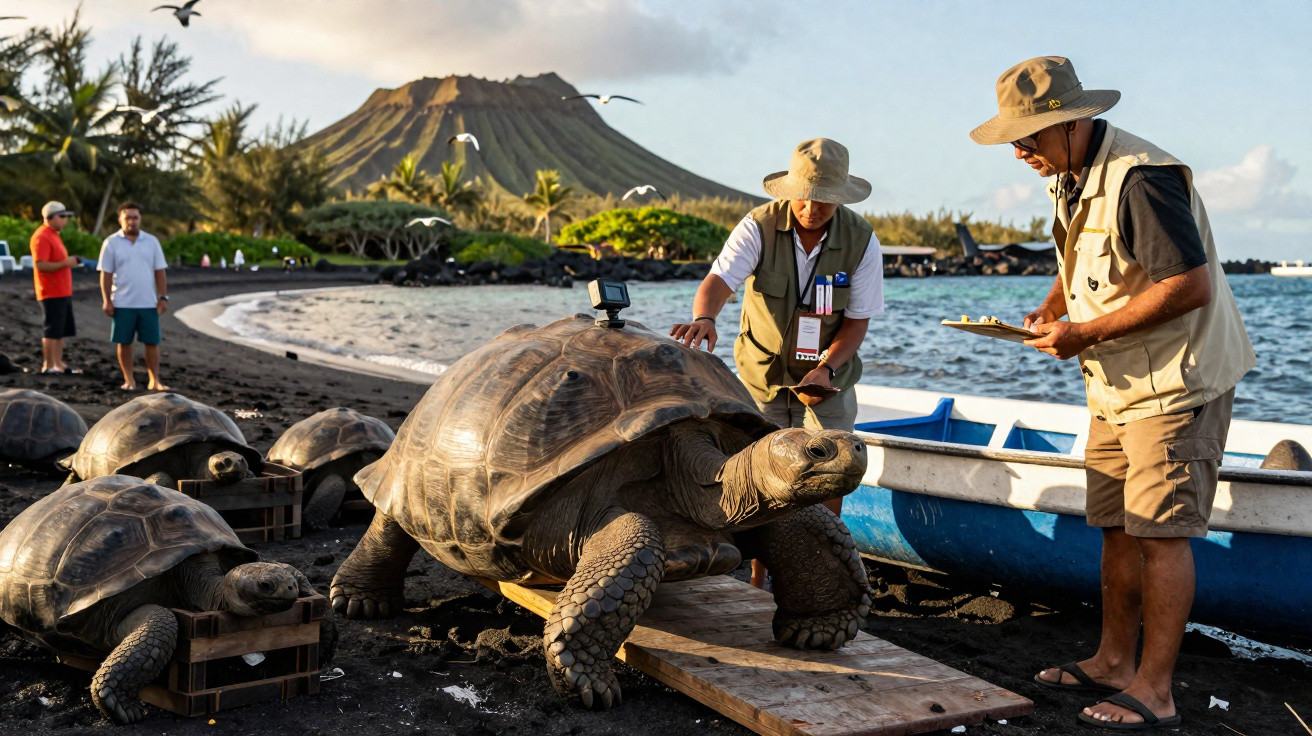
On a peaceful Pacific island, an ancient rhythm is being heard once more: unhurried footsteps, weighty shells and a landscape slowly starting to breathe again.
The Galápagos archipelago, long regarded as a living laboratory for evolution, has just seen one of its most resonant returns. Following almost two centuries of absence, giant tortoises are back on Floreana Island through an ambitious rewilding project connecting 19th-century whaling vessels with 21st-century conservation science.
The devastating history that almost wiped out Floreana’s giant tortoises
During the early 19th century, whaling ships and pirate vessels treated giant tortoises as both provisions and cargo. Sailors piled the animals into dark holds like barrels, using them as living ballast and a reserve food supply.
Tortoises suited lengthy sea journeys. Able to live for months without food or fresh water, they allowed crews to kill them for meat over time. Thousands were removed from the Galápagos, including Floreana, where incessant hunting devastated the local subspecies, Chelonoidis niger.
By about 1840, Floreana’s giant tortoises were thought to have disappeared. They were not merely scarce: they were gone. For generations, their existence endured only in elders’ stories and on the pages of natural-history books.
What looked like routine cruelty at sea turned out to be the tiny, unlikely thread that kept this lineage alive.
The vessels that stripped Floreana of its tortoises also occasionally unloaded animals on other islands when crews needed to lighten their ship or reorganise stores. Unintentionally, they moved genetic material around the archipelago.
The DNA discovery on an isolated volcano
Jump forward to the early 2000s. Researchers were examining the DNA of giant tortoises on Wolf Volcano, a remote, unforgiving area at the northern end of Isabela Island.
The samples contained an extraordinary finding: several animals carried genetic markers connected to the tortoise believed extinct on Floreana. This showed that the Floreana lineage had not vanished entirely. Remnants were still roaming the islands, although no longer on Floreana itself.
Geneticists subsequently identified around twenty tortoises whose DNA profiles most closely resembled those of the original Floreana subspecies. This small group became the basis for an exacting breeding programme.
From twenty survivors to another generation
The selected tortoises were transferred to a breeding centre on Santa Cruz Island, which hosts one of the Galápagos’ principal conservation centres. Through years of managed breeding, staff paired adults with care to retain as much as possible of the remaining Floreana genetic signature.
That work has now produced a figure: 158. This was the number of young tortoises, between eight and thirteen years old, prepared to return to Floreana in February 2026.
Their release was far from a discreet scientific exercise. It became a community occasion, as local families assembled to see crates opened and shells inching across soil once shaped by the tortoises’ ancestors.
Children on Floreana were invited to give names to the first tortoises set free, turning a scientific milestone into a shared local memory.
How one slow reptile can transform a whole island
For conservation scientists, the story is about more than sentiment or correcting historic wrongs. It concerns restoring the way an ecosystem functions.
On Floreana, giant tortoises are what ecologists describe as a “keystone species” – one whose effect on its surroundings is far greater than its population size may imply.
- They spread the seeds of native plants after consuming fruit and vegetation.
- Their grazing and trampling influence plant growth and distribution.
- When they excavate shallow hollows and make muddy pools, they create “microhabitats” used by insects, birds and other animals.
Scientists have already observed the effects of tortoise returns on another Galápagos island, Española. A 2023 study published in the journal Conservation Letters found that, after reintroductions there, vital cactus species in the genus Opuntia recovered, as did endemic land iguanas reliant on those cacti.
This evidence reinforced the argument for Floreana: restore the tortoises and the plants, lizards, insects and birds dependent on the landscape patterns they produce can recover as well.
A living connection between land and sea
Their influence is not limited to vegetation and soil. On Floreana, giant tortoises also have an indirect connection with seabird colonies.
By altering plant cover and creating open spaces and microhabitats, tortoises help sustain improved nesting conditions for certain seabirds. Thriving bird colonies then nourish offshore food webs as guano and organic matter enter the sea, fertilising waters that support coral reefs and coastal fisheries.
The Floreana project treats island and ocean as a single, connected system rather than two separate conservation problems.
This model forms part of the Island-Ocean Connection Challenge, a programme intended to restore 40 globally important islands by 2030, combining land-based action with gains for the seas around them.
Preparing Floreana: tackling invasive species
The giant tortoises were not released onto an untouched island. Like many islands with a long human presence, Floreana has been profoundly changed by rats, cats and other species introduced over recent centuries.
These invasive animals preyed on eggs, chicks, reptiles and invertebrates, severely reducing local biodiversity. By the start of the 21st century, several native species had disappeared from everyday life on Floreana and remained only in historical accounts.
A substantial operation to remove invasive predators began in 2023. The results are already emerging. Endemic finch populations have begun increasing again. A bird locally called the Pachay, last documented during Charles Darwin’s 1835 visit, has been sighted again. Native snails, missing for more than a century, have reappeared too.
As predator numbers fall and habitats recover, Floreana is progressively becoming secure enough for the return of large, long-lived animals such as tortoises.
What follows the giant tortoises
Releasing the tortoises represents only the opening stage of a wider rewilding strategy. Conservation organisations plan to reintroduce several more species, each performing a distinct ecological role.
| Species | Type | Expected status |
|---|---|---|
| Floreana racer snake | Reptile | Active reintroduction planned |
| Vermilion flycatcher | Bird | Active reintroduction planned |
| Lava gull | Bird | Active reintroduction planned |
| Floreana mockingbird | Bird | Active reintroduction planned |
| Five finch species | Birds | Some expected to return naturally, others assisted |
Improving conditions may allow some of these animals to return without intervention. Others will require structured measures like those used for the tortoises, including captive breeding, carefully managed releases and long-term monitoring.
A community seeing its history return
To Floreana’s residents, the tortoises are more than scientific records. They are parts of family history brought back into reality. Many older inhabitants were raised on grandparents’ accounts of giant reptiles that once filled the island’s tracks and fields.
People at the release ceremony described moving moments, with residents and conservation staff alike in tears. Local leaders spoke of their disbelief that, after years of planning and setbacks, the island had finally reached this moment.
What used to be a tale told over dinner is now something children can see and touch, giving the island a living connection to its own past.
That sense of connection is important to lasting success. Conservation work on inhabited islands can often fail when communities feel excluded. On Floreana, residents participate not only as spectators, but also as contributors and stewards.
Rewilding explained: benefits, risks and difficult realities
The Floreana initiative is a form of “rewilding” – a term for efforts to repair lost or damaged ecological processes, frequently through restoring important species. It may involve large mammals, birds, reptiles or even absent predators.
Rewilding offers clear possible advantages: greater biodiversity, ecosystems better able to withstand change and, in some cases, increased eco-tourism and stronger local economies. However, it also involves risks and challenging choices.
On islands such as Floreana, those managing projects must consider several issues:
- Will a reintroduced species have sufficient food and shelter while avoiding harm to existing native species?
- Might changing climates make future conditions unsuitable for long-lived creatures such as tortoises?
- How will human activity, including farming and tourism, interact with growing wildlife populations?
Every question calls for evidence, local involvement and time. At Floreana, decades of research on other Galápagos islands, together with detailed genetic research, gave conservationists greater confidence that restoring giant tortoises would bring benefits exceeding the risks.
One helpful way to view the project is as a long-term experiment in mending a damaged system with living tools. The same hands that once placed tortoises in ships’ holds as food and ballast inadvertently dispersed their genes and preserved the lineage. Today’s hands are using that accident to restore form and function to an island that has, in a sense, waited for almost two centuries.



Comments
No comments yet. Be the first to comment!
Leave a Comment