
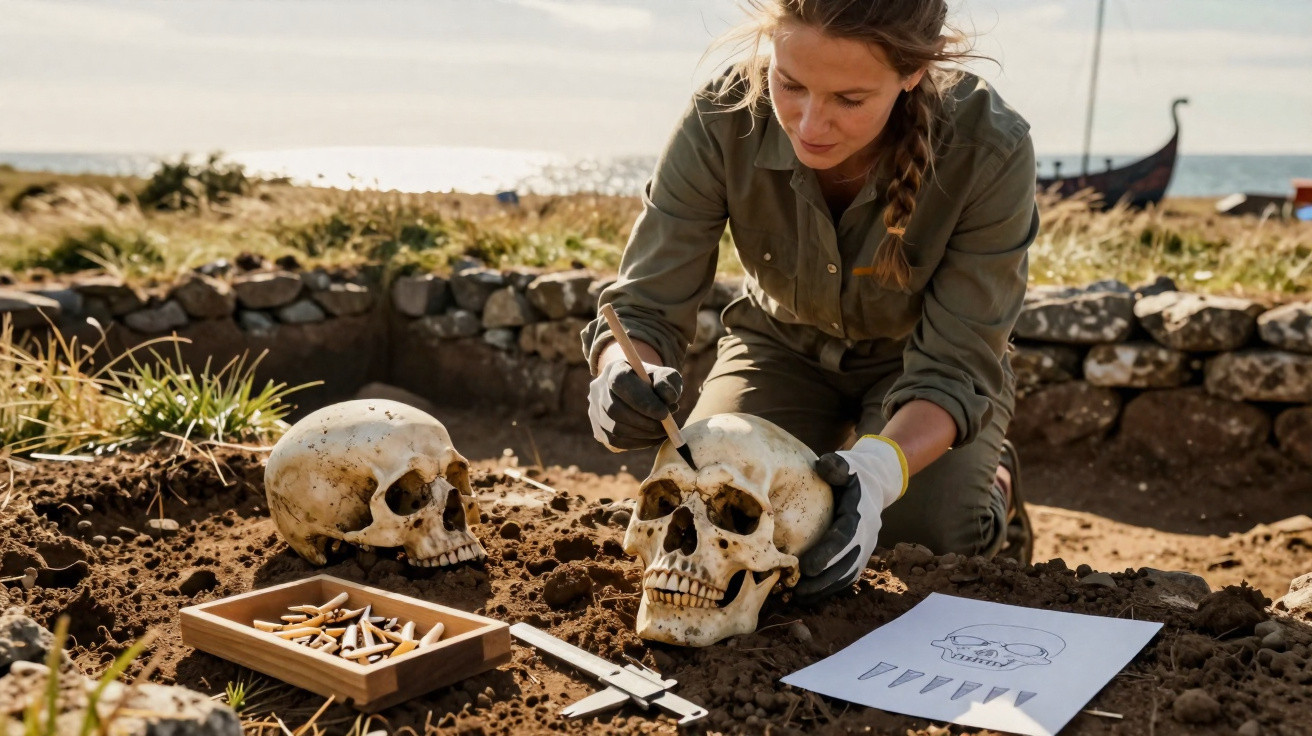
People have altered their bodies in many different ways throughout history, including through tattooing, piercing, scarring, implants and even the deliberate deformation of anatomical features. Despite how widespread these practices have been, their purpose is not always obvious. Cultural customs play an important role, as do ideals of beauty, which differ between periods and places.
A fresh study of people who lived on Viking Age Gotland roughly 1,000 years ago indicates that bodily alterations may have strengthened social identities.
Archaeologists Matthias Toplak, of the Viking Museum Haithabu, and Lukas Kerk, of the University of Münster in Germany, concluded that horizontal grooves deliberately filed into teeth may have identified a group of male merchants.
By contrast, the only known cases of deliberately reshaped and lengthened skulls connected with the Viking Age belong to three women from Gotland. The source and significance of this particular form of modification have proved difficult to establish.
"While both forms of body modification have received wide attention in other cultural contexts," the researchers write in their paper, "the specific expressions of these customs in Viking Age society still lack systematic investigation in terms of their social implications."
Tooth filing in Viking Age Gotland
Teeth and skulls have been modified in numerous ways by cultures over thousands of years. It has long been known that Vikings practised tooth modification: expertly created horizontal grooves have been identified on the teeth of Viking Age men from areas now within Sweden and Denmark. The custom appears to have continued for centuries.
Gotland has yielded the greatest concentration of remains with filed teeth. That could indicate that the practice began there, but it also makes the island a particularly valuable case study for investigating its purpose. Were filed teeth simply considered stylish by Vikings, or did they carry a more profound meaning?
Earlier research proposed that individuals with filed teeth may have belonged to a particular social group. Reviewing the bones of about 130 such men, Toplak and Kerk observed that the remains had been placed at sites associated with trade, while every person with filed teeth appears to have been an adult male.
Furthermore, all remains with filed teeth in one Gotland cemetery were located together in a single area. Many were buried face down, supporting the possibility that this was a burial ground for people from elsewhere who spent periods in the town.
"We therefore theorize that the custom of tooth filing might have been linked to trading activities of larger groups of professional merchants," they write.
"According to this theory, they might have functioned as a rite of initiation and sign of identification for a closed group of merchants, as some kind of precursor to the later guilds."
Although it may have served as an identifying characteristic for Gotland merchants, tooth filing itself was certainly not limited to that location. Differences in both the number of treated teeth and the number of grooves on each tooth suggest that the practice could have fulfilled distinct roles in different parts of Viking Age Sweden and Denmark.
Skull modification among three Gotland women
Of the three women with modified skulls, one was buried with only a small number of surviving grave goods. The other two, however, were interred with the elaborate jewellery and clothing typical of Gotland burials, implying that they were recognised and valued within their communities.
Skull modification has not previously been linked to cultures in this region. Yet earlier DNA analysis showed that one of the women came from Gotland and another from the Baltic area. As a result, the practice cannot confidently be assigned to somewhere outside Gotland, as has occurred with examples from other cemeteries.
It remains possible, however, that the Gotland woman was born elsewhere to Gotlandish parents, had her skull bound during early childhood, and later returned to Gotland. In any event, the three women appear to share some connection. They lived at approximately the same time, and their skulls seem to have been shaped using the same technique.
Because Viking communities on Gotland did not adopt these bodily modifications more widely, the researchers consider that they probably held little meaning there. They therefore infer that the procedure must have taken place somewhere beyond Gotland.
Body modification as social communication
According to the researchers, tooth filing and skull shaping illustrate two separate forms of body modification in Viking Age Gotland.
"The society of Viking Age Gotland utilized the custom of tooth filings as an internal sign system in their social communication. As a conscious and actively chosen embodiment of adults, predominantly male, we have argued that tooth filings were primarily intended for endogenous interpersonal communication – members of a certain social group could identify each other," they write.
"The skull modification, on the other hand, was imposed on the three females during their earliest childhood to express their affiliation to a certain social group. This embodiment also expressed a form of endogenous interpersonal communication, that is as communication within a larger cultural group. On Gotland, however, this sign was probably unknown to the wider society."
It is impossible to establish with certainty the purpose served by the body modifications of our distant forebears. Still, considering them through the lens of communication and community may offer the first steps towards understanding them.
The team’s research was published in Current Swedish Archaeology.






Comments
No comments yet. Be the first to comment!
Leave a Comment