
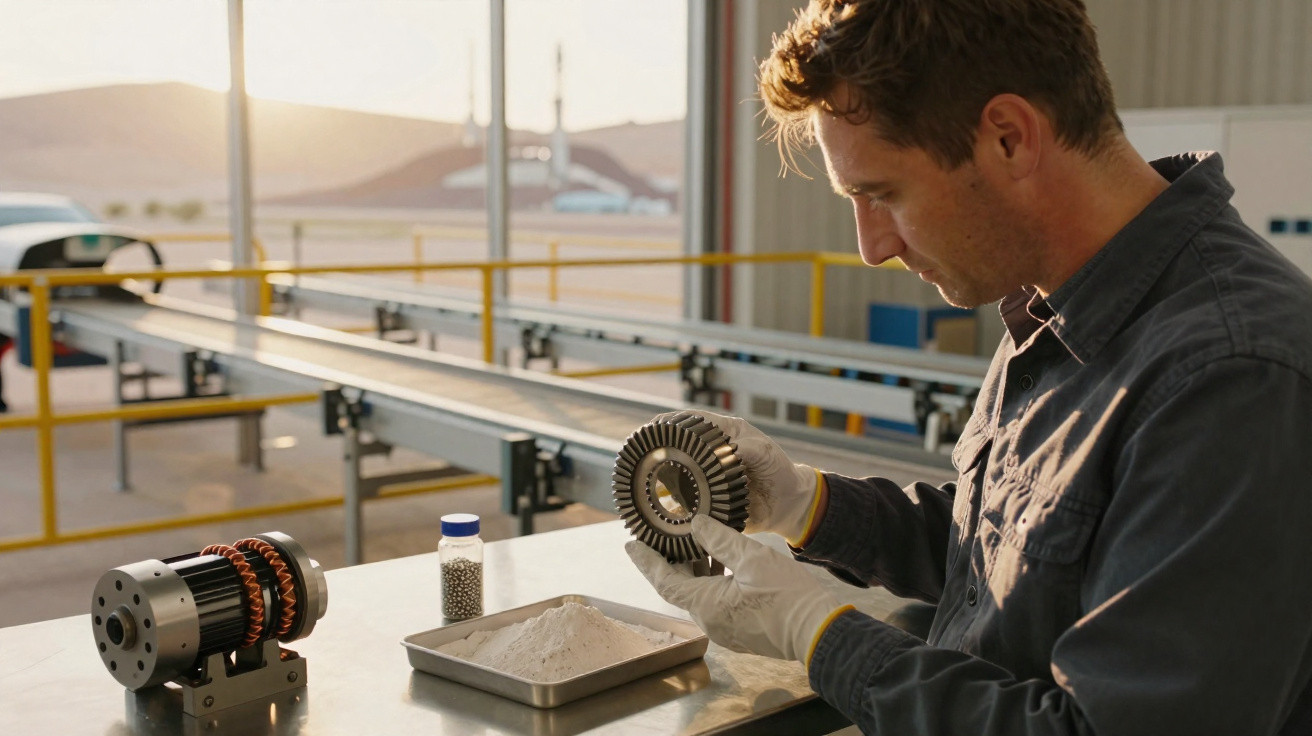
The contest is not being fought on a battlefield or in a data centre. It is unfolding in mines, refineries and magnet factories that are almost absent from US territory. At its heart is a straightforward question with far-reaching implications: can America command the rare earth elements needed to power future autonomous weapons, or will Beijing retain control of the supply?
Rare earths: the quiet backbone of autonomous power
Rare earth elements, known as REEs, are embedded in the hardware that supports artificial intelligence, autonomous vehicles and precision-guided weapons. They are used to make exceptionally powerful permanent magnets for drone motors, radar, sonar, electric vehicles and missile guidance systems.
China now controls nearly every link in this supply chain, from extracting ore to refining it into valuable magnet alloys. That dominance gives Beijing significant influence over US military preparedness and industrial capability.
In a crisis, a single Chinese export decision could stall production of US drones, missiles and electronic warfare systems.
US officials have been monitoring this vulnerability for years, but it is no longer a merely hypothetical concern. China has previously imposed export controls on other critical minerals to make political points. Rare earths may be the next tool.
The case for vertical integration inside US borders
One approach gaining support in Washington is complete vertical integration: establishing every part of the REE supply chain, from extraction to finished magnets, within the United States or among closely trusted allies.
Instead of viewing rare earths as an ordinary commodity, policymakers increasingly regard them as strategic resources, comparable with nuclear fuel or advanced semiconductors.
Vertical integration aims to remove each foreign choke point, so no single country can hold US autonomy systems hostage.
Mountain Pass as a prototype
MP Materials, owner of the Mountain Pass rare earth mine in California, has emerged as the leading test case. The company runs North America’s sole active rare earth mine and processing operation, while seeking to move well beyond the extraction of ore alone.
It is making substantial investments to establish US capacity for separating rare earth oxides and manufacturing magnets. A new Pentagon partnership is intended to speed up this expansion into downstream production.
- The US Department of Defense becomes MP’s largest shareholder
- A 10-year price floor helps de-risk massive capital spending
- The Pentagon commits to buying magnets for both defense and commercial uses
MP states that it has already invested almost $1 billion in reconstructing an end-to-end REE supply chain. Importantly, it has committed to ending shipments of concentrate to China, directing the material instead to domestic refineries and magnet factories.
Beyond mining: closing the most dangerous gaps
Although mining attracts much of the attention, the greatest vulnerabilities lie later in the supply chain. China’s lead is most pronounced in refining, separation and magnet fabrication, precisely where US capacity is most limited.
Shipping raw concentrate overseas for refining would simply swap one dependency for another, even if the ore comes from US soil.
Analysts caution that, without focused policy support, the United States may develop new mines while continuing to depend on overseas companies for the most vital stages. Such an outcome would leave important parts of the drone and missile industrial base vulnerable.
What lawmakers are being asked to do
Industry leaders and security specialists want Congress to complement its mining support with strong measures for advanced processing and magnet production. This would include long-term contracts, research funding and deeper connections with the defence sector.
| Stage of chain | Main US goal | Security risk if missed |
|---|---|---|
| Mining | Secure domestic ore supply | Reliance on foreign raw materials |
| Separation & refining | Turn ore into usable oxides and metals | Foreign control of critical processing |
| Magnet alloying & fabrication | Produce permanent magnets at scale | Choke point for drones and weapons |
| System integration | Feed magnets into autonomous platforms | Delays or cancellations of key programmes |
Some supporters call for a “Manhattan Project for magnets”, centred on co-operation between companies such as MP Materials, national laboratories and university research clusters. The objective is to surpass Chinese capabilities in high-performance magnets for stealth aircraft, space systems and autonomous undersea vehicles.
From physical materials to battlefield dominance
Having control over rare earths represents only one part of the equation. The other is how effectively the United States uses that control.
Autonomous dominance relies on converting magnets and metals into large numbers of intelligent drones, loitering munitions and adaptive sensors that can be deployed quickly. Achieving this calls for an agile development culture that the US military has often found difficult to replicate.
Ukraine’s war has shown how small teams with cheap drones and quick feedback loops can blunt heavy armour and reshape battlefields.
Ukrainian forces have made use of improvised drones, open collaboration between frontline fighters and engineers, and rapid iteration. Fresh designs can be developed, tested near the front and improved in weeks rather than years.
In contrast, US defence procurement remains shaped by slow, inflexible procedures, lengthy requirements documents and programmes lasting several years. That structure suits major platforms but not rapidly evolving autonomous systems.
A new cycle for autonomous weapons design
Defence strategists are advocating a different approach, combining vertically integrated rare earth supply with software-style agility.
A number of proposals are gathering momentum:
- Public design repositories under open, but controlled, licences where US and allied start-ups can contribute drone designs
- Modular hardware architectures so motors, sensors and software can be swapped in and out quickly
- Embedded liaison teams working directly with front-line units to test prototypes and collect real combat feedback
- Acquisition rules tailored for low-cost, rapidly updated systems instead of decade-long mega-contracts
Under this model, a secure domestic rare earth ecosystem would serve as the foundational layer, supplying motors and magnets to a flexible innovation pipeline.
Politics, risk and the charge of “corporate welfare”
The level of public backing required inevitably creates political concerns. Critics argue that supporting rare earth supply chains amounts to providing corporate subsidies to a limited number of companies.
Others fear that the widespread production of autonomous systems may promote more reckless military conduct, because the perceived human cost falls when machines do the fighting.
Supporters counter that relying on a geopolitical rival for critical components is a far more dangerous gamble.
The argument is influenced by an unusual area of bipartisan agreement. Many Democrats consider domestic REE projects part of green industrial policy, reducing pollution linked to weakly regulated overseas refineries while creating skilled employment. Many Republicans emphasise shielding the US from Beijing’s leverage and safeguarding technological sovereignty.
Key concepts behind “autonomous dominion”
Two ideas are central to this effort.
Vertical integration here describes bringing every production layer, from extracting ore to producing completed magnets, under US or close allied control. It does not mean the government must own every stage, but it does require strong incentives, assured demand and close supervision.
Autonomous dominion means being able to design, manufacture and deploy autonomous systems at scale without depending on rivals for essential components or software. It combines material independence with fast innovation and trusted supply networks.
Taken together, these concepts point to future conflicts in which fleets of US-made drones, satellites and underwater vehicles can be manufactured quickly, replaced at low cost and upgraded frequently, all supported by domestic rare earth supply.
What happens if the US fails to integrate?
Planners are concerned by several credible scenarios. One involves a crisis in the Taiwan Strait or South China Sea, followed by Chinese restrictions on exports of particular rare earths required for high-performance magnets. US drone and missile production lines could then slow markedly within months.
A second threat is less obvious: American companies may hold back from investing in advanced REE processing because government support appears unreliable. Capacity would instead expand overseas, frequently in countries more prepared to reach agreements with Beijing. The United States could retain mines, yet the economic and technological gains would be realised elsewhere.
Conversely, successful vertical integration could have effects far beyond defence. The same magnets are used in wind turbines, electric cars and medical equipment. Shared production capacity could cut costs and broaden industrial choices, although it might also intensify local environmental and planning disputes surrounding new mines and refineries.






Comments
No comments yet. Be the first to comment!
Leave a Comment