
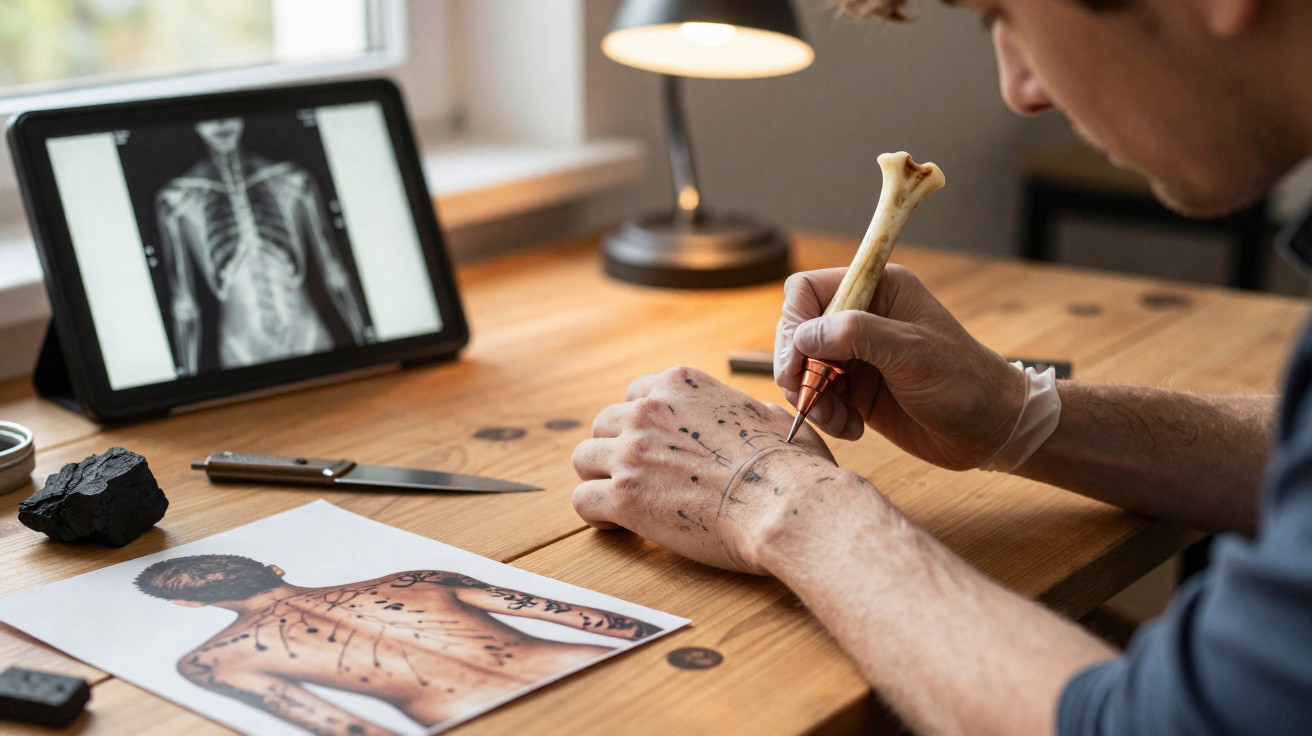
A man who died roughly 5,300 years ago appears to have been tattooed using techniques strikingly close to those used today.
Ötzi the Iceman, whose remarkably mummified body was discovered decades ago in a glacier in the Ötztal Alps, bore numerous tattoos. Careful examination of his remains has identified 61 markings made with carbon pigment across his lower back, abdomen, left wrist and lower legs.
The long-standing view is that these tattoos were created by rubbing soot into cuts in Ötzi's skin. A group of scientists and tattoo artists has now raised substantial doubts about that explanation. They produced tattoos using several techniques, allowed them to heal, and then compared the results with Ötzi's markings.
Ötzi the Iceman's tattooing methods
"One early discussion of the Iceman's marks proposed that they weren't traditional tattoos, but instead places where plant matter had been packed into incised wounds and then set on fire," archaeologist Aaron Deter-Wolf of the Tennessee Division of Archaeology told ScienceAlert.
"There's absolutely no proof of that, and over time the bit about fire got left behind, but the idea of their being incised persisted. Most of the archaeologists who have discussed Ötzi's tattoos in recent years are upfront that we don't know how they were made - but the idea still appears in just about every popular media discussion.
"I think this reflects a general perception that cutting with stone tools is the oldest form of tattooing. There's no specific archaeological data to support that idea, but there's also nothing that disproves it."
Human skin rarely withstands the damage caused by thousands of years, so it is scarcely represented in the archaeological record. Yet the surviving samples are tattooed more frequently than might be expected. Together with ancient tattooing implements uncovered by archaeologists, this evidence indicates that tattoos were probably not unusual in prehistoric periods.
Much about ancient tattooing remains uncertain. We do not know why it was carried out: it may have held spiritual importance, or perhaps our ancestors simply thought tattoos looked impressive. Researchers have suggested that Ötzi's tattoos could have been medicinal, functioning as an early form of acupuncture, but this cannot be confirmed.
What researchers can do is assess the surviving physical evidence and determine how the tattoos may have been produced.
Recreating ancient tattoo techniques
In a 2022 study, Deter-Wolf and his colleagues worked with tattoo artists Danny Riday of The Temple Tattoo in New Zealand and Maya Sialuk Jacobsen of Inuit Tattoo Traditions in Denmark. They used eight different tools and four tattooing methods to apply the same repeating motif to Riday's leg.
The tools included animal bone, obsidian, copper, boar tusk and a modern steel needle. The methods were hand-tapping, hand-poking, incision and subdermal tattooing. In the latter method, a piece of bone is pushed through the skin and out through a second puncture, placing pigment beneath the skin.
The team then recorded the healing process in detail, along with the healed scars and the changing appearance of every tattoo. This created a database that could be used in the new research to compare ancient tattoos.
"Every time a tattooing tool breaks the skin it makes a small wound, and all wounds have distinctive traits that depend on how they were created," Deter-Wolf explains.
"Puncture tattooing leaves wounds that generally mirror the profile of the tool tip, and so wounds tend to be circular. To tattoo a solid line you overlap separate punctures, which under magnification gives the edges an irregular shape.
"That's a completely different signature from incision wounds and incision tattoos, both of which have straight, clean edges where the skin was sliced by a blade. Also the ends of an incision wound are thin and tapered where uncut tissue pulls the skin back together. That doesn't happen in puncture tattooing."
Earlier research had already captured detailed images of Ötzi's tattoos. When the researchers placed Riday's tattoos alongside Ötzi's, Deter-Wolf says, they believed the comparison supported their case.
They therefore compared the markings on Riday's leg directly with those on Ötzi's desiccated skin. Riday also tattooed himself further, recreating a cluster of marks from Ötzi's skin with several methods, and those results were compared as well.
Evidence for hand-poked tattoos
The findings suggest that, unlike the accepted explanation, Ötzi's tattoos were unlikely to have been produced through incision. Instead, their physical characteristics - including stippling, line widths, rounded ends and the way ink spreads at the edges - most closely resemble hand-poking with a single-pointed implement.
"We ultimately proposed that Ötzi's tattoos were made by puncture, likely using either a bone or copper awl," Deter-Wolf tells ScienceAlert.
"Those types of artifacts appear in the archaeological record of the region, but none have ever been identified as tattooing tools. We hope this paper will inspire archaeologists to reassess how artifacts may have been used, and maybe discover actual Copper Age tattooing tools!"
The findings may also prompt a reassessment of assumptions about so-called ‘primitive’ people. Tattooing in the Chalcolithic period may not have been as crude as once believed.
The research was published in the European Journal of Archaeology.





Comments
No comments yet. Be the first to comment!
Leave a Comment