
There is a moment many of us have experienced: an official announcement arrives, stark and decisive, while real life is anything but stark or simple.
That was the scene yesterday in an uninspiring conference room, where public officials confirmed what many older people had quietly feared: pension cuts from next year. This was not a technical adjustment or a minor administrative detail, but a tangible reduction in the income that millions rely on every day.
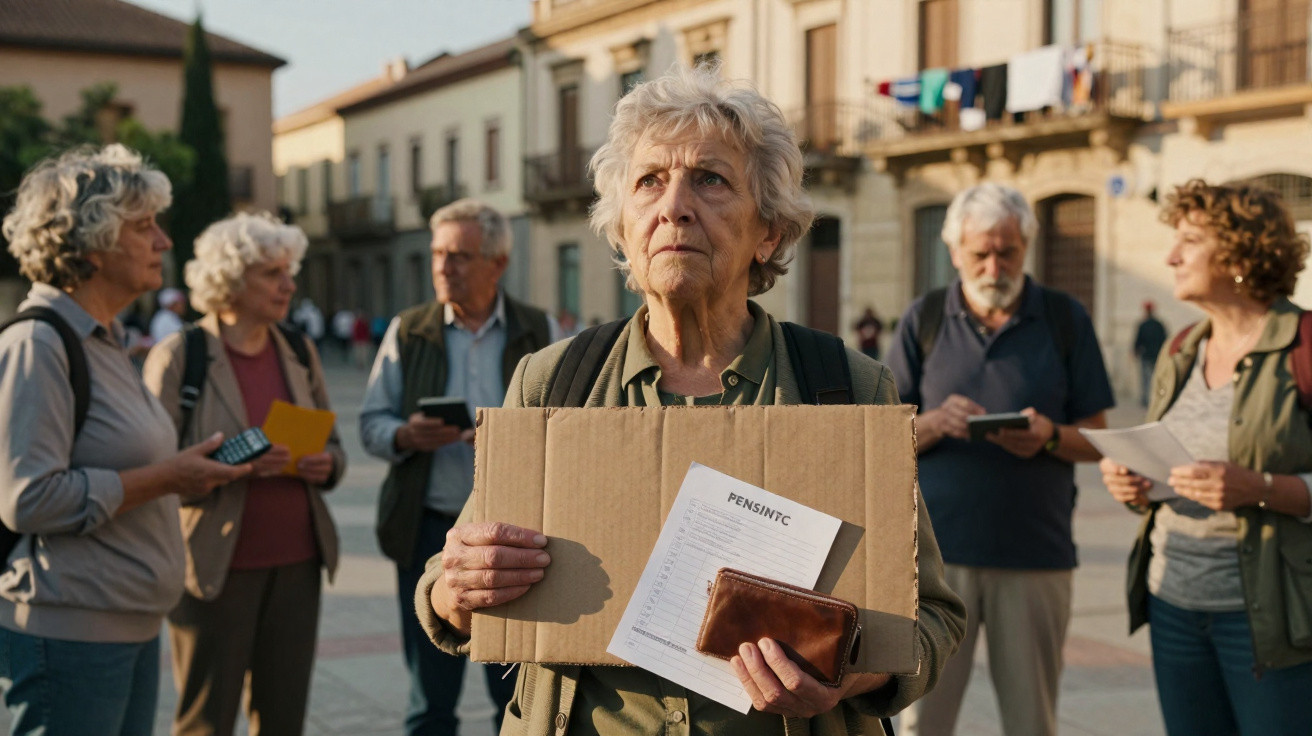
As the projections appeared on screen, the invited pensioners’ expressions hardened. One woman lifted her phone to photograph the slide, as though she needed evidence to show her children. At the back of the room, a man gripped his walking stick with clenched fists. Rain battered the windows outside. Inside, anger was building. Then something changed when the first older person stood up and said no.
“We did our part. Now they cut ours.”
The atmosphere began to unravel quietly. At first there were sighs, rolled eyes and the weary resignation so often seen in town hall meetings. Then one voice rang out: “You told us our pensions were safe.” Everyone turned towards the man: 72, a former bus driver, wearing a jacket too thin for the approaching winter. His protest was not theoretical. He was talking about his rent, his medicines and the grandchildren he looks after on Wednesdays.
People around him nodded. One woman pulled a folder stuffed with electricity bills from her bag. Another took out a notebook in which she records every expense: blue lines for food, red lines for prescriptions. The officials responded with carefully chosen terms: “sustainability”, “adjustment”, “shared effort”. Yet every PowerPoint line represented an intensely practical compromise: one fewer meal out, a “small” outing cancelled, or the heating turned down for longer.
The figures themselves are harsh, almost impersonal. Initial forecasts suggest that hundreds of thousands of pensioners will see their real pension income fall once inflation is included. Some estimate 3 %, others 5 %, depending on the country, type of scheme and private top-ups. On paper, it seems abstract, perhaps even manageable. In daily life, it is the narrow margin between paying for a dentist and delaying an appointment; between buying decent meat and choosing discounted pasta instead. Cuts do not show up in graphs; they show up in fridges and medicine cabinets.
How pensioners are quietly learning to push back
What has surprised many observers is not only the scale of next year’s proposed cuts. It is also the way pensioners are organising in response. You might expect a wave of resignation, sighs and hushed discussions in supermarket queues. What is happening is more subtle: new WhatsApp groups, improvised meetings in parish halls, and neighbours becoming spokespeople almost despite themselves.
In a small coastal town, a group of older people has set up a “budget club” in the public library. Once a week, they gather around a large table with calculators, bank statements and lukewarm coffee. One member has learned how to spot hidden bank charges. Another has compiled a list of little-known local support schemes. They swap tips, compare pensions and learn how to interpret official letters that are often left on the fridge unopened. Let us be honest: nobody really does this every day. But together, they do it once a week, and that already changes the equation.
Behind these small-scale efforts lies a simple principle: when pensions fall, individual bargaining power weakens, while collective influence can grow. Pensioner associations bring these groups together. They arrange petitions, speak to local media and prepare questions for public meetings with elected representatives. Older people are discovering that they have not only a right to endure decisions, but also a right to set conditions. Those conditions concern both their finances and their ability to speak up to decision-makers.
Practical steps when your pension is under pressure
The first step, repeated in almost every account from pensioners coping slightly better than others, is straightforward: examine your pension as a business owner would examine company accounts. Take out the statements and list every incoming and outgoing payment, line by line. Divide the year into months, and the months into weeks. It is neither pleasant nor “motivating”, but it is the only way to understand what the announced cuts will genuinely mean.
A practical method has been circulating in these “budget clubs”: write down everything non-negotiable on one side - rent, energy and healthcare - and everything that can be adjusted, even slightly, on the other. Then test scenarios based on 3 % or 5 % less pension income. This exercise, sometimes done in an ordinary spiral notebook, helps identify bills that can be renegotiated, subscriptions that can be cancelled and costs that can be shared with relatives or neighbours. It is not magic, but it makes the cuts visible before they arrive.
A common mistake is to remain alone with the figures and the shame. Shame frequently appears in personal accounts: shame about admitting that, after turning 70, you can no longer make your budget stretch. Yet those who manage a little better are often the people who dare to tell someone close to them that they are struggling. Or who walk into a welfare advice service, even after avoiding it for months. They may then find local grants, discounts and reduced-cost energy or transport schemes that never make the headlines.
Another trap is believing that everything must change at once. Many people begin with one simple action: picking up a bill and calling customer services to ask for a social tariff, instalment plan or discount. One pensioner says she gained the equivalent of half a week’s pension each month simply by renegotiating her phone and internet subscriptions with help from her grandson. Sometimes real courage is not about “carrying on”, but about recognising that you can no longer live as you did before.
At the centre of this unrest, one sentence keeps returning like a thread running through it all.
“We kept our promise to the system. Now we’re asking the system to keep its promise to us.”
It is repeated at meetings, written on improvised placards and included in letters to MPs. It captures the sense of a broken relationship, the point at which trust starts to crack. But it also conveys a calm demand: that the words of gratitude offered to “our older people” should match the very real budget decisions being made.
On a small note scribbled on the board at a community centre, someone wrote:
- Understand the real amount after inflation, not only the headline figure
- Identify pension cuts planned for next year in your country or region
- Join at least one local group for pensioners or service users
- Prepare three specific questions for an elected representative or pension provider
- Talk about money with those close to you instead of carrying the burden alone
After the announcement: what kind of old age will we accept?
When the officials left the room yesterday, silence lasted for a few seconds. Then the conversations restarted, quieter but more intense. One woman asked her neighbour exactly how much she received. A former factory worker approached a young journalist to describe his years of night shifts. It was no longer simply a matter of percentages, but an almost personal question: what kind of old age is acceptable in a society that calls itself prosperous?
These pension cuts for next year are not merely a technical argument between economists. They raise questions about how we treat the end of working life: the moment when someone shifts from being considered “productive” to being treated as a “cost” on a budget spreadsheet. They force us to confront what we accept for our parents, our neighbours and ourselves in later life. They also reveal another reality: a great many pensioners have no intention of accepting this quietly.
What is emerging in many places is a form of quiet but determined solidarity. Neighbours share a journey to an out-of-town discount supermarket. Families create rotas to help a parent sort through bills. Organisations run workshops to explain pension letters. This story is not fixed. It will unfold at the ballot box, in elected representatives’ inboxes and in market halls, where people often speak more openly than they do in television studios.
Perhaps the issue ultimately goes beyond the pension itself. It concerns dignity, a word people do not always dare to use for fear of sounding overly dramatic. The dignity of being able to heat your home in winter without mentally calculating the cost of every thermostat adjustment. The dignity of saying no, even to a form, even to an authority. And the dignity of firmly but quietly reminding people that retirement is not a favour granted, but a commitment made long ago, when these same pensioners were getting up at dawn to keep the country running.
| Key point | Detail | Why it matters to the reader |
|---|---|---|
| Scale of the cuts | A real reduction of 3 to 5 % depending on the circumstances, once inflation is taken into account | Helps you anticipate the practical effect on your monthly budget |
| Pensioners’ response | Local groups, petitions, public speaking and mutual budget support | Offers ways to avoid being isolated when announcements are made |
| Practical strategies | Detailed spending review, contract renegotiation and use of local support | Helps turn an imposed cut into a realistic action plan |
Frequently asked questions
- Will my pension definitely be cut next year? Not everybody will experience the same reduction. It depends on your country, pension scheme and whether payments are linked to inflation. Check your latest official letter or online account to see what has been announced for your individual circumstances.
- How can I find out how much less I’ll receive? Compare your current monthly payment with any forecast issued by your pension provider or government. If the figures are unclear, ring the helpline and ask for a “net monthly estimate for next year”, including any indexation or freeze.
- Is there anything I can legally do to oppose these cuts? You can join or support pensioner associations challenging reforms, sign petitions, contact your elected representatives and take part in public consultations. You may also appeal individually if you identify administrative mistakes in the way your pension has been calculated.
- What should I change first in my budget if cuts go ahead? Begin by listing essential costs - housing, utilities and healthcare - alongside non-essential spending. Look for contracts that can be renegotiated, subscriptions you no longer use and local support schemes for older people covering energy, transport or rent.
- How can I talk about this with my family without feeling like a burden? Present it as a shared planning conversation, rather than a dramatic request for help. Explain the upcoming cuts calmly, show them your figures, and ask for practical ideas or support with phone calls and paperwork instead of financial help alone.






Comments
No comments yet. Be the first to comment!
Leave a Comment