
The sonar image appears before anything else: a faint, pale shape against a black screen.
It is a rectangle far too regular to be natural rock, resting silently on the seabed off Western Australia. In the research vessel’s control room, conversation stops for several seconds. There is only the machinery’s low drone and waves tapping softly against the hull, 40 metres above a secret undisturbed for more than two centuries.
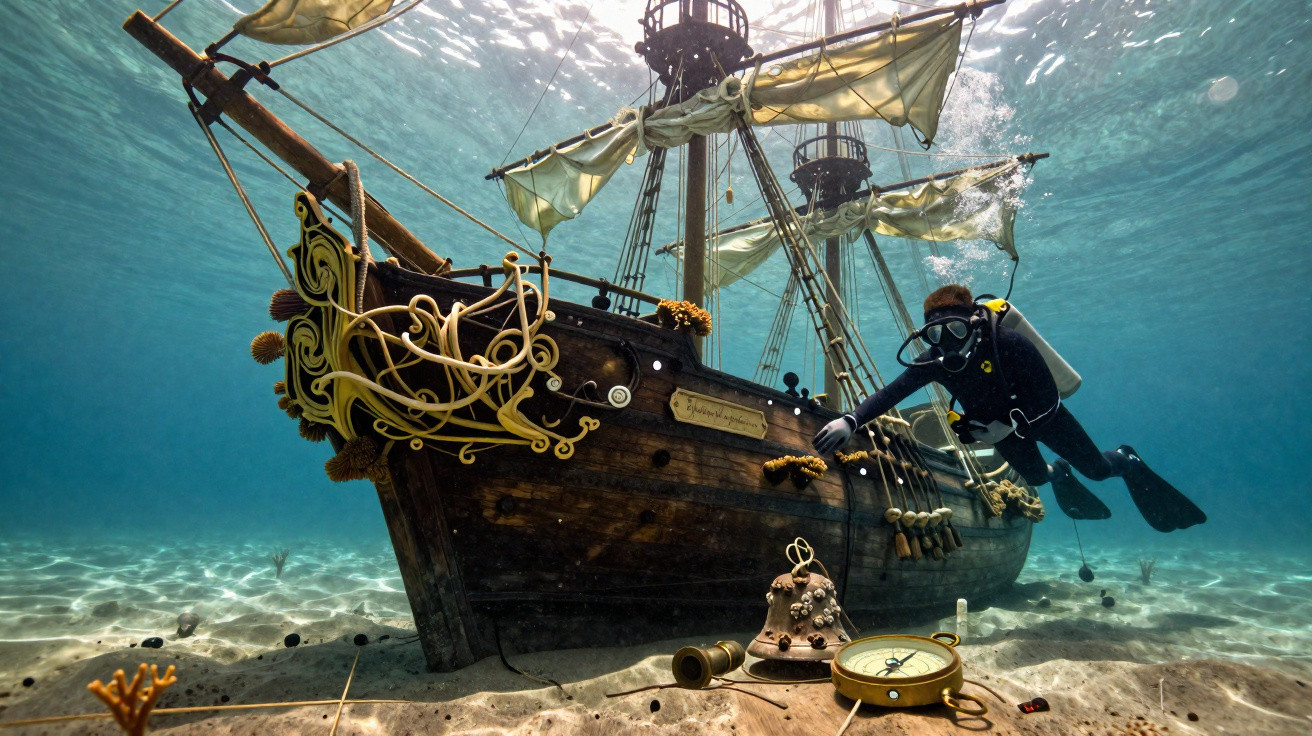
When the camera eventually descends through the blue water, outlines emerge. A bow. A rail. The sweep of a wooden hull so well preserved that it almost looks arranged for display. It is a vessel held at the instant it vanished from history, consumed by storms, saltwater and silence. Then somebody quietly says the name of an explorer who was last seen 250 years ago.
The footage continues, but everyone in the room has already travelled a long way back in time.
There is something unsettling about the ship, a detail that sends a shiver across your skin.
Frozen in time beneath the waves
The wreck rests on its side, remarkably intact, as though the sea had paused the 18th century halfway through. Its planks remain connected, iron fittings are still fixed in place, and fine stern carvings sit partly concealed beneath marine growth. In this silent world, steam power, telegraphs and photography have not yet arrived. There is only canvas, oak and the determined conviction that the uncharted spaces on maps were theirs to claim.
Divers speak of the unnerving feeling of floating above its deck. There are no bodies and no visible drama, only the orderly silhouette of a ship that departed and never returned. The wheel survives. So does the anchor. Even a lantern bracket remains, now empty but once holding the final warm glow over a cold, black sea. Every feature delivers the same message: time moved on above, but not below.
For decades, historians pursued the vessel’s trace through correspondence, faded logbooks and second-hand testimony from crew members aboard other ships. The explorer commanding it had left Britain to survey the unknown margins of the Southern Hemisphere, driven by ambition, imperial purpose and simple human curiosity. Then, somewhere near the Australian coast, the evidence ends. There was no verified wreck, no final signal, only an absence.
The sea guarded the answer. Researchers plotted possible routes, spoke with descendants and set storm records against ships’ movements. Every few years, a further search expedition headed out with improved technology, stronger modelling and larger budgets. Each returned with the same result: nothing. That changed only when a small group chose to survey an unremarkable stretch of seabed that most charts barely considered noteworthy.
They did not find a scattered mass of shattered timber. Instead, they discovered an almost whole ship, protected by cold, oxygen-poor water and mild currents. It was a time capsule covered in barnacles.
A wreck in this condition is unusual in itself. A wreck connected to a documented explorer with a known name is comparable to finding a lost series of a famous television programme. Suddenly, missing parts of the historical record can be examined through real dimensions, physical artefacts and actual marks in the timber. The cabin arrangement corresponds with surviving drawings. The hull planks reveal how seriously the builders took reefs and ice. Even the thickness of ropes, preserved on deck like rigid fossils, indicates the sails the crew were prepared to set.
For maritime archaeologists, this is more than an evocative discovery. It is evidence. Every nail, tool and plate left in the galley can address questions they have debated for years. How hard were these vessels pushed? What was traded away for greater speed or distance? What was day-to-day life truly like for crews in confined, wet darkness? The arguments are no longer merely theoretical. Their answers lie there, enclosed in salt and silt.
How the lost explorer’s ship becomes a living story
After the “ghost ship” had been confirmed, astonishment gave way to painstaking procedure. The research team began with an exacting 3D survey, moving cameras gradually across every part of the wreck and combining hundreds of thousands of images to create a virtual duplicate. This digital version enables historians to examine the decks without laying a hand on a single plank. They can enlarge nail holes, assess the angle of mast remnants and measure the hull’s lean where it struck the seafloor.
One straightforward principle shapes every choice: interfere as little as possible. The ocean has proved an unexpectedly capable curator. Rather than lifting everything at once, the team approaches the wreck as if it were a delicate library. One core sample from here. One tool from there. One carefully raised chest whose contents may still be inside, protected from oxygen ever since the year of the sinking.
The following stage is less dramatic but demands greater patience: verification. Artefacts are examined beneath microscopes, placed in CT scanners and subjected to chemical testing. Wood fibres identify the timber used by shipyards. Fragments of paint reveal colours erased by the sea. Even material removed from a plate can hint at the crew’s final meal.
Then comes the gradual process of connecting the finds with written sources. A London letter may refer to a repair by the carpenter. A colonial archive entry may note a postponed sailing. A barely readable note in the margin of a logbook might suddenly correspond with a fracture in the stern or a replacement beam. It is detective work delayed by 250 years, with the wreck acting as the final witness.
At a human scale, the account becomes more personal. A pipe bowl indicates the place where someone preferred to stand. A spoon bent at its handle suggests an impatient grip. It is easy to imagine the dullness of long watches, the stench below deck and the coarse jokes exchanged by men who knew dry land might remain months away.
Beneath the romance lies a difficult question: whose history is this ship actually recounting? The explorer’s name appears in headlines, funding applications and statues in old urban squares. Yet the people who hauled ropes, scrubbed decks, died from scurvy or disappeared in the storm are often unnamed. The wreck presents an unusual opportunity to correct that imbalance.
Archaeologists can investigate how rank divided the crew, where hammocks were suspended and which tools received the heaviest use. They can establish whether trade goods, weapons or scientific equipment were given priority aboard. The use of space on a vessel reveals much about whose life was valued on board. It also brings uncomfortable realities of empire into view: “exploration” commonly accompanied conquest, charting coastlines for colonial convenience while disregarding the people who already lived there.
Let us be honest: hardly anyone sits down every day to calmly reconsider the stories of glory learned at school. Yet a silent wreck can compel that reflection in a way textbooks seldom achieve.
Why a dead ship feels so strangely alive
If you are asking what this has to do with you, imagine the first time you entered a grandparent’s loft. There is dust, ageing boxes and the scent of paper and fabric; then you find an object belonging to a version of them you never knew. This ship is that loft on an immense scale. Its timbers hold not just one individual’s history, but a network of lives extending across oceans.
For present-day readers, the real wonder lies in how physical the past becomes. Rather than dates on a timeline, there is a particular mug with a chipped edge beside the spot where a bunk once hung. Rather than the statement that “crew conditions were harsh”, you can see the actual low ceiling, the stale lower deck and the narrow gap between hope and catastrophe. It is not an abstraction. It is a space your body can imagine inhabiting.
There is a digital benefit as well. Detailed models and VR reconstructions mean that people will not need to dive through cold green water to explore the site. Museums are already discussing how to turn the scans into interactive visits. Before long, you may be able to “walk” beside the rail using a browser or headset, stopping where the explorer once stood and looking out at the same boundless blue. Such immersion remains in the memory far longer than a schoolbook paragraph.
Teachers see an opportunity in the discovery. One ship can support lessons on climate, navigation, colonialism and even nutrition. Why were so many barrels carried? How was latitude calculated before GPS? Why did meetings with coastal communities become so fraught? Every space on board, from the captain’s cabin to the galley, prompts questions linking 18th-century decisions with 21st-century realities.
At an instinctive level, the wreck touches a fear we rarely voice: that our own lives could disappear without leaving a meaningful trace. These timbers survived 250 years of saltwater, storms and darkness, yet have suddenly become central to a global discussion. The idea that your most ordinary belongings might one day become another person’s urgent mystery alters the way you view your own everyday clutter.
“The sea has been quietly keeping our secrets,” one marine archaeologist said on deck, staring at the live feed. “This time, it chose to return one of them.”
For communities along Australia’s coast, however, the find has a different significance. Some Indigenous elders refer to long-held accounts of unfamiliar vessels and early encounters that were not minor footnotes but decisive events. The wreck places those narratives alongside European archives, requiring researchers to respect both without reducing either.
There is increasing support for managing discoveries like this through shared guardianship. Rather than allowing one country to claim the wreck entirely, discussions focus on who was affected by the voyage, whose waters hold it and whose ancestors saw its sails appear on the horizon. The ethics are as complex as the ship’s rigging once was.
- Respecting the wreck as a probable grave site
- Collaboration between Indigenous groups and historians
- Strict decisions about what is recovered and what remains beneath the water
On a more individual level, that emotional perspective changes the way the rest of us click, share and speak about stories of this kind. The reaction becomes more than “wow, cool ship”; it becomes “what does this reveal about how we remember, and who is remembered?”
What this “time capsule” asks of us now
From the research vessel’s deck, while the spectral hull slowly turns across a monitor, it is possible to feel two eras pressing together. Above the water are satellite internet, immediate news notifications and coffee in paper cups. Below are an unfinished journey, dreams made of canvas and the quiet ending of a hundred small routines. The instant the cameras detected that shape on the seabed, the two periods began to share one story.
Most of us have experienced an old object affecting us more deeply than any history lesson could. It may be a handwritten recipe, a soldier’s postcard or a childhood toy found in a removal box. This ship magnifies that feeling across an ocean. It asks what from today will still exist in 250 years, and what will disappear within months, consumed not by waves but by failed hard drives and closed servers.
Maybe that is the real sting of this discovery: what lasts is not necessarily what we intended to preserve. The explorer sailed out to redraw maps; centuries later, strangers study his plates and floorboards. Future researchers may do the same with our flats, smartphones and abandoned cloud backups. For now, a wooden hull off the Australian coast has emerged from obscurity as a mirror. It reflects not the heroic tales we prefer to repeat, but the fragile, untidy way human lives meet time and, sometimes, the deep.
| Key point | Detail | Why it matters to the reader |
|---|---|---|
| Perfectly preserved wreck | An 18th-century explorer’s ship was found intact off Western Australia | Provides a vivid, almost cinematic view of a lost age |
| Time capsule of everyday life | Tools, cabins and the vessel’s layout show how crews really lived and worked | Makes abstract history tangible and relatable |
| Ethical and emotional questions | Debates concern memory, empire and who “owns” the past | Encourages readers to consider legacy, identity and their own traces |
FAQ:
- Was the explorer’s ship really identified with certainty? Researchers used 3D scans, historical plans, cargo records and timber analysis, reaching a high degree of confidence that the wreck corresponds to the documented vessel.
- How can a wooden ship remain so well preserved for 250 years? The depth, low oxygen conditions and fairly gentle currents off the Australian coast slowed deterioration and shielded the hull from storms and shipworms.
- Will objects from the wreck be taken to museums? Some artefacts will probably be recovered for research and exhibition, but most of the structure will stay underwater to respect the site and prevent rapid decay when exposed to air.
- Can the public “visit” the wreck in some way? High-resolution digital scans are being developed into virtual tours, enabling people to explore the decks online or in VR without disturbing the location.
- Why is this particular discovery so important? It connects a well-documented expedition to a nearly intact ship, allowing historians, communities and visitors to build a fuller, more nuanced account of exploration and its consequences.



Comments
No comments yet. Be the first to comment!
Leave a Comment