
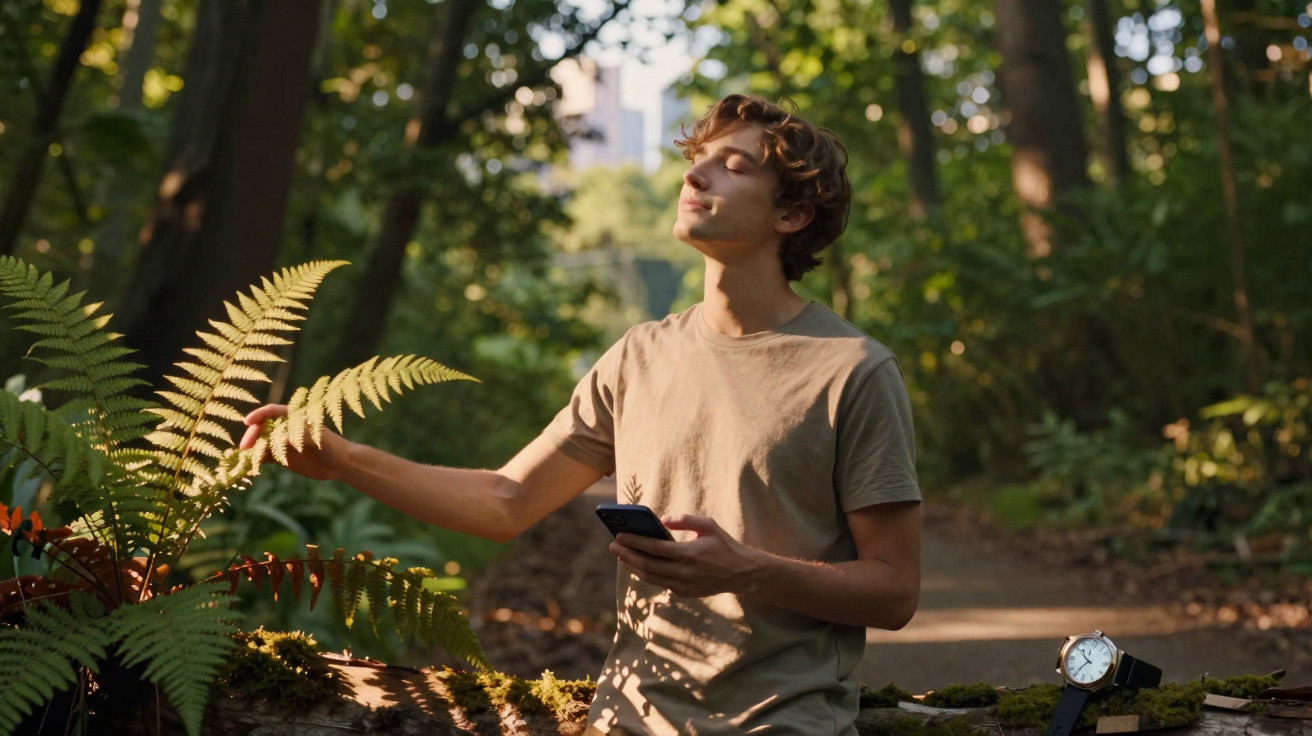
Nature and our sense of time
Do you sometimes feel there are simply too few hours in the day? Time can seem to speed past, leaving no way to fit everything in. Yet when you leave for the countryside, everything may suddenly feel calmer and slower, as though time itself has shifted.
You are not imagining it: recent research indicates that nature can influence how we perceive time.
For many people, the competing pressures of work, home and family create a constant sense of not having enough time. Digital technology has intensified this time poverty, too. Being permanently connected can lengthen the working day and make it harder to disengage from the expectations of friends and family.
Recent findings suggest that the natural world may offer an antidote to this lack of time. Richardo Correia, a psychologist at the University of Turku in Finland, found that being in nature could alter our experience of time and perhaps even create a feeling of time abundance.
Correia reviewed research comparing people's experiences of time while completing different tasks in urban and natural settings. Across these studies, participants consistently described time as feeling more expansive in nature than in urban surroundings.
For instance, people are more likely to judge a countryside walk as longer than an equally long walk through a city. Likewise, they report that time passes more slowly when carrying out tasks in natural green spaces rather than urban environments. Nature appears to slow down and broaden our perception of time.
The natural world seems to affect more than our immediate experience of time; it may also influence how we view the past and future. Earlier research shows that time spent in nature can move our attention beyond the present moment and towards future needs. Instead of concentrating on the stress created by time demands, nature may help us take a wider view.
This broader perspective can make it easier to rank our priorities and pursue long-term goals, rather than existing in a continual state of "just about keeping our head above water".
Part of the reason may be that nature appears to reduce impulsiveness, helping us postpone immediate gratification in favour of longer-term rewards.
Why does nature affect our sense of time?
Time in nature is already known to offer many health and wellbeing benefits. Access to natural places, including beaches, parks and woodlands, is linked with lower anxiety and depression, better sleep, reduced obesity and cardiovascular disease, and improved wellbeing.
Several of these benefits could help explain why nature changes our experience of time.
Our internal biological condition and the events unfolding around us shape the way we experience time. Consequently, feelings such as stress, anxiety and fear can alter our perception of time passing.
Natural environments can have a calming effect that counteracts stress and anxiety, leading to a more consistent experience of time. The lack of access to nature during COVID-19 may, in fact, partly explain why people's perception of time became so distorted during pandemic lockdowns.
In the short term, stepping away from the pressures of modern life may provide the breathing space needed to reconsider priorities and ease time pressure by concentrating on what truly needs doing. Over the longer term, time in nature may improve memory and attention capacity, leaving us better equipped to manage the demands on our time.
Accessing nature
Going out into nature may seem an easy solution, but it can be difficult for many people to do, especially those in urban areas. Green infrastructure in and around towns and cities-including trees, woodlands, parks and allotments-is vital for ensuring that everyone can access the benefits of time in nature.
Regaining control of your time
If spending time in nature is not possible, other approaches can help you take back control of your time. Begin by looking carefully at how you spend time across a typical week. A time audit can reveal where time is being lost and highlight actions that could create more time in your life.
You could instead set boundaries around how you use your time. This might mean restricting when you check emails and social media, or scheduling time in your calendar for a break. Taking charge of your time and the way you use it can help you overcome the feeling that time is slipping away.
Ruth Ogden, Professor of the Psychology of Time, Liverpool John Moores University and Jessica Thompson, PhD candidate in Environment and wellbeing, University of Salford
This article is republished from The Conversation under a Creative Commons licence. Read the original article.






Comments
No comments yet. Be the first to comment!
Leave a Comment