
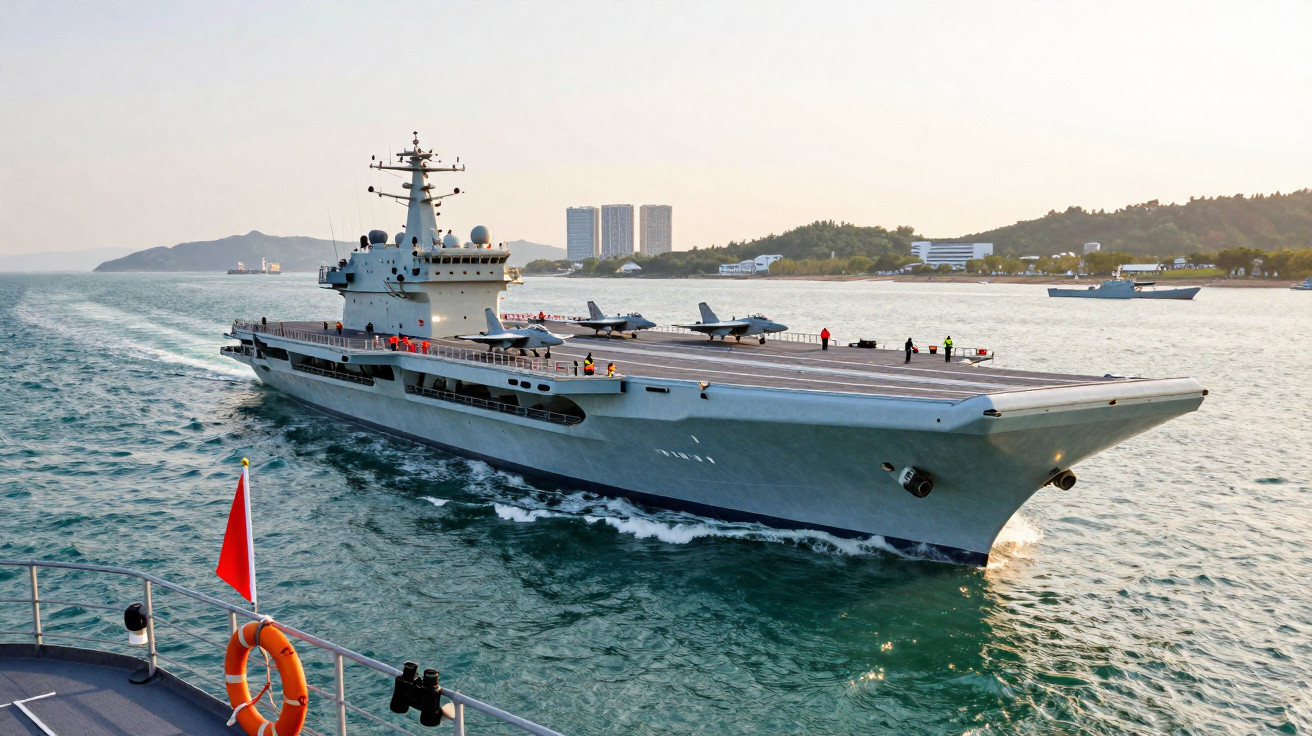
China’s newest aircraft carrier has discreetly passed through one of the world’s most fraught waterways, prompting renewed questions over power, security and timing in East Asia.
The Fujian’s journey through the Taiwan Strait was officially described as a routine test. Yet it comes as competition intensifies between Beijing, Washington and their regional partners, suggesting that China’s largest warship is moving nearer to full operational service.
A new giant enters a crowded sea
China said on Friday that the Fujian, its most advanced aircraft carrier so far, had recently crossed the Taiwan Strait en route to the South China Sea for sea trials and training tasks.
Captain Leng Guowei, a naval spokesman, said the vessel was undertaking “scientific research tests” and cross-regional training. He maintained that the voyage was a standard stage of carrier development and was not directed at any particular country.
The Fujian’s first long-distance voyage signals that China’s third carrier is shifting from shipyard showpiece to active power projection tool.
The Taiwan Strait, the narrow stretch of water between mainland China and self-governed Taiwan, is among the world’s most sensitive flashpoints. Movements through it by major warships are closely watched not only in Taipei and Beijing, but also in Washington, Tokyo and elsewhere.
Taipei watches and “responds accordingly”
Taiwan’s defence authorities said they tracked the Fujian and its accompanying vessels through a combination of naval ships, aircraft and land-based systems.
Taipei said it had sought “full awareness of the situation” and had “responded accordingly”, without disclosing whether it had taken countermeasures or carried out shadowing operations.
Beijing considers Taiwan a breakaway province that must ultimately be brought under its control, and it has not excluded the use of force. The island, which maintains its own democratic government and military, rejects Beijing’s claim of sovereignty.
Every military transit in the Strait has a political message, even when described as routine training.
In recent years, China has increased air and naval operations around Taiwan, including large exercises that simulate blockades and precision strikes. Such activity is intended both to demonstrate resolve and to place pressure on Taiwan’s smaller armed forces.
Japan spots the Fujian near disputed islands
Japan’s Defence Ministry said its forces observed the Fujian on Thursday with two destroyers, about 200 kilometres north-west of the Senkaku Islands.
The uninhabited islands, called the Diaoyu in China, are administered by Tokyo but claimed by Beijing, making them another point of tension between the two Asian powers.
Japan’s navy followed the carrier group as it travelled south-west, adding to the impression that the ship is starting to operate more freely in disputed waters instead of remaining close to China’s coastline.
China’s carrier fleet grows in ambition
Before the Fujian, China had two aircraft carriers in active service:
- Liaoning – a former Soviet hull purchased from Ukraine in 2000 and refitted, mainly used for training and experimentation.
- Shandong – China’s first domestically constructed carrier, commissioned in 2019, which has participated in exercises around Taiwan, including a simulated blockade this spring.
Both vessels rely on older ski-jump launch systems, restricting the weight and fuel aircraft can carry when taking off. The Fujian alters that calculation.
Why the Fujian stands out
The conventionally powered Fujian is expected to carry up to 50 aircraft, including fighter jets, early-warning aircraft and helicopters.
Analysts at Washington’s Center for Strategic and International Studies say the carrier will employ an advanced catapult system, probably electromagnetic, comparable in concept to that used on the US Navy’s latest Ford-class carriers.
More powerful catapults allow aircraft to launch with heavier weapons loads and more fuel, extending their range and punch.
That technical improvement could significantly change the distance Chinese carrier-based aircraft can operate from the ship and the amount of firepower they can carry, particularly during a conflict spanning the western Pacific.
| Carrier | Origin | Launch system | Role |
|---|---|---|---|
| Liaoning | Ex-Soviet, refitted in China | Ski-jump | Training, basic carrier ops |
| Shandong | China-built | Ski-jump | Regional deterrence, Taiwan drills |
| Fujian | China-built | Advanced catapults (expected) | Power projection, long-range operations |
A ship named after a frontline province
The Fujian is named after the Chinese coastal province directly facing Taiwan, a symbolic decision that has drawn attention in both Taipei and Washington.
It is also the biggest warship China has ever constructed, highlighting the progress of the country’s shipbuilding industry over two decades.
The carrier began its first sea trials in 2024. Every trial stage examines propulsion, navigation, combat systems and aircraft-launch procedures, and may expose faults requiring extensive repairs in port.
Beijing describes its carrier programme as defensive and says its aims are peaceful, centred on protecting “national sovereignty” and sea lanes. However, the Fujian provides China with a more credible means of operating farther from home, from the Indian Ocean to the central Pacific.
A deliberate mystery around commissioning
China has not stated when the Fujian will formally enter full service. Military specialists believe the date may be selected for political symbolism, potentially linked to an important national anniversary.
Writing in state-linked media, Chinese military commentator Zhang Junshe said the ship’s first lengthy voyage indicates that commissioning is drawing closer, although substantial training and refinement remain necessary.
Achieving genuine combat readiness for a carrier takes time. Its air wing must master deck procedures, logistical chains must be tested, and escort vessels need to practise together in varying weather and threat environments.
What this means for the balance of power
The Fujian’s development is part of the wider contest between China and the US-led alliance network in the Asia-Pacific. US aircraft carriers have long stood as the region’s leading symbol of military power.
China’s growing carrier fleet creates further challenges for planners in Washington, Tokyo, Canberra and New Delhi, who now include Chinese carrier groups in war games and crisis planning.
A third carrier gives Beijing more options: simultaneous operations near Taiwan, in the South China Sea and in the western Pacific.
During a Taiwan crisis, a fully operational Fujian could support air operations to the east of the island, making it more difficult for the US and its allies to reinforce Taiwanese defences or break a blockade.
Key terms that shape the debate
Two concepts frequently feature in discussions of the Fujian and the Taiwan Strait:
- Deterrence – the capacity to persuade an adversary that beginning a conflict would be prohibitively costly. On paper, a larger and more capable carrier fleet increases China’s deterrence, but it may also unsettle neighbouring states and encourage them to rearm.
- Anti-access/area denial (A2/AD) – strategies intended to keep opposing forces, especially US carriers and aircraft, at range by using missiles, submarines and air defences. The Fujian forms part of China’s response to US maritime power, while US planners also consider how it could be targeted in a crisis.
Some analysts contend that, as China acquires prominent assets such as the Fujian, those platforms may themselves become attractive targets. In a conflict, both sides could feel compelled to strike first before the other is able to use such vessels decisively.
Risks and scenarios ahead
The Fujian’s Taiwan Strait transit did not lead to immediate escalation, but every new voyage brings risks. A wrongly interpreted radar signal, an assertive fighter-jet interception or a collision at sea could set off a chain of accusations and military alerts.
Governments across the region are investing in crisis hotlines, communications protocols and joint exercises to reduce those risks. At the same time, the capabilities on display – from hypersonic missiles to advanced carriers – increase the stakes whenever naval forces operate near one another.
For now, the Fujian is still in its testing phase. However, its passage through the Taiwan Strait has already conveyed a clear message: China’s blue-water ambitions are no longer theoretical, and the strategic chessboard around Taiwan is becoming increasingly crowded and finely balanced with every passing month.






Comments
No comments yet. Be the first to comment!
Leave a Comment