
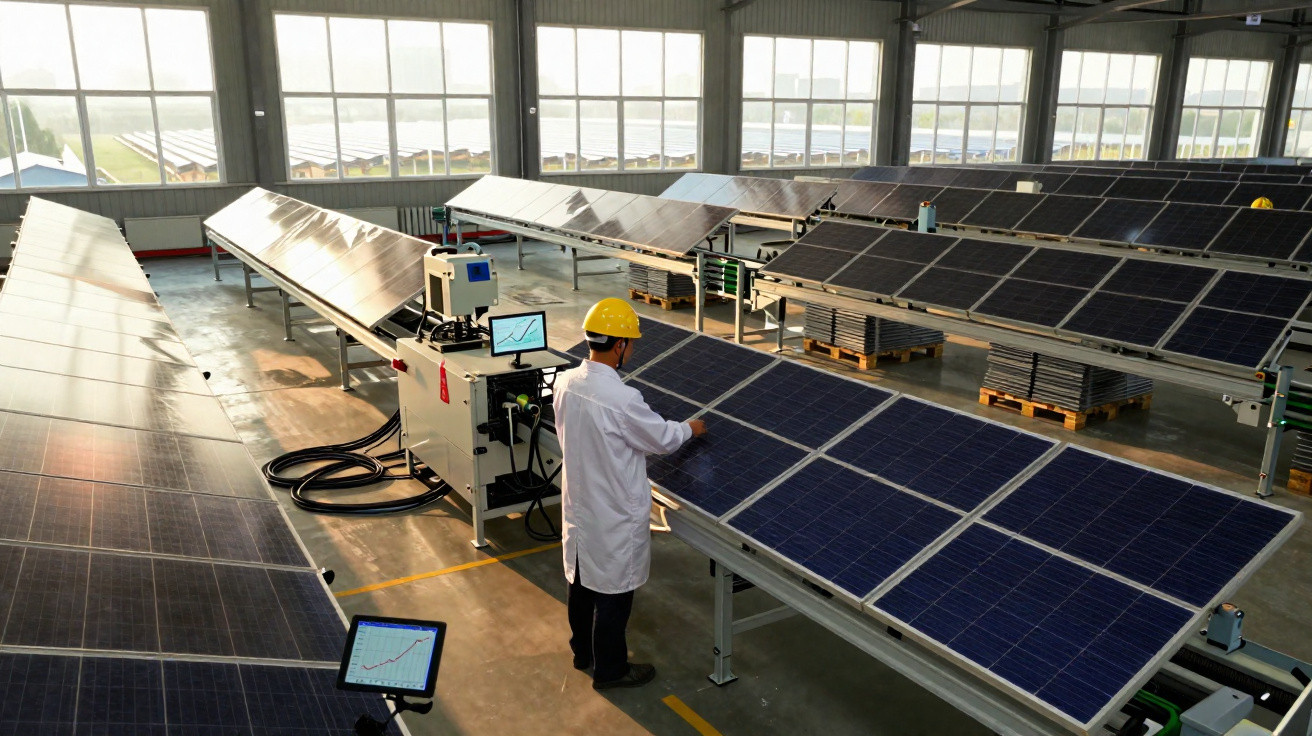
The very panels that once powered China’s global solar surge are now stacking up in warehouses, while prices plunge and Beijing discreetly tells manufacturers to cut output or halt production lines. The country that saturated world markets with solar equipment is applying the brakes before the sector breaks apart. What follows could alter the course of clean energy from Shanghai to Sacramento.
On a smoggy morning in Jiangsu province, the solar boom hardly resembles a miracle. It is visible in the weary workers filing out of a factory where the lights remain on but the orders have disappeared. In the yard, lorries stand unused, filled with panels nobody is rushing to pick up. A manager refreshes prices on his phone as spot rates edge lower week after week, with margins disappearing screen by screen. This is the shadow cast by a success that expanded too far and too quickly. Between climate goals and uncompromising industrial policy, something has given way.
The boom that became a solar glut
Visit any significant solar manufacturing centre in China and the problem is unmistakable: there are simply more panels than the market needs. For ten years, Beijing channelled subsidies, low-cost lending and political backing into creating the world’s biggest solar manufacturing system. It succeeded almost excessively well. Vast plants opened one after another, each claiming to be more efficient, automated and formidable than the previous one. They were all pursuing the same aim: to command global solar as China had come to command steel and smartphones.
The figures make the point more clearly than any catchphrase. By 2024, Chinese firms could manufacture vastly more solar modules than the world could install over a year. In around eighteen months, module prices dropped by more than half, reaching levels that would have appeared ridiculous only a few years earlier. That is excellent news for panel buyers, but punishing for manufacturers. Export volumes climbed, yet unsold stockpiles grew too, particularly in Europe, where ports and warehouses have quietly become storage sites for solar panels. It is rather like a party where the music continues, even though half the people there are already heading for the door.
Economists call this overcapacity; for those working on production lines, it feels more like standing at the edge of a precipice. When every company expands simultaneously, none wants to be the first to stop. Chinese local authorities often supported additional factories because growth statistics mattered, even after the market had become oversupplied. Beijing is now confronting the cost of its own achievement: an industry that dominates internationally but is also perilously vulnerable. The government is therefore considering stricter requirements, limits on new schemes and discreet pressure on smaller or less sophisticated plants to close. The goal remains the same, but the pace is changing.
How China is seeking to prevent a solar crash
The approach appears simple enough: remove the weakest plants from the market and compel those left to mature. Policy papers refer to “orderly” development and “high-quality” capacity. In reality, this brings fresh licensing conditions, tighter efficiency standards and lending that no longer reaches every ambitious start-up with a wafer line and presentation deck. Firms with outdated technology, heavy energy consumption or inflated cost structures are at risk. The signal is unmistakable: become genuinely world-class or cease to exist.
For overseas purchasers, this is where matters become more complicated. The exceptionally low prices of Chinese panels were no accident; they resulted from this industrial race for scale. Developers across Europe, Africa and Latin America built entire solar programmes around the assumption that modules would remain extraordinarily inexpensive. They are now observing Chinese manufacturers consolidate, trade disputes intensify and import restrictions become tighter. Some worry that prices will gradually rise once weaker factories have shut, or that supplies will become more politically charged. On a human level, it is difficult not to sympathise with workers who helped drive a worldwide green wave and may now be left behind by it.
For Beijing, reducing output is less an act of generosity than one of self-preservation. A price war left unchecked can destroy even the strongest competitor. A solar panel is more than a product; it is industrial strategy fixed to a roof. China still intends to set both the speed and direction of the worldwide energy transition, from polysilicon through to advanced back-contact cells. Closing or combining factories offers a means of retaining that influence while avoiding a dramatic collapse that could give greater leverage to competing producers in the US, India or Europe. It is a high-stakes bet, but allowing the market to dismantle itself would be worse.
What China’s solar glut means for the rest of the world
For policymakers and energy buyers beyond China, this disruption carries a quiet warning: do not base the future of clean energy on one intensely concentrated supply chain. A practical first move is to trace the true origin of panels - not merely the label on them, but also the locations where their wafers and cells were produced. Once that picture is clear, governments and major buyers can diversify their contracts over time by combining Chinese supply with regional production, long-term purchasing agreements and smaller specialist providers. It is comparable to avoiding the decision to put an entire pension fund into a single share, however unstoppable that share may seem.
Households and small firms need a different change in perspective. Many postpone fitting solar panels because they expect prices to decline still further. China’s industry shake-up suggests that reasoning could quickly become outdated. Delaying for another year to save a few pence per watt may prove costly if trade rules become stricter or subsidies are revised. Let us be honest: nobody really spends every day tracking panel prices for hours like a trader. Eventually, securing a sound offer from a reliable installer is more valuable than pursuing the absolute lowest price. This is especially true when the real objective is a smaller electricity bill and greater independence, rather than victory in a contest of price timing.
Competitors around the world are also attempting to interpret this moment. Officials in Brussels, Washington and New Delhi regard China’s overcapacity as both a danger and an opportunity. Some are increasing tariffs or introducing subsidy programmes to shield domestic factories; others continue buying inexpensive Chinese modules quietly because they help deliver national climate targets more quickly. One European developer put it bluntly:
“Without China’s flood of panels, half our solar projects would still be PowerPoints.”
That conflict is not about to disappear. It will influence both the pace and the fairness of the energy transition.
- China’s solar glut holds prices down, while also making global supply less stable.
- Factory closures in China may increase prices or make deliveries more uncertain.
- Manufacturing incentives elsewhere can reduce exposure to risk, but will need years to reach scale.
The fragile future of a world of cheap solar
There is a striking irony at the centre of this story. The overcapacity burdening Chinese producers has also been vital to climate policy. Extremely cheap panels made solar the standard choice in numerous markets, including those with difficult politics or deeply embedded fossil fuels. Should Beijing succeed in bringing order to the disruption by cutting factory numbers and moving prices towards a more sustainable level, the world may need to confront what clean energy truly costs when it is no longer cross-subsidised by one industrial superpower. That does not end the transition, but it does make it more mature and perhaps a little less idealistic.
At an individual level, the solar glut also reflects something back at us. We are attracted to the promise of green technology becoming endlessly cheaper, quicker and lighter, without compromise. Then reality arrives in the form of warehouse workers, trade disputes, former industrial sites and communities asking what will happen once the boom has faded. We have all experienced the moment when a promise that seemed too good eventually reveals its limits. The panels on a neighbour’s roof reveal nothing about the night shift in Anhui or the Shenzhen bank meeting where a loan is quietly withdrawn. Nevertheless, every one of those events is built into the price stated in the quote you receive.
Perhaps that is the uncomfortable but necessary idea to consider. The era of “China will make it cheap, forever” is becoming unsteady. It is not ending, but it is wobbling. Countries that depended on that assumption will need to revisit their strategies. Investors will have to account for policy risk as well as hours of sunshine. Homeowners will consider not just the price per watt, but also where and how their panels were manufactured. Solar’s future remains bright, but the route towards it is less seamless than the marketing implies.
| Key point | Detail | Why it matters to the reader |
|---|---|---|
| China’s solar overcapacity | Factories can produce far more panels than the world installs each year | It helps explain the price collapse - and why it may not continue |
| Planned factory closures | Beijing is encouraging weaker or outdated plants to close or merge | This indicates a turning point that could affect worldwide panel prices and availability |
| Need to diversify supply | Governments and buyers are considering non-Chinese sources and domestic manufacturing | This provides ways to reduce reliance on a single country for essential green technology |
FAQ:
- Why did China build so much solar capacity in the first place? Beijing regarded solar as a strategic sector: a means to reduce pollution, achieve global technological leadership and create employment. Generous subsidies, inexpensive land and readily available credit encouraged businesses to expand aggressively, even when demand did not fully support it.
- Does the glut of Chinese panels mean solar will stay cheap forever? Not necessarily. Prices are exceptionally low at present because competition is fierce and supply exceeds demand. If weaker plants close and trade restrictions tighten, costs could settle or rise slightly, especially in markets imposing tariffs.
- Should homeowners rush to install solar before prices change? For many households, waiting for panels to become marginally less expensive is less helpful than securing lower energy bills sooner. Where there is a strong quotation from a reputable installer and stable incentives, moving ahead often makes more sense than trying to find the perfect moment.
- How are other countries responding to China’s dominance? Areas including the US, EU and India are providing subsidies, tax credits and trade protection to establish their own solar factories. These initiatives require time, however, so Chinese panels remain dominant in the short term.
- Is this crisis bad for global climate goals? It has two sides. The current glut has made clean electricity cheaper and faster to deploy. If China cuts capacity too severely, or if trade tensions worsen, some projects may slow down. Over a longer period, a more balanced and resilient supply chain could make the transition stronger.






Comments
No comments yet. Be the first to comment!
Leave a Comment