
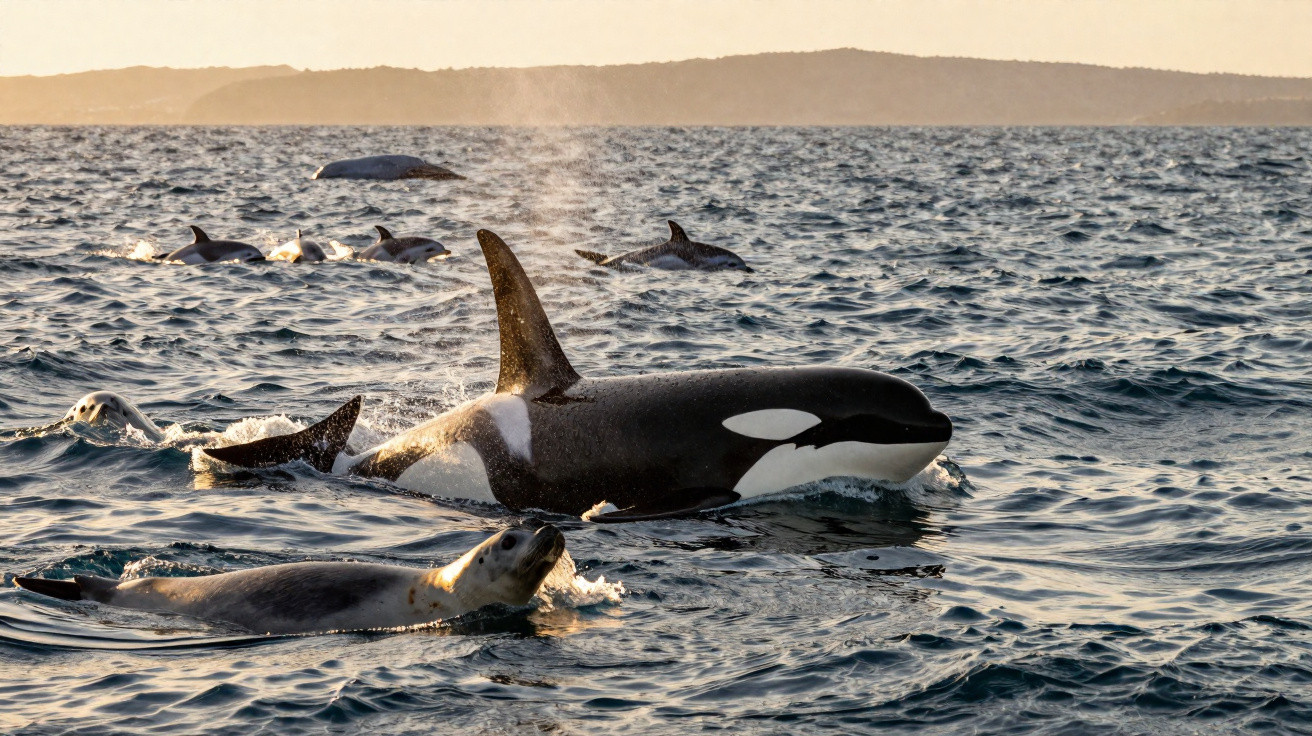
A group of orcas spending time well off California’s coastline has developed effective ways to catch prey in open water.
Because marine mammals make up almost all of their diet, orcas must hunt efficiently enough to ensure every member of the group eats.
Nearer shore, the animals they target can often be trapped and captured more easily, although competition may be intense. Travelling farther offshore can offer a richer food supply to predators equipped to catch it.
Transient orcas hunt in open Pacific waters
The transient orcas of the Northeast Pacific have learned that seals and young whales can be taken through a combination of strategy and sheer force. Before feeding, they may ram their prey or use their tails to hurl it into the air.
"The subpopulation of transient killer whales we observed in Monterey Bay preferentially stayed in open, deep water, and primarily fed on seasonally available California sea lions, gray whale calves, and northern elephant seals," write a team led by marine biologist Josh McInnes of the University of British Columbia in Canada.
"They exhibited specialized hunting techniques that differ from those used to capture marine mammals in shallow near-shore waters associated with reefs, rocky outcroppings, and islets."
Around the globe, orcas are divided into genetically and culturally separate subgroups called ecotypes. The Northeast Pacific Ocean contains three of these ecotypes: resident, transient and offshore populations.
Each group follows its own version of orca life. Although they may be spotted in broadly the same area, they are genetically distinct, differ physically, target different kinds of prey, and neither associate nor breed with one another. They also use their own orca languages.
Transient orcas focus on marine mammals, including seals and other cetaceans such as dolphins and whales. Since people live on land, it has been relatively easy to observe how transient orcas hunt along the coast, and their methods there are well documented.
During the late 1980s, however, scientists off Canada found that some transient individuals ranged farther out to sea, where their inner-coastal hunting approaches would not necessarily be effective. The researchers wanted to establish how these outer-coastal transients obtained food.
Tracking the outer-coastal transient population
To investigate, the team analysed every available source of information: marine-mammal surveys carried out from 2006 to 2018 and whale-watching trips conducted between 2014 and 2021. These records were assembled into a long-term database of orca sightings.
Records of encounters with the outer-coastal transient orca population were gathered between 2006 and 2021. Both their behaviour and group sizes changed with the seasons, while the highest total number of encounters occurred in spring, as grey whales travelled north from their calving lagoons off Mexico’s coast.
In open water, the orcas were observed hunting sea lions, northern elephant seals, dolphins, porpoises and grey whale calves.
How orcas catch seals, whales and dolphins
When pursuing sea lions, several orcas encircled a single animal and took turns charging at it, ramming it, or striking it with their heads or tails. They also threw sea lions into the air. After killing one, the group either shared and ate it or carried the carcass around for some time. Their approach to elephant seals was slightly different: the orcas surrounded the seal, slapped it with their tails, then seized its flippers and shook it.
Adult female orcas commonly began and led hunts for grey whale calves. The group pursued the mother and calf until the youngster became exhausted. The orcas then attempted to split the pair, positioning themselves between mother and calf before gripping the calf and pulling it away. These hunts could become particularly violent, as the orcas rammed and bit the calf and jumped onto its blowhole to drown it.
Dolphin hunts involved close coordination. The orcas moved along either side of a large dolphin school to isolate particular individuals. Once a dolphin had been left exposed, an orca would either strike from beneath to send it flying through the air or seize it and pull it underwater until it died. They used comparable tactics against porpoises.
The researchers say the results improve understanding of the North Pacific ecosystem’s complexity and the place orcas occupy within its different food webs. They also provide a framework for interpreting the populations and behaviour of prey species found there.
"Transient killer whales have been studied primarily in coastal shallow water habitats, and there is currently little known regarding their behavior in offshore and deep pelagic systems," they say.
"This study highlights the complex foraging behavior and ecology of transients and how they act as apex predators in productive deep submarine canyon systems and how their behavior is linked to multiple marine mammal prey populations in the North Pacific Ocean."
The research was published in PLOS ONE.




Comments
No comments yet. Be the first to comment!
Leave a Comment