
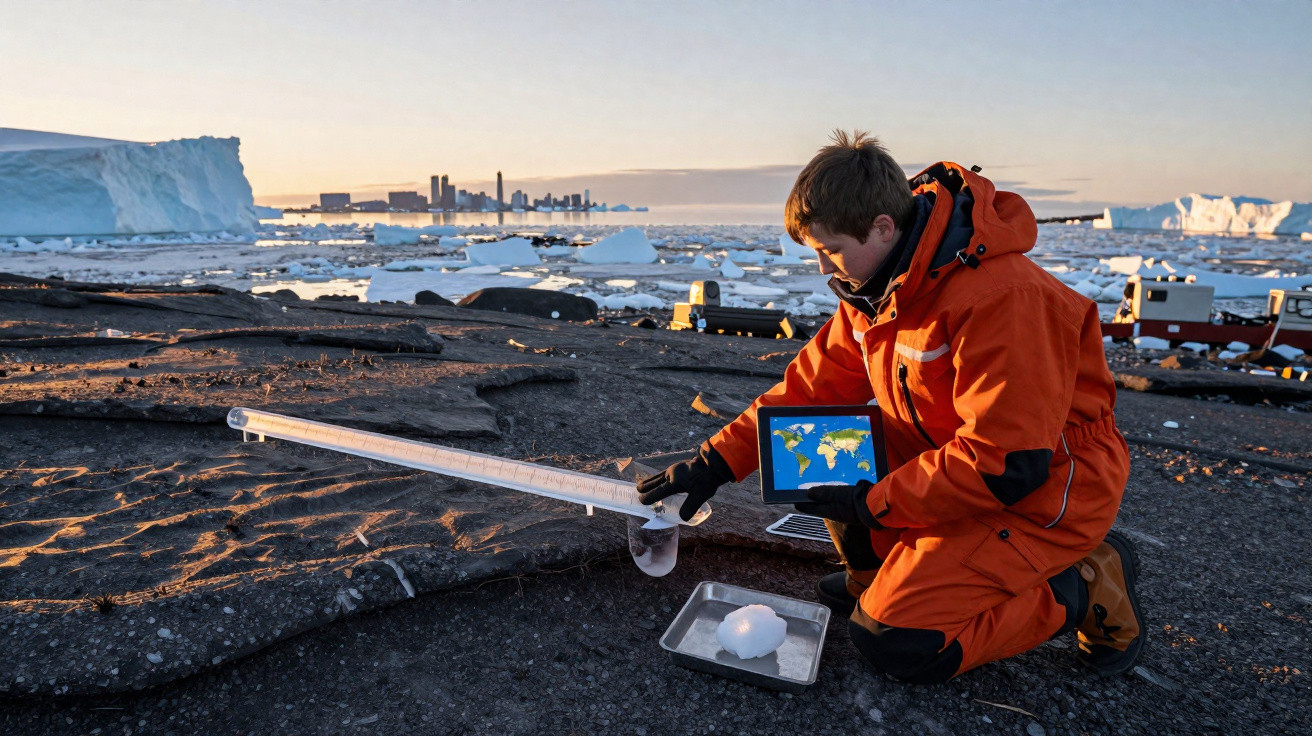
Antarctica is losing mass, enabling the continent to rebound from the ocean much like a compressed sponge that can expand once more.
That mass is made up of ice.
Known as post-glacial uplift, this process could profoundly affect future global sea-level rise, according to new research. Depending on how many heat-trapping, ice-melting fossil-fuel emissions we continue to release, it may cut Antarctica's contribution by as much as 40 percent - or substantially worsen the outcome.
Antarctica's ice loss and post-glacial uplift
"With nearly 700 million people living in coastal areas and the potential cost of sea-level rise reaching trillions of dollars by the end of the century, understanding the domino effect of Antarctic ice melt is crucial," says McGill University glaciologist Natalya Gomez.
In recent years, Antarctic ice has also persisted at strikingly low levels.
A look at the absurd outliers for #Antarctic sea ice this year and last year… 😳Full seasonal cycle graphs available at zacklabe.com/antarctic-se…
[image or embed]
- Zack Labe (@zlabe.bsky.social) Jul 28, 2024 at 11:24 AM
Gomez and her colleagues investigated Earth's mantle below the Antarctic ice sheet, finding that it is especially pliable in several important regions. Seismic evidence showed that this high viscosity is driving the land's unexpectedly rapid rise.
"Our measurements show that the solid earth that forms the base of the Antarctic ice sheet is changing shape surprisingly quickly," says Ohio State University geologist Terry Wilson.
"The land uplift from reduced ice on the surface is happening in decades, rather than over thousands of years."
Sea-level rise scenarios for Antarctica
Using 3D modelling, the researchers simulated sea-level rise caused by Antarctica's shifting landmass under a range of scenarios. With warming held to low levels, Antarctica adds up to 1.7 metres (5.6 feet) to sea levels by 2500; if global warming is instead allowed to continue unchecked, that figure could reach 19.5 metres.
When ice-sheet retreat occurs faster than uplift, more water is pushed into the oceans. Yet if ice melt can be slowed, the rising ground may raise part of the ice clear of warmer seawater, helping to retain it for longer.
"This study marks a breakthrough in our ability to better predict the impacts of climate change on rising seas and to inform effective environmental policy," says University of Massachusetts glaciologist Rob DeConto.
Because Earth is not a perfectly smooth sphere, gravitational, rotational and geological differences mean that sea-level effects will vary from place to place.
"Our results further support recent findings that low-latitude islands and coastal sites already being affected by sea level rise will experience higher than average sea level rise associated with Antarctic ice loss, regardless of the ice loss scenario," Gomez and team explain.
"This finding highlights the climate injustice toward nations whose emissions are low, while their exposure and vulnerability to sea level rise is high."
The scientists warn that substantial uncertainty remains in the model, especially because seismic information from West Antarctica is limited. Their estimates also exclude changes involving Greenland's ice and glaciers in the world's mountain ranges.
Due to anomalous conditions ongoing in the #Arctic and #Antarctic, the total extent of sea ice globally is a record low for the date and nearly 4 million square kilometers below the 1981-2010 average…
More graphics: zacklabe.com/global-sea-i…
[image or embed]
- Zack Labe (@zlabe.bsky.social) Jul 30, 2024 at 10:45 AM
Coastal impacts of rising sea levels
"To document how fast our world is changing, it's very important to continue advancing our ability to make predictions that are more certain, which is the only path that will allow us to tend to our future in a meaningful way," explains Wilson.
Low-lying islands, including those in Kiribati, are already feeling the effects of rising seas. Much of South Tarawa lies below 3 metres above sea level. In Temaiku, villagers have attempted to keep the ocean back with sandbags, but these were washed away earlier this year, flooding houses and contaminating farmland soils and water wells with salt.
Wetlands, meanwhile, are squeezed between encroaching water and built infrastructure such as roads. The loss of these ecosystems - which clean water and limit erosion - would leave these places even more exposed to larger sea-level rises.
"Reducing greenhouse gas emissions will allow the rebound of the solid Earth to play a greater role in preserving more of the Antarctic ice sheets and avoiding the worst and most inequitable impacts of future climate change on global coastlines," Gomez and colleagues conclude.
The research was published in Science Advances.



Comments
No comments yet. Be the first to comment!
Leave a Comment