
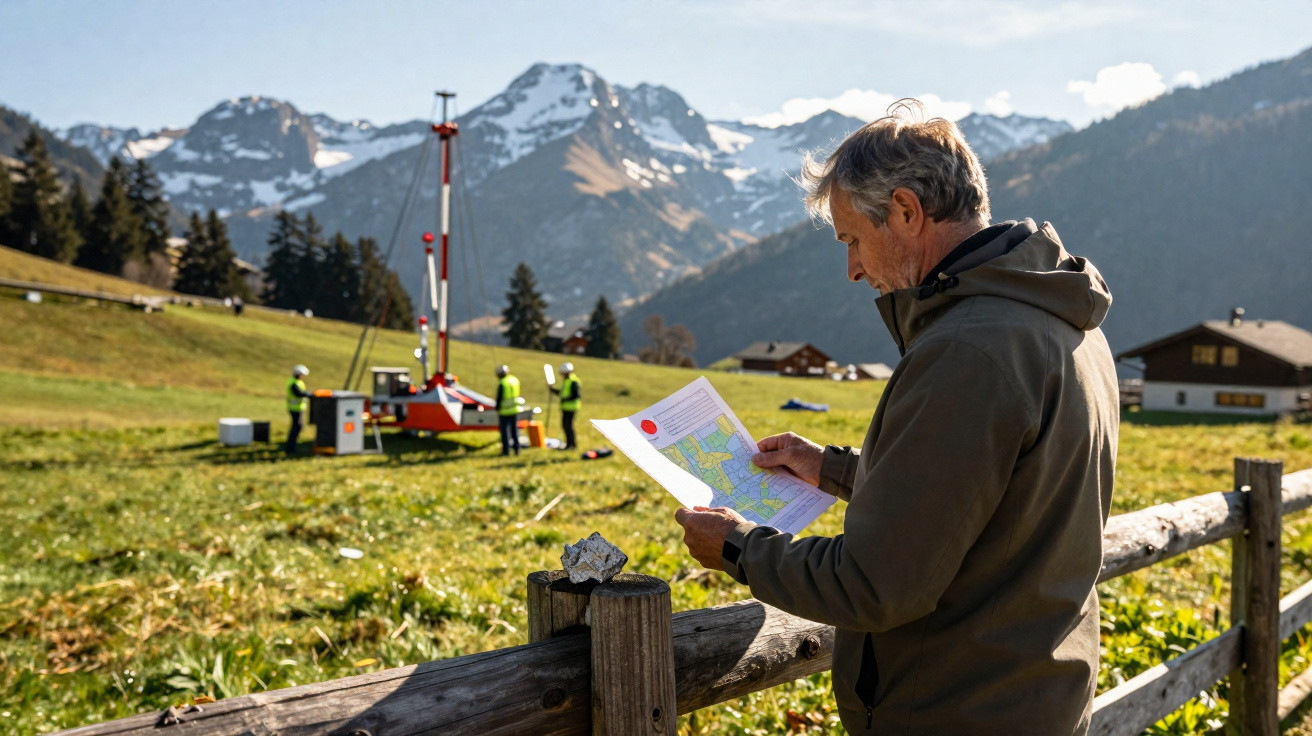
At first light, on a sloping plot in the Alps, a landowner notices a dark vein emerging between two rocks. He has known this land for years: the routes taken by his tractor, the dry-stone walls, and the spots where snow remains until April. This time, however, what he has found is far from ordinary: tests suggest the presence of tungsten, a metal that has become strategic for industry, aerospace and certain defence equipment. A few months later, a Canadian company receives permission to work the site without obtaining his consent. The blow is severe. On paper, the land unquestionably belongs to him. Yet beneath his feet, the situation is much more complex - and extends far beyond his gate.
A discovery on his land, but not necessarily his treasure
We all know the feeling: “It is my property, so it is my decision.” In the Alps, that assumption clashes with a long-standing rule of French mining law: owning the surface does not automatically mean owning every resource buried below it, particularly substances categorised as mines, such as tungsten.
Tungsten is not merely an interesting stone for a collection. This highly heat-resistant metal is used to make cutting tools, electronic components and parts for sensitive industries. Its price and strategic importance explain why manufacturers are interested in it, especially as Europe seeks to lessen its reliance on imports from China.
In the Alpine case, the owner is said to have identified mineralised signs before administrative procedures surrounding the deposit gathered pace. At first sight, the scenario seems absurd, but it follows a clear principle: the State may grant an exploration permit or mining concession to a company, including a foreign one, provided it operates under French law and the authorisations issued.
Why a Canadian company can obtain extraction rights
A Canadian business cannot simply arrive with machinery on an Alpine pasture overnight. It will generally need to operate through a French subsidiary, submit technical, environmental and financial applications, and then follow a process involving State departments, the relevant local authorities and, in some cases, a public inquiry.
For nearby residents, the problem often lies in the gap between official notices and everyday reality. A notice posted at the town hall, a technical file available for a few weeks, or a meeting held during the day can all feel remote when people are working, raising children or running a farm. Let us be honest: nobody really does that every day.
The landowner does not always have the right to veto the extraction itself, but retains important rights concerning access to the plot, easements, damage caused by the works and possible compensation. A mine may be deemed to serve the public interest without erasing the daily lives of those living above it. This is exactly where tensions begin: noise, lorry traffic, dust, water, the landscape and property values become very real concerns.
What to do when a mining project approaches your land
When an exploration or extraction scheme emerges, the first step is to request the precise documents: the permit concerned, the cadastral map, the environmental impact assessment, the works timetable and the identity of the company genuinely behind the project. Written correspondence should be kept, while the original condition of tracks, fences, springs and buildings should be recorded in photographs before any work begins.
A common mistake is signing a right-of-way authorisation, an occupation agreement or a verbal arrangement described as temporary too quickly. This is not excessive mistrust: access initially granted for sampling can develop into a much more long-term presence. A notary, a solicitor specialising in rural or mining law, and a local association can help review the clauses, so that the owner is not left alone with highly technical documents.
A serious negotiation should not be limited to a one-off payment. It must set out responsibilities, disturbance and the restoration of the land to an acceptable condition once the works are complete.
“Finding ore on your land does not automatically mean that you alone can decide whether it is extracted; however, the owner must never give up their rights without understanding the consequences precisely.”
- Have the initial condition formally recorded in writing and with photographs.
- Check the exact nature of the mining title granted.
- Ask what financial guarantees are in place for restoration work.
- Assess the impact on water, access and agricultural activity.
In the Alps, tungsten revives an old question of ownership
This case is a reminder that ownership is not always as straightforward as the fence around a field. The owner sees the land as a workplace, a store of memories or a family legacy; the company sees a rare resource; and the State may identify a matter of national industrial importance. These three perspectives meet, yet none speaks quite the same language.
Tungsten, long absent from public debate, is taking on new significance amid the race for critical raw materials. The prospect of local jobs may appeal to a valley seeking economic activity, while other residents fear an irreversible alteration of Alpine landscapes. The real issue is not simply the ore, but how an industrial decision enters private property.
Transparency is therefore crucial. Who is financing the project? What quantities are planned? For how many years? What safeguards are in place for groundwater, mountain streams and grazing land? A foreign company is not illegitimate simply because it is foreign, but it must persuade people with the facts, comply with French rules and accept scrutiny from local residents. Mountains retain the marks of decisions made in only a few months for a very long time.
| Key point | Detail | Value for the reader |
|---|---|---|
| Ownership of the subsoil | Tungsten may fall under mining law rather than the landowner’s property rights alone. | Better understand why the owner’s consent is not always required for a concession. |
| Landowner rights | Access, easements, damage, compensation and restoration remain regulated. | Know which issues to monitor before any work begins. |
| Foreign project | A Canadian company can extract resources through an entity subject to French rules. | Avoid misconceptions and demand practical guarantees. |
FAQ:
- Does a landowner automatically own minerals found beneath their land? No. In France, certain substances such as tungsten fall under the mining regime and are governed by the Mining Code.
- Can a foreign company work a mineral deposit in France? Yes, if it follows French procedures, obtains the necessary authorisations and provides the required guarantees.
- Can the landowner stop the works? They do not necessarily have a veto over the mining title, but they can challenge certain decisions and protect their rights relating to the occupation of their land.
- Is compensation possible? Yes, particularly where there is damage, easements, agricultural losses, or deterioration of access and facilities.
- What should be done if a mining project is planned nearby? Consult public documents, retain all evidence, take part in public inquiries and promptly seek independent legal advice.





Comments
No comments yet. Be the first to comment!
Leave a Comment