
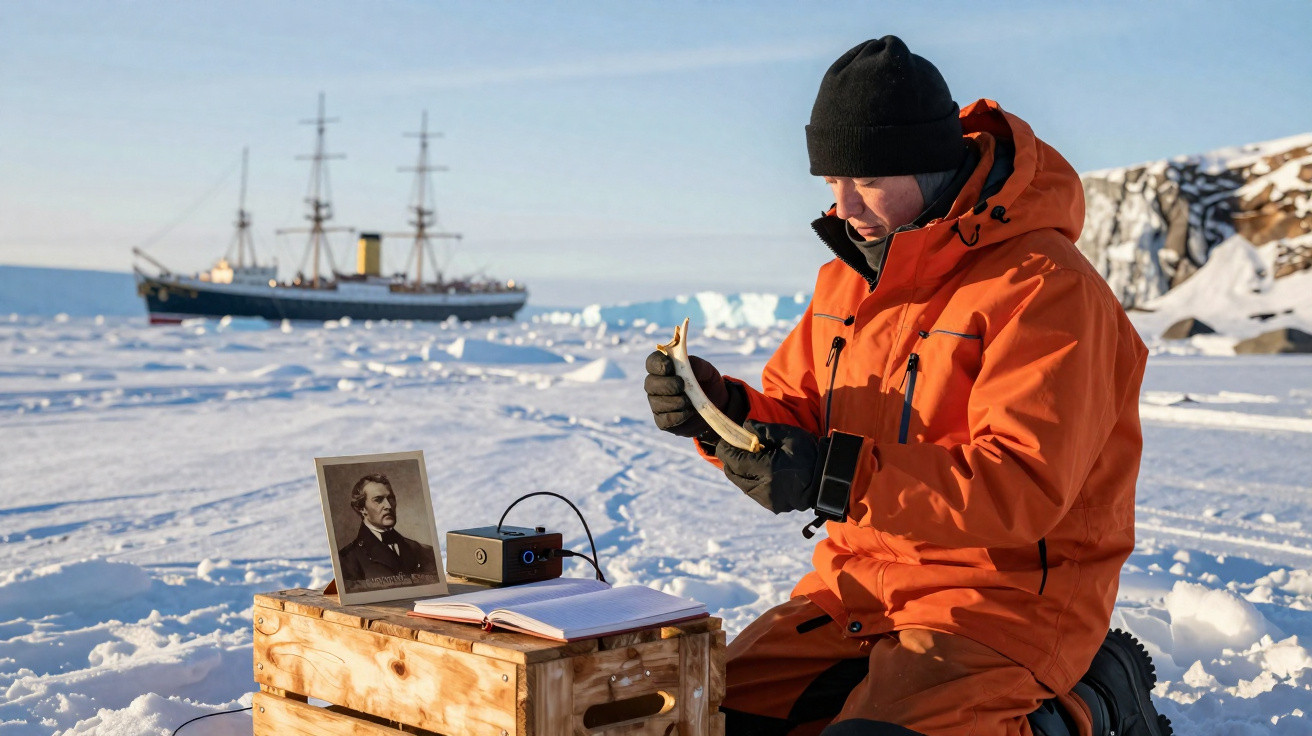
Sir John Franklin's Northwest Passage expedition remains a historical episode that continues to capture considerable interest and stir the imagination.
The sailors who died while attempting to flee the Arctic after their ships, Terror and Erebus, were trapped in ice in 1846 stand as a testament to human resilience – and desperation.
The remains of James Fitzjames, captain of the Erebus and leader of the final desperate attempt to reach home, have now been identified. They reveal a deeply distressing story.
James Fitzjames identified from Franklin expedition remains
In 1848, when the 105 surviving crewmen left their ships to face the merciless Arctic ice, Captain Fitzjames wrote a bleak statement. It was later discovered in a cairn on King William Island.
"HMS ships Terror and Erebus were deserted on the 22nd April, 5 leagues NNW of this having been beset since 12th Sept 1846," he wrote.
"Sir John Franklin died on the 11th of June 1847 and the total loss by deaths in the Expedition has been to this date 9 officers and 15 men."
None of those 105 men returned home, and they probably never left the island. Since then, many sailors' bones have been recovered from this isolated area. Now, at last, some of them can be laid to rest.
Researchers identified James Fitzjames by locating known relatives and descendants of the crew, then comparing their DNA with samples extracted from bones recovered on King William Island.
A DNA sample from one of Fitzjames's descendants matched DNA taken from a tooth among the more than 400 bones recovered so far. This is only the second identification ever made from Franklin expedition remains found on King William Island.
Evidence of cannibalism on King William Island
The jawbone associated with the tooth offers insight into at least part of Fitzjames's fate. Cut marks on the bone are consistent with butchery, indicating that crew members – probably starving and ill – used his body as best they could: they ate him.
"This shows that he predeceased at least some of the other sailors who perished, and that neither rank nor status was the governing principle in the final desperate days of the expedition as they strove to save themselves," says archaeologist Douglas Stenton of the University of Waterloo in Canada.
The finding aligns with accounts from the period. British search expeditions sent to locate the missing explorers during the 1850s heard from Inuit people living on King William Island that the survivors' remains bore evidence of cannibalism.
Research undertaken in the 1990s later confirmed that those accounts were accurate: bones belonging to at least four people recovered from the archaeological site showed signs of butchery.
The desperation of the Franklin expedition survivors
This is not a sensational story of misconduct or scandal, but one about men pushed to the furthest limits of endurance. They were probably starving and unwell after going without sufficient nutrition for a long period. Food supplies were limited. In these circumstances, cannibalism can become a final means of survival.
"It demonstrates the level of desperation that the Franklin sailors must have felt to do something they would have considered abhorrent," says anthropologist Robert Park of the University of Waterloo.
"Ever since the expedition disappeared into the Arctic 179 years ago there has been widespread interest in its ultimate fate, generating many speculative books and articles and, most recently, a popular television miniseries which turned it into a horror story with cannibalism as one of its themes. Meticulous archaeological research like this shows that the true story is just as interesting, and that there is still more to learn."
Through this research, Fitzjames is the first Franklin expedition member identified as a victim of cannibalism. His recovered remains have been placed in a cairn with those of the others, with a commemorative plaque marking the place where they died.
Stenton and his team encourage other descendants of the expedition's crew to get in touch, in the hope of identifying the remaining bones.
Further reading on Fitzjames is available in James Fitzjames: The Mystery Man of the Franklin Expedition by William Battersby. More information about HMS Erebus can be found in Erebus: The Story of a Ship by Michael Palin. For more on the Franklin expedition, see Frozen in Time: The Fate of the Franklin Expedition by Owen Beattie and John Geiger.
The research was published in the Journal of Archaeological Science: Reports.






Comments
No comments yet. Be the first to comment!
Leave a Comment