
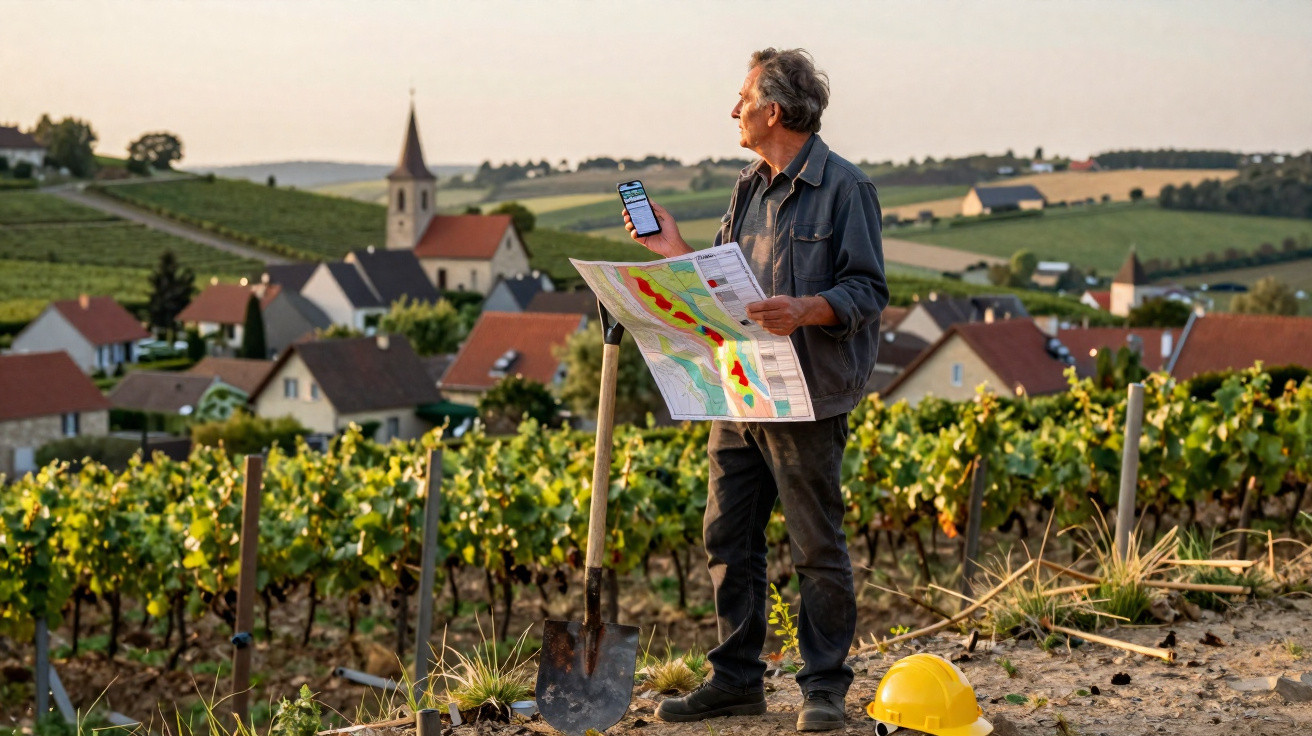
On a Sunday morning in a village square in Aude, a single message posted in a Facebook group can sometimes send a rumour in an unexpected direction. It speaks of ground packed with lithium, wealth supposedly worth €36 billion, and residents who allegedly learnt about it after everyone else. That figure is enough to make heads spin, especially in communities familiar with the struggle to keep a shop, school or GP surgery open. Yet there is a vast gap between a mining prospect and an officially confirmed discovery. Public records, exploration licences and geological studies rarely tell a story as straightforward as a viral post. One very practical question therefore remains: is this fortune really lying beneath the feet of Aude residents?
A striking figure, but no officially established discovery so far
The story of a lithium deposit beneath an Aude commune, supposedly worth €36 billion, spreads remarkably well: it has a neat figure, a strategic metal and a population said to have been kept in the dark. We all know the feeling when local news seems too huge to overlook. At present, no readily identifiable official source - whether the Ministry for Ecological Transition, the Bureau de recherches géologiques et minières (BRGM), Aude Prefecture or a company holding an exploration licence - publicly confirms an exploitable discovery matching that precise description. This does not mean Aude’s geology holds no interest. It does mean the claim deserves more than a hasty share.
For a deposit to be described as a confirmed discovery, far more is required than an anomaly found in rock or an estimate circulated online. Geologists must establish the lithium grade, determine the extent of the ore, assess its depth, technical constraints and the quality of the resource. A €36 billion deposit would also require a transparent calculation method: what volume, what lithium price, what recovery rate and what extraction costs? Without that information, the sum looks more like a projection than a genuine economic value. In mining, what lies underground is never simply a pot of money.
France does have recognised lithium projects, notably around the Beauvoir site in Allier, while work on critical-metal resources is under way in several regions. Such schemes lead to public announcements, local debate, environmental assessments and lengthy administrative procedures. Aude itself has a rich mining and geological history, encompassing former workings, mountain ranges and sedimentary land. That reality can readily fuel speculation. But a potential resource is not a mine, and a mine does not automatically make for a profitable project. The word “confirmed” requires evidence, not merely shared enthusiasm.
What residents can check before believing in buried wealth
When faced with such a dramatic claim, the most useful first step is to ask for the exact name of the commune, the company involved and the exploration licence being mentioned. These are not administrative details reserved for experts: they make it possible to locate a case file, public consultation or council resolution. The BRGM website, prefectural publications and registers covering mining titles are sensible places to begin. A town hall may also confirm whether it has been formally notified of a project. Let us be honest: nobody does this every day. However, five minutes of checking can prevent weeks of confusion.
A common mistake is to treat a geological map as proof of an economically workable deposit. Such a map may identify a favourable rock type, former mineral occurrences or an area investigated in the past. On its own, it does not show that thousands of tonnes of lithium can be recovered at an acceptable cost. Caution is also needed with calculations that multiply an assumed volume by a high lithium price while ignoring the cost of drilling, processing plants, energy, transport, waste treatment and site restoration. The shortcut is understandable: large numbers are compelling. They do not amount to a feasibility study.
Local people are entitled to seek clear answers without being branded either anti-progress or, conversely, gullible. Serious mining information should be explainable through dated documents, identified contacts and figures that do not shift with each new publication.
“A geological indication can launch a scientific investigation; by itself, it is not a promise of wealth for an area.”
- Check the precise source of the announcement and its publication date.
- Look for an exclusive exploration licence or a related prefectural procedure.
- Ask for the stated lithium grade, estimated tonnage and the method used.
- Read council minutes and information from any public meetings.
- Separate the metal’s theoretical value from the actual profitability of an operation.
The real debate goes far beyond the announced €36 billion
Imagine that a prospecting campaign were one day to confirm a significant resource in Aude. The issue would not be limited to the figure displayed on an infographic. It would involve water, landscapes, lorry routes, noise, biodiversity and local employment. In a small commune, an industrial development may offer an opportunity, but it can also create a deeply personal concern: seeing the land behind one’s home change, or a child’s route to school altered. Residents are not simply onlookers above underground assets valued by others. They live there.
The shift towards electric vehicles and energy storage is increasing interest in European lithium. Producing it nearer to French factories could reduce certain dependencies, provided social and environmental standards are sufficiently demanding. Public debate benefits from moving beyond slogans. Saying “it must be exploited” does not answer questions about the processes involved. Saying “nothing should be done” does not answer the need for raw materials in batteries, electricity networks and some everyday equipment either. Between those positions lie transparency, independent oversight and a genuine opportunity for discussion.
This Aude rumour illustrates one simple point: a lack of clear information provides fertile ground for the most extravagant scenarios. If exploration is taking place, it must be explained early, including its limits and uncertainties. If it does not exist in the form being claimed, that must be stated just as clearly. Residents should not have to guess what is happening beneath their commune. Geological data are never neutral when they enter village life: they can raise hopes, fuel tensions and turn a café conversation into a debate about the future of an area.
A lithium story that needs facts, not just promises
The notion of a hidden treasure beneath an Aude commune is a powerful one. It evokes economic revival, French resources and villages that could suddenly matter on the country’s industrial map. But the investigation begins precisely where the story becomes appealing: who produced the €36 billion figure, on what data, and under what regulatory framework? Until those answers are available, presenting the discovery as confirmed would be misleading. Residents may understandably feel frustrated, particularly if they hear about exploration late or through unreliable channels.
Sharing verified information, questioning a town hall, attending a public meeting or asking for the source behind a figure is not a sign of automatic distrust. It is a way to reclaim a place in a debate concerning an area’s land, water and future. Perhaps Aude contains resources that remain poorly understood. Perhaps the circulating figure has no solid basis at all. Between these two possibilities lie the patient work of geologists and citizens’ right to understand what is being prepared close to home.
| Key point | Detail | Benefit for the reader |
|---|---|---|
| Claim to verify | No clearly identifiable public validation confirms an Aude deposit worth €36 billion. | Avoid mistaking a viral rumour for established information. |
| Deposit criteria | Grade, tonnage, depth, costs, extraction process and environmental impact must all be documented. | Understand why the mere presence of lithium guarantees nothing. |
| Residents’ role | Citizens can consult licences, the prefecture, the BRGM and council minutes. | Take part in local debate with concrete information. |
FAQ:
- Is there an officially confirmed lithium deposit in Aude worth €36 billion? At this stage, no clearly established public source makes it possible to confirm an exploitable discovery corresponding precisely to that claim.
- Why should the €36 billion figure be treated cautiously? The value of a deposit depends on the volume that can genuinely be recovered, the ore quality, market price and operating costs. A theoretical calculation can be far removed from economic reality.
- Must a town hall be informed about mining exploration? Depending on the project’s progress and the procedures under way, the commune may be involved through administrative information, consultations or discussions with project promoters.
- Where can an exploration licence be checked? Prefectural publications, the relevant state services and BRGM documentary resources can help locate reliable information.
- Can lithium be extracted without local impacts? No. Any industrial operation raises issues involving water, transport, landscapes, waste and consultation with local residents.



Comments
No comments yet. Be the first to comment!
Leave a Comment