
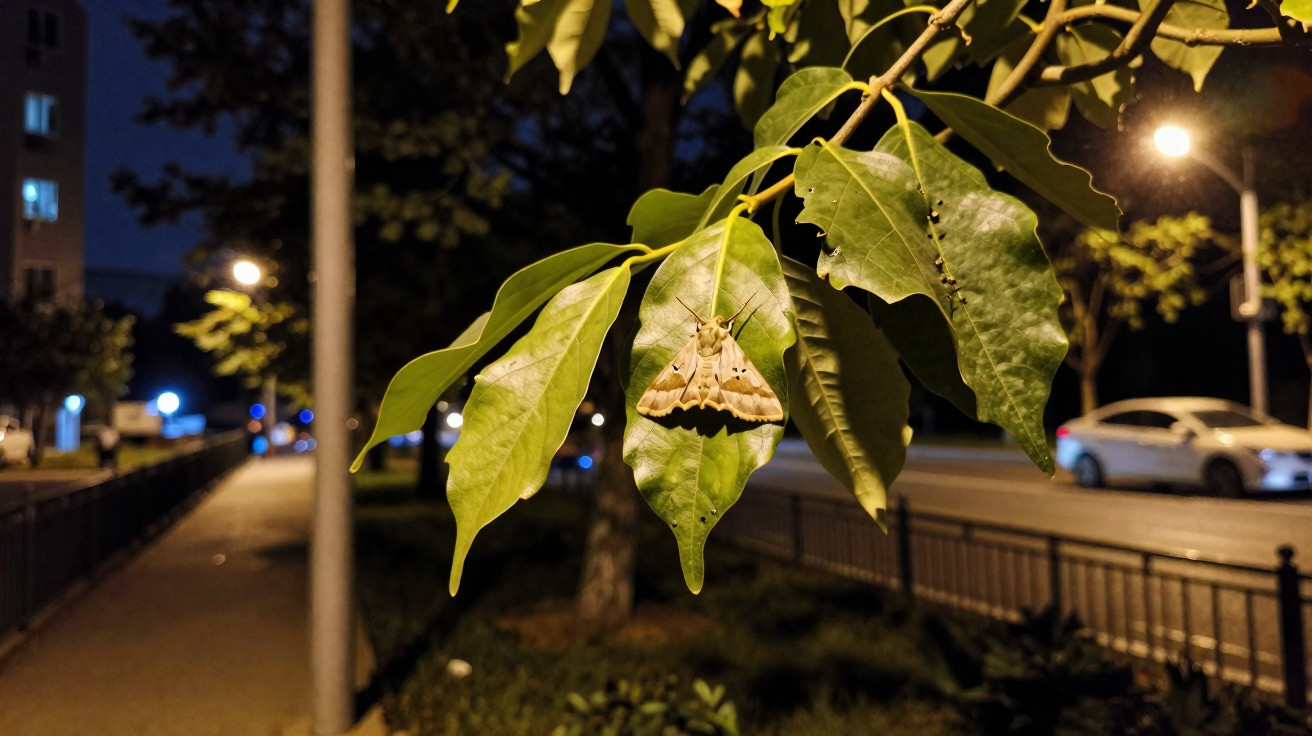
Artificial light brightening the night landscape may make plants harder for insects to eat, leaving them to seek food elsewhere or potentially starve, a new study has found.
According to researchers at the Chinese Academy of Sciences, this effect may be helping to drive the global decline of insects, with knock-on consequences for entire ecosystems.
"We noticed that, compared to natural ecosystems, tree leaves in most urban ecosystems generally show little sign of insect damage," says environmental scientist Shuang Zhang. "We were curious as to why."
Zhang, alongside ecologists Yu Cao and Ke-Ming Ma, gathered nearly 5,500 leaves from Beijing's two most widespread tree species: Japanese pagoda (Styphnolobium japonicum) and green ash (Fraxinus pennsylvanica). The trees were growing beside major roads that remain lit continuously.
At every tree location, the researchers recorded light intensity and compared it with leaf characteristics, including leaf size, moisture content, chemical defences, nutrients, toughness and evidence of insect herbivory.
Artificial light at night makes leaves tougher
"Artificial light at night led to increased leaf toughness and decreased levels of leaf herbivory," Zhang says.
The pattern appeared in both species. The team found that tougher leaves showed less insect damage, suggesting the plants may be using a substantial share of energy obtained through street lighting to strengthen their defences against insect predators.
Earlier research has likewise identified a link between greater light exposure and the increased strengthening of structural leaf components, such as fibre.
"Lower levels of herbivory imply lower abundances of herbivorous insects, which could in turn result in lower abundances of predatory insects, insect-eating birds, and so on," Zhang warns. However, he also cautions that the findings should not be extended too broadly, because the work "was conducted in only one city and involved just two tree species."
Light pollution and ecosystem nutrient cycling
This break in the food chain produces a trophic cascade: reduced insect activity means fewer nutrients circulate through the ecosystem's different levels. Tougher leaves are also known to decompose more slowly, which could further harm nutrient cycling within ecosystems.
Nutrient changes in the leaves also varied according to tree species and light exposure. Higher levels of artificial light were linked to lower nitrogen and phosphorus levels in Japanese pagoda leaves, while green ash leaves had less tannin but more nitrogen.
Although individually small, insects and the world's other creepy crawlies collectively outweigh humans and livestock combined. This living mass, and the activity it carries out, is vital to keeping Earth's ecosystems functioning.
Insect herbivory, Cao and colleagues write in their published paper, "is one of the most crucial energy flow pathways in ecosystems."
Insect herbivory under artificial light
Light pollution is already known to affect insects directly. It can severely disorient moths and interfere with the feeding ability of nocturnal pollinators. The new findings add another dimension to the growing problem as more of the planet's surface is illuminated and trees continue to be destroyed worldwide.
"The decrease in herbivory could also be attributed to the prolonged exposure of herbivores to their predators under artificial light at night," the researchers qualify.
Further work is therefore required to establish how other factors, including pollution, contribute to this effect. The study examined only chewing insects, whose feeding damage is visible on leaves. The effects of other herbivorous insects are less obvious, but they should be included as well.
"The decline of insects is a global pattern observed over recent decades. We should pay more attention to this trend," Zhang warns.
The research was published in Frontiers in Plant Science.





Comments
No comments yet. Be the first to comment!
Leave a Comment