
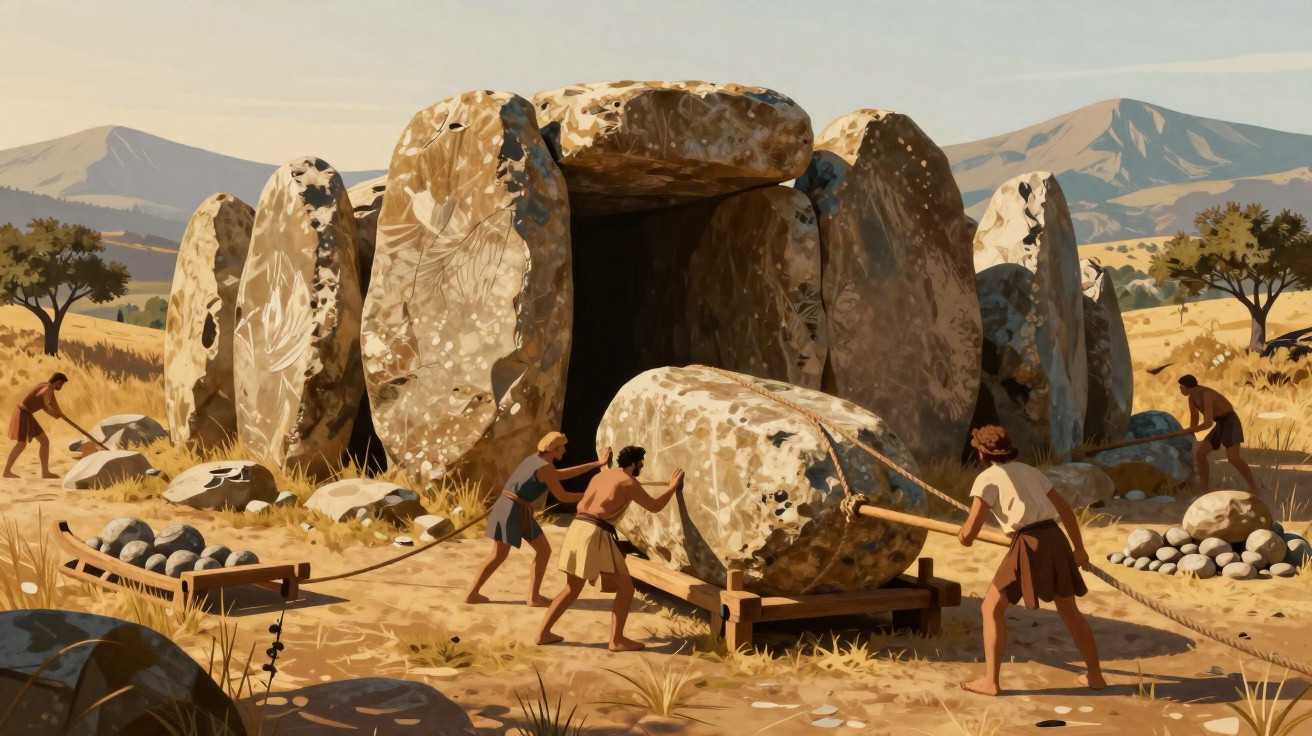
The remarkable Dolmen of Menga
Walking into the Dolmen of Menga can feel, with a sense of awe, like crossing into a different realm. Constructed almost 6,000 years ago, this ancient structure remains remarkably intact, despite being made from stones that weigh as much as 150 tonnes apiece.
Building something on this scale would clearly have demanded an advanced, wide-ranging grasp of engineering principles.
New research suggests that the Neolithic people responsible for Menga were exceptionally capable, well informed and proficient at tackling difficult engineering challenges.
"Initially, what sparked my interest in the Menga dolmen was undoubtedly its monumentality. Entering its interior and contemplating such a colossal monument from the Neolithic period, attracted my curiosity to learn more about this dolmen," geoarchaeologist José Antonio Lozano Rodríguez, of Spain's Canary Islands Oceanographic Center, told ScienceAlert.
"They were people with very important knowledge of early science, which indicates how evolved the intellectual, practical and technical capacities of these societies in the south of the Iberian Peninsula were almost 6,000 years ago."
The Dolmen of Menga is undeniably one of the ancient world's great marvels. Built into the flank of an earthen mound sometime between 3800 and 3600 BCE, its vast chamber runs for 27.5 metres (90 feet) and is faced, in both its walls and roof, with enormous stones.
It ranks among the biggest megalithic monuments of ancient Europe. Its capstone, estimated to weigh 150 tonnes, is also among the largest stones ever transported in Neolithic Europe.
The monument seems to have served a funerary purpose, as grave goods have reportedly been found within it. It must also have held considerable significance: earlier studies showed that its construction required an enormous amount of labour.
Lozano Rodríguez previously led research establishing that the dolmen's uneven walls were deliberate and aligned around the solstices. That work also found that the soft stone used for the monument came from roughly 1 kilometre (0.6 miles) away, demonstrating that its builders understood how to quarry and move massive pieces of rock.
How the Dolmen of Menga was built
The Dolmen of Menga comprises a chamber whose walls and roof are formed from large stones. Three stone pillars run along its length to bear the roof's weight. Together, the 32 huge stones weigh approximately 1,140 tonnes.
To investigate how the stones were positioned and how the monument was assembled, Lozano Rodríguez and his team carried out research spanning sedimentology, archaeology, palaeontology and petrology.
Transporting these immense stones would have been among the most difficult tasks. The researchers concluded that it required a solid understanding of friction.
The most straightforward method would have involved sledges travelling on a prepared wooden trackway. As the quarry lay above the building site, the process would also have called for knowledge of acceleration and braking.
The team notes that all the stones are classified as "soft" sedimentary rock, chiefly limestone, meaning they would have needed to be handled carefully to prevent damage. Even so, they were set in place with millimetre-level precision. The stones also interlock and incline slightly towards one another, offering clues about both the method and sequence used to install them.
Foundations, pillars and structural engineering
They are also tightly wedged into the bedrock. In 200 years of research at Menga, this is the first time the feature has been identified: the stones sit in deep foundation sockets. Creating these would have required careful placement, implying the use of counterweights and descending ramps to slide each stone into position before levering it upright. Such deep foundations would also have reduced the need to raise the roof stones.
The pillars were installed in a comparable way, with deep foundations, although they were probably positioned after the wall stones. The walls were arranged so their upper edges angle gently inwards, leaving the chamber trapezoidal: narrower at its top than at its base. The researchers consider this an ingenious solution, because it made it possible to use smaller capstones than a broader roof would have required.
"Almost 6,000 years ago they used a relieving arch to solve complex problems of stress distribution, thus solving problems related to weight, which would be one of the biggest structural problems they would encounter in the design of this great monument. This is also solved by using pillars inside," Lozano Rodríguez marvels.
"I was also surprised to see that the monument was designed to be partially buried so that the capstones could be placed without the aid of ascending ramps."
This enigmatic ancient structure clearly still has much to reveal, not only about construction practices but also about the ingenuity of Neolithic people and the importance of keeping an open mind about our ancestors' capabilities.
"The incorporation of advanced knowledge in the fields of geology, physics, geometry, and astronomy shows that Menga represents not only a feat of early engineering but also a substantial step in the advancement of human science, reflecting the accumulation of advanced knowledge," the researchers write in their paper.
"Menga demonstrates the successful attempt to make a colossal monument lasting over thousands of years."
The research has been published in Science Advances.





Comments
No comments yet. Be the first to comment!
Leave a Comment