
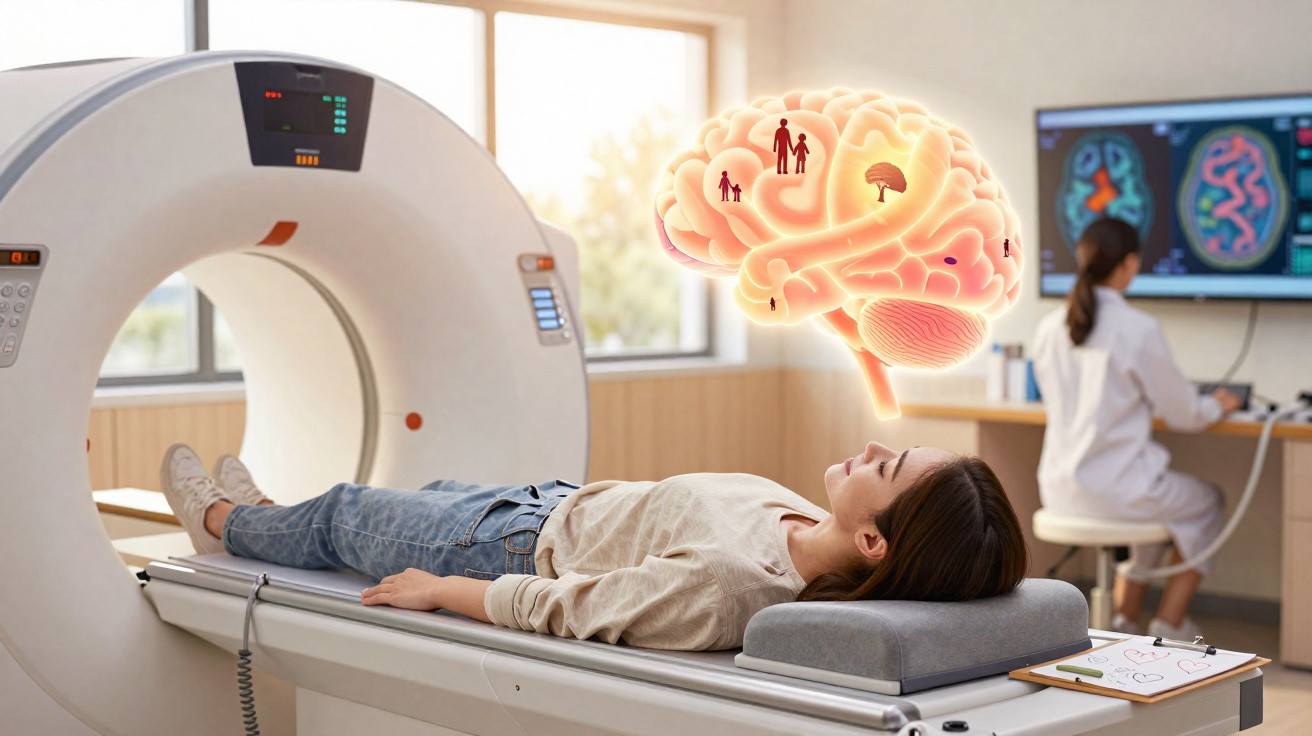
Our capacity to develop emotional bonds is remarkable, extending from nature and pets to romantic partners and children.
Researchers have used brain scans to show that these different forms of love each have their own distinctive neural signature.
Brain scans reveal different types of love
Among the varieties of love mapped by philosopher Pärttyli Rinne of Aalto University in Finland and his colleagues, parental love generated the strongest brain activity.
Romantic love came next. As previous research has found, romantic love activates many of the same areas in fMRI studies as parental love. However, parental love additionally engages the striatum, which is involved in planning and decision-making, and the thalamus, which is linked to consciousness and alertness.
"In parental love, there was activation deep in the brain's reward system in the striatum area while imagining love, and this was not seen for any other kind of love," explains Rinne.
That pattern makes evolutionary sense, considering the effort, planning and decision-making involved in raising a child.
The team also examined love for friends, nature, pets and strangers.
Every form of love activated the brain's reward centres, including the superior frontal gyrus, which connects self-awareness with the sensory system, and the cingulate gyrus, which links actions with emotional responses and thereby supports learning.
How love for friends, strangers and nature differs
Although all types of love involved these reward regions, their activation patterns varied. Love for strangers, for instance, triggered the same underlying brain processes as close relationships, but much less powerfully.
"Different types of interpersonal affiliation can thus be seen to form a continuum from closer affiliative bonds to more distant relationships according to the degree of subcortical and cerebellar activation," Rinne and team write in their paper.
Compared with the other forms of love, love of nature activated the widest range of distinct brain areas. Interestingly, it still activated the cingulate gyrus, as social forms of love do.
Pet owners show a distinct brain response
When examining people's love for pets, the researchers could readily tell apart participants who lived with pets from those who did not.
"When looking at love for pets and the brain activity associated with it, brain areas associated with sociality statistically reveal whether or not the person is a pet owner," explains Rinne.
"Our result suggests that for pet owners, love for pets is neurally more similar to interpersonal love than for participants without pets," the researchers add.
To produce these images, participants underwent fMRI scanning while listening to a neutral scenario, such as imagining that they were absent-mindedly brushing their teeth.
They then heard a simple story designed to evoke love, including: "You see your newborn child for the first time. The baby is soft, healthy and hearty – your life's greatest wonder. You feel love for the little one."
Researchers compared the brain scans from both scenarios for 55 people in Finland aged 28 to 53. All participants were healthy, in a relationship and had at least one child, while around half lived with a pet.
At the end of each spoken narrative, participants were shown an image relating to the story and asked to immerse themselves in its emotion. Their brain activation patterns were similar at this stage, though less intense.
"We now provide a more comprehensive picture of the brain activity associated with different types of love than previous research," says Rinne.
While this is the largest study of its kind so far, its sample remains relatively small and is limited to a single culture.
"Love is a complex and multifaceted set of biologically grounded and culturally modified phenomena," the team cautions. "Further cross-cultural research is still required for a better understanding of how cultural and demographic factors influence various feelings of love and their correlates in the human brain."
The researchers hope that a better understanding of the brain mechanisms behind different experiences of love could lead to improved treatments for attachment disorders and other mental health conditions.
The research was published in Cerebral Cortex.




Comments
No comments yet. Be the first to comment!
Leave a Comment