
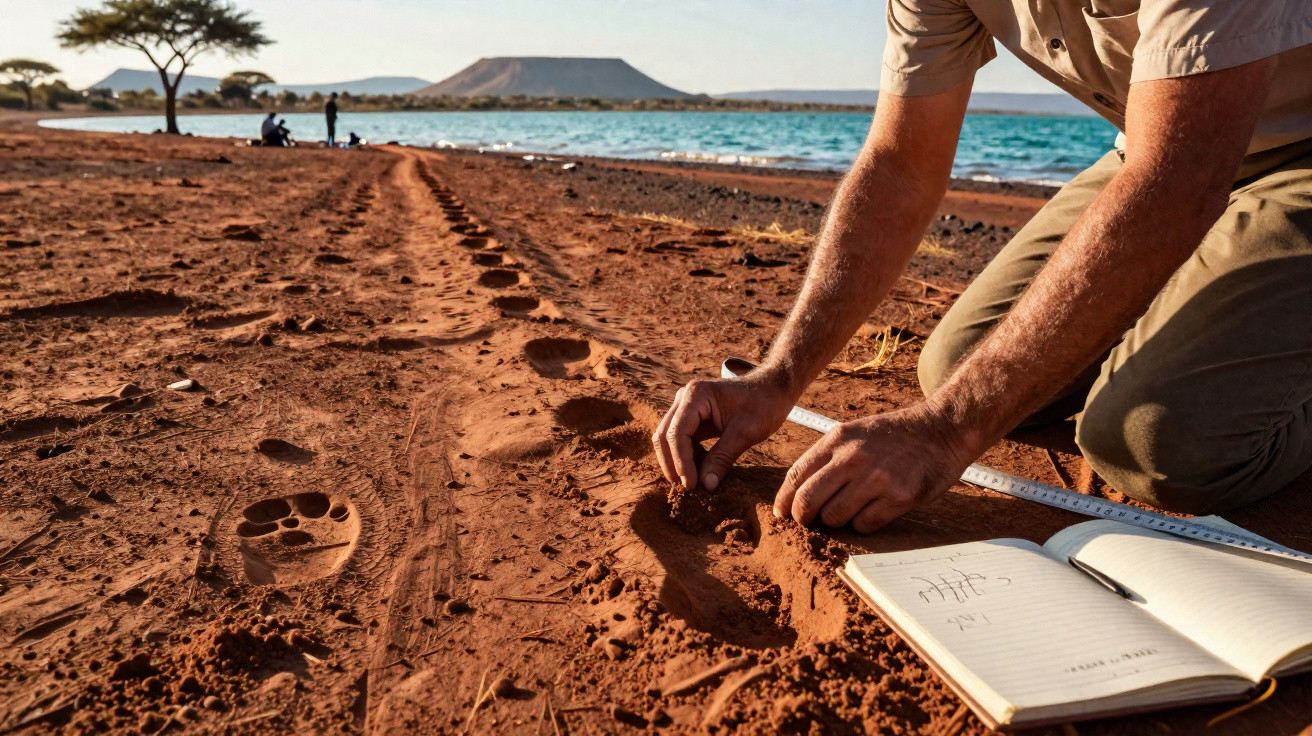
Bones can reveal height, age and anatomy, yet they rarely record a lived moment. On an ancient shore of Lake Turkana in northern Kenya, a surface bearing footprints from around 1.43 million years ago preserved eight hominins walking in the same direction, like a photograph pressed into mud.
Where were the footprints found?
The tracks came from the GaJi10 site in East Turkana, an area renowned for fossils of human ancestors. Wet sediments captured the impressions and were buried before wind, water or other animals could erase them. Volcanic layers helped researchers date the surface to roughly 1.43 million years ago.
Published in 2026 in the Proceedings of the National Academy of Sciences, the study was led by an international team headed by Kevin Hatala. Unlike bones accumulated over centuries, footprints on a single surface make it possible to reconstruct direction, step sequence and how closely in time individuals were present.
How many individuals walked together?
One preserved surface contained 21 footprints arranged in several trackways, attributed to at least eight individuals who crossed the shore within a short period. Their similar direction and the closeness of the trails point to collective movement, although the relationship between the members and the purpose of their journey cannot be determined.
The scene captured in fossilised footprints is especially valuable because social behaviour almost never fossilises. The mud cannot reveal whether the group was hunting, seeking water or simply travelling along the shore, but it does show that several bodies were there at virtually the same time.
Who most likely made the GaJi10 footprints?
The footprints’ morphology, together with fossils known from the region, led researchers to link the tracks with Paranthropus boisei, a robust human relative that lived in East Africa. This attribution rests on anatomical comparison and context, so it should be regarded as the best-supported hypothesis rather than a direct identification of particular individuals.
The research also reassessed the body size of this hominin. Some footprints indicate adults larger than earlier estimates, with individuals potentially reaching about 1.8 metres and 75 kilograms. This demonstrates how feet impressed into the ground can revise a picture previously based only on incomplete skeletons.
- The GaJi10 surface is approximately 1.43 million years old.
- Twenty-one main footprints indicate at least eight individuals on the same shore.
- The shape of the tracks is consistent with Paranthropus boisei.
- Some estimates suggest adults with larger bodies than those indicated by previously known fossils.
Was the group made up only of males?
The similar sizes prompted the team to consider whether many of the tracks may have belonged to adult males, forming something comparable to a male association. The interpretation is appealing because male groups occur among some primates, but neither sex nor kinship can be read directly from a fossil footprint.
The authors present the idea as a hypothesis about social behaviour. Further trackways and comparisons with fossils will be needed to establish whether the group really consisted of males, included large females, or merely represented a temporary coincidence of individuals using the same stretch of shore.
Why do footprints tell a different story from bones?
A bone records that someone existed. A trackway records that someone moved, in which direction and at what approximate pace. When several trails share one surface, there is a rare opportunity to observe individuals coexisting rather than assembling fossils separated by hundreds or thousands of years.
For that reason, the Turkana discovery is worth more than a new height estimate. It preserves a shared moment of an extinct human species. Continued excavation of these shores may reveal whether group travel was common and how different hominins shared the African landscape during the Early Pleistocene.






Comments
No comments yet. Be the first to comment!
Leave a Comment