
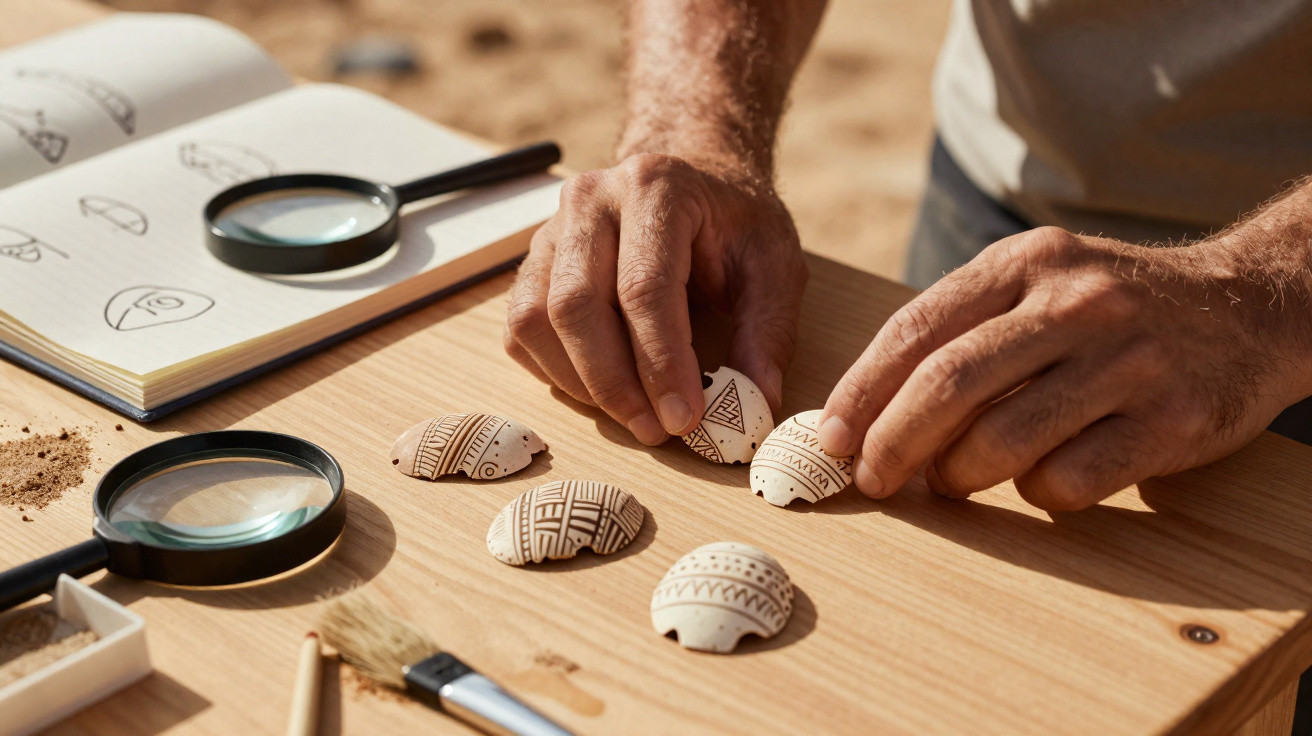
At first glance, they look like nothing more than tiny shards of broken eggshell. Yet 112 fragments recovered in southern Africa retain lines, angles and figures engraved by Homo sapiens around 60,000 years ago. An analysis published in 2026 found that these marks were not random: they follow recurring visual rules that reveal a striking ability to plan geometrically.
What did scientists find on the eggshells?
The study, published in the journal PLOS ONE, examined images of 112 engraved fragments from Diepkloof and Klipdrift in South Africa, as well as Apollo 11 in Namibia. The objects belong to the Howiesons Poort archaeological context of the African Middle Stone Age, dating to roughly 65,000–60,000 years ago.
Researchers digitally reconstructed every mark and measured features including direction, parallelism and intersection angles. According to Valentina Decembrini, Silvia Ferrara and their co-authors, the findings reveal a consistent formal arrangement, suggesting that the ancient engravers combined simple elements according to repeated principles rather than merely making improvised scratches.
Which patterns occur in these ancient drawings?
The engravings feature groups of parallel lines, intersections close to right angles, hatched bands, grids and diamond-like forms. Statistical analysis found that characteristics associated with orthogonality, alignment and spatial regularity occur in more than 80% of the studied sample.
Most intriguing is how these elements were brought together. The authors identified operations involving repetition, rotation, displacement and the fitting of structures inside others. For the team, this indicates a kind of “geometric grammar”, a term describing rules of visual organisation rather than written language itself.
- The researchers compiled images of 112 fragments from three archaeological sites.
- Parallel lines and angles close to 90 degrees recur throughout the compositions.
- Some motifs create grids, hatched bands and diamond-like designs.
- The repeated placement of marks suggests visual planning before engraving began.
What were the eggshells used for?
The shells probably belonged to containers used to store or carry water, a use documented in the African archaeological record since the Middle Stone Age. This makes the engravings particularly compelling, as the patterns were not necessarily separate from everyday life but may have appeared on objects used by these communities.
Earlier studies at Diepkloof had already identified an engraving tradition on ostrich eggshell containers dating back about 60,000 years. The new research goes further by applying geometric and statistical methods to explore not only which designs occur, but how their makers’ minds organised each composition.
Were these designs a form of writing?
The researchers do not claim that the marks constituted writing, nor do they know precisely what each motif meant to the people who made it. The study focuses on the visual structure of the engravings. Therefore, describing the collection as a “code” is only a comparison: there is insufficient evidence to translate the designs as particular words or messages.
What can be demonstrated is an ability to arrange forms according to recurring rules. Silvia Ferrara, a professor at the University of Bologna and the research coordinator, emphasises that parallelisms, grids, rotations and systematic repetitions reveal sophisticated geometric organisation and offer clues to the cognitive foundations of human graphic behaviour.
What do these fragments reveal about our ancestors?
The study suggests that humans tens of thousands of years ago could already envisage a composition, arrange spatial relationships and apply specific rules repeatedly to create it. The authors interpret the engravings as an early expression of complex graphic representation and of the human capacity to structure geometric thought.
The 112 fragments do not tell us exactly what their makers wished to communicate, but they reveal something perhaps even more fascinating: they were thinking visually in an organised way long before writing. Every new analysis of these small shells may bring archaeology closer to the point at which simple lines began to develop into increasingly complex systems of human representation.





Comments
No comments yet. Be the first to comment!
Leave a Comment