
Repetition has an unusual effect on the mind. Consider déjà vu: the sensation that a completely new event has happened before, producing an eerie feeling of familiarity.
Yet our findings suggest that déjà vu offers a glimpse into how the memory system operates.
Our research indicates that it occurs when the brain region responsible for recognising familiarity falls out of step with reality. Déjà vu acts as an alert to this mismatch: a form of "fact checking" performed by the memory system.
Repetition, however, can create an effect that is stranger still.
The reverse of déjà vu is "jamais vu", where something you know is familiar suddenly seems unreal or somehow new. Our recent study, which has received an Ig Nobel prize for literature, examined the process underlying this experience.
Jamais vu can happen when a familiar face abruptly appears odd or unrecognisable. Musicians may experience it briefly when they lose their place in a passage they know extremely well. You might encounter it when travelling to a familiar location, becoming disorientated or viewing it with "new eyes".
It is rarer than déjà vu, and perhaps even more unsettling and peculiar. In questionnaires on everyday experiences, people have described it like this: "While writing in my exams, I write a word correctly like 'appetite' but I keep looking at the word over and over again because I have second thoughts that it might be wrong."
In everyday circumstances, staring or repetition can trigger it, although neither is essential. One of us, Akira, experienced it while driving on the motorway and had to stop on the hard shoulder until his unfamiliarity with the pedals and steering wheel could "reset". Fortunately, such occurrences are uncommon outside the laboratory.
Jamais vu: a simple set-up
Little is known about jamais vu. We suspected, however, that it would be straightforward to bring about in a laboratory. Asking someone to repeat an action continually often causes it to become confusing and meaningless.
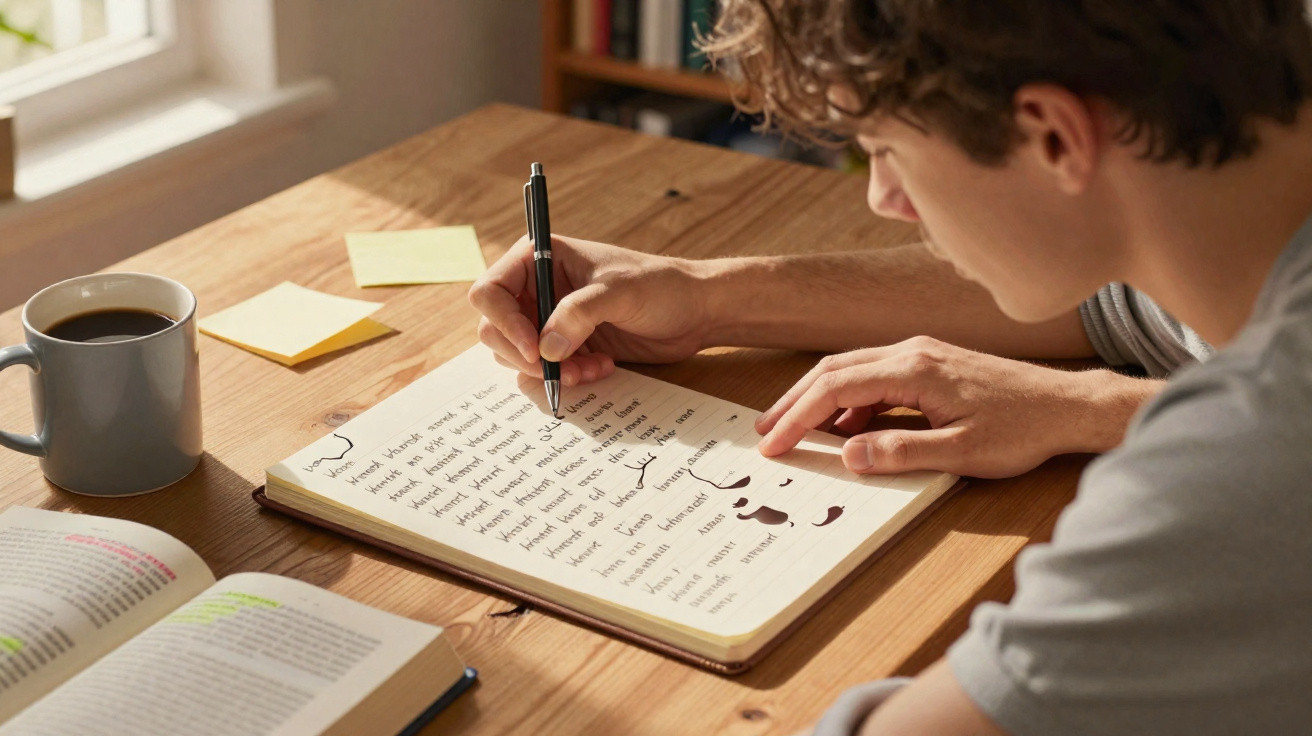
That premise formed the basis of our jamais vu experiments. In the first study, 94 undergraduate students repeatedly wrote the same word. They did this using twelve words, from common examples such as "door" to less frequent ones including "sward".
Participants were instructed to write each word as quickly as they could. We also said they could stop, offering several possible reasons, including boredom, a sore hand or feeling peculiar.
The most frequently selected reason for stopping was that the task had started to feel strange. About 70% stopped at least once because they felt what we classified as jamais vu. This generally happened after roughly one minute (33 repetitions), most often with familiar words.
For the second experiment, we used just the word "the", as we considered it the most common. On this occasion, 55% of participants ceased writing for reasons matching our definition of jamais vu (although this occurred after 27 repetitions).
Accounts of the experience ranged from "They lose their meaning the more you look at them" to "seemed to lose control of hand", along with our favourite: "it doesn't seem right, almost looks like it's not really a word but someone's tricked me into thinking it is."
Writing up and publishing this scientific research took us about 15 years. In 2003, we had acted on the intuition that writing a word repeatedly would make people feel odd. One of us, Chris, remembered that repeatedly writing lines as a punishment at secondary school had made him feel strange, as though it were not real.
The 15-year delay happened because we were less original than we had believed. The idea was not as new as we assumed. In 1907, Margaret Floy Washburn, one of psychology's overlooked founding figures, published an experiment with a student demonstrating the "loss of associative power" in words stared at for three minutes. Over time, the words became unfamiliar, fragmented and devoid of meaning.
We had simply reinvented the wheel. These kinds of introspective approaches and studies had fallen out of fashion in psychology.
Deeper insights into jamais vu
Our distinctive contribution is the proposal that repetition-induced changes and losses of meaning come with a specific sensation: jamais vu.
Jamais vu signals that something has become overly automatic, fluent or repetitive. It enables us to "snap out" of our present processing, and the feeling that things are unreal is actually a reality check.
This need is understandable. Cognitive systems must remain adaptable, so that attention can be directed where it is required instead of becoming trapped in repetitive activities for too long.
We are only at the beginning of understanding jamais vu. The leading scientific explanation is "satiation" - an overload of a representation that causes it to become meaningless.
It may also be connected to the "verbal transformation effect": repeating a word continually activates its so-called neighbours. Thus, someone listening repeatedly to the word "tress" may begin by hearing it as intended, but later report hearing "dress," "stress," or "florist".
There also appears to be a link with research on obsessive compulsive disorder (OCD), which examined the consequences of compulsively staring at objects such as illuminated gas rings. As with repeated writing, the results are strange and reality begins to slip away, but this could help us understand and treat OCD.
When repeatedly checking that a door is locked makes the act meaningless, it becomes hard to determine whether the door is in fact locked, setting off a vicious cycle.
Ultimately, we are pleased to have received the Ig Nobel prize for literature. Winners of these awards produce scientific work that can "make you laugh and then make you think".
We hope that our research into jamais vu will encourage further studies and deeper insights in the near future.
Akira O'Connor, Senior Lecturer in Psychology, University of St Andrews and Christopher Moulin, Professor of cognitive neuropsychology, Université Grenoble Alpes (UGA)
This article is republished from The Conversation under a Creative Commons licence. Read the original article.
An earlier version of this article appeared in September 2023.





Comments
No comments yet. Be the first to comment!
Leave a Comment