
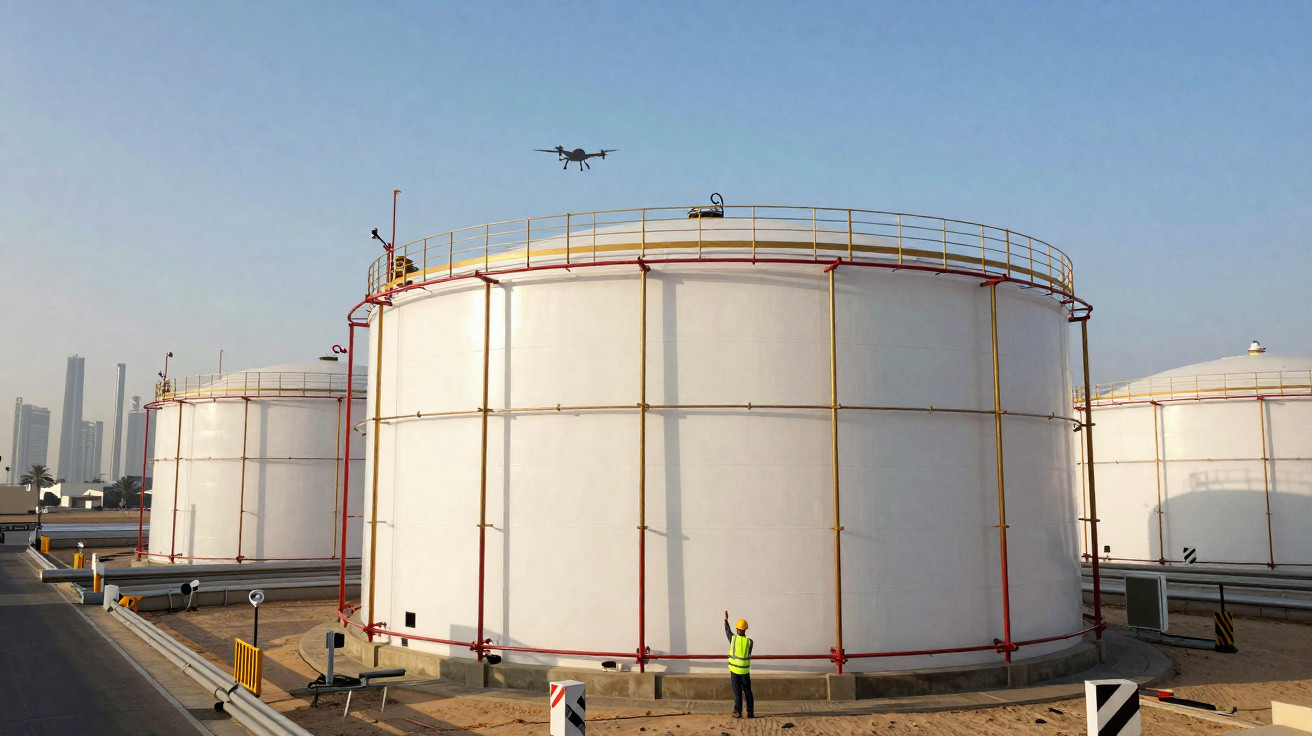
Ultra-modern air-defence systems are not enough to neutralise formidable Iranian drones. The United Arab Emirates has therefore chosen to reinforce its most strategic sites with a far more practical, straightforward solution.
Since hostilities involving Iran, the United States and Israel began, neighbouring countries such as the United Arab Emirates have found themselves directly at risk. Tehran relies heavily on its Shahed drones to carry out targeted strikes. These kamikaze aircraft are especially cheap to manufacture, fly slowly at low altitude, carry explosives and are often deployed in swarms.
They have consequently inflicted major damage on strategic infrastructure across the region. On 16 March, for instance, a kamikaze drone struck a tank at Dubai Airport directly, triggering a spectacular blaze and a temporary closure of the airspace.
Why conventional air defences struggle against Iranian drones
Traditional air-defence systems have limits when faced with this threat. Designed to intercept fast, sophisticated missiles, they struggle to stop every drone when dozens are launched at once. Countries in the region have therefore been looking for more pragmatic forms of protection.
View this post on Instagram
A post shared by 🌍Impact Index (@indeximpact)
Steel cages protecting fuel reserves
This is the approach adopted by the United Arab Emirates. A video shared on social media shows huge steel and metal-mesh cages surrounding fuel tanks at Dubai International Airport and several key energy sites in Abu Dhabi.
Directly inspired by the war in Ukraine, where such structures already shield armoured vehicles and oil facilities, the method is based on a very simple principle. The cage acts as a barrier by intercepting the drone, causing it to explode away from the tank and significantly limiting damage to the targeted infrastructure.
Strategic protection for Dubai Airport and energy hubs
The stakes are high because the United Arab Emirates economy depends heavily on major logistics hubs, from oil terminals to aviation centres. Even the smallest disruption to operations can carry serious financial consequences.
And securing Dubai Airport, one of the world’s busiest airports, is clearly an absolute priority. While Emirates traffic is gradually returning to its pre-war levels, the local tourism sector is still trying to reassure visitors.




Comments
No comments yet. Be the first to comment!
Leave a Comment