
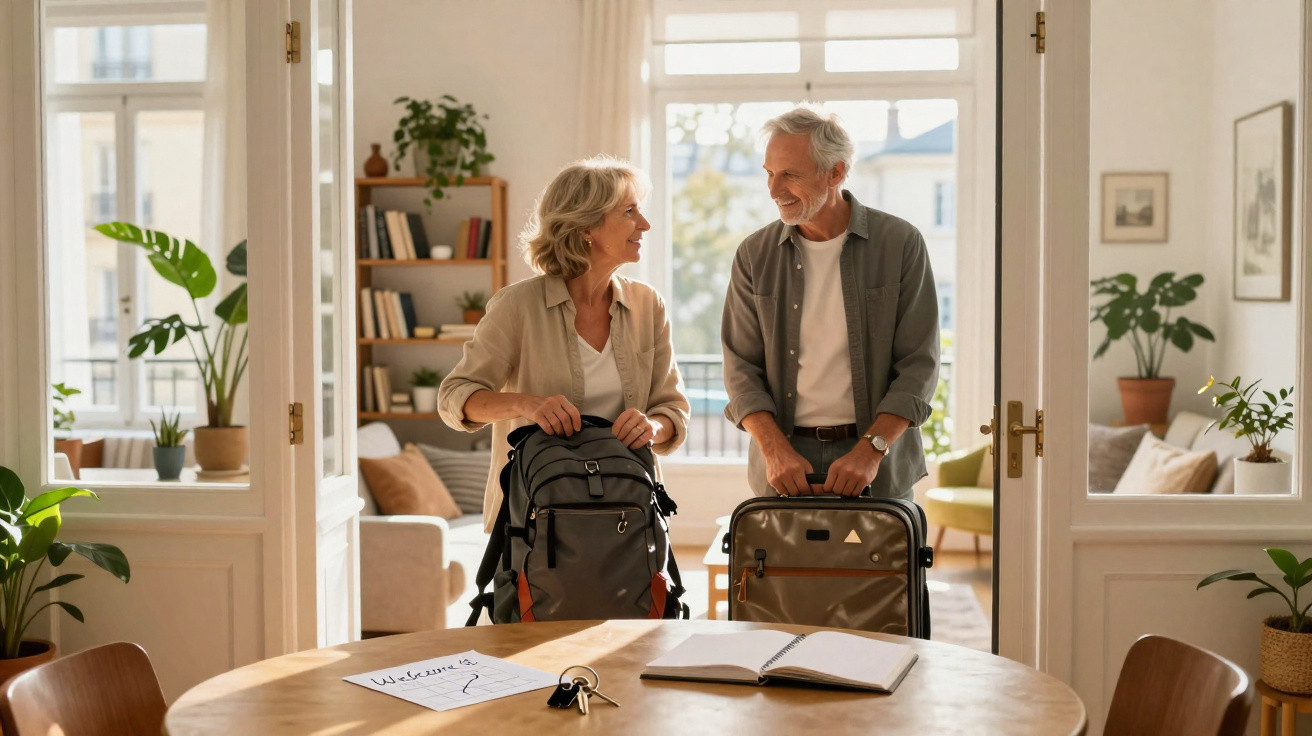
On Monday morning, a graph-paper notebook, two cups of coffee and a small globe bought years ago from an antiques dealer sit on the kitchen table. Claudine, 74, writes down potential dates, while Jean-Louis, 75, checks train times on his phone with the slightly amused focus familiar to anyone trying to get to grips with a screen. Their combined pension is €2,400 a month: enough to require careful budgeting, but not so little that every wish must become a frustration. Even so, they have travelled four times this year: to the Jura, Lisbon, near La Rochelle and for a few days staying with local people in the Vaucluse. Their solution is not an unexpected inheritance. It comes down to a different way of finding accommodation away from home.
They swapped hotels for home exchange
For Claudine and Jean-Louis, the turning point came after a weekend break that cost far too much for what it actually offered: a cramped room, breakfasts charged as extras and the feeling that every expense had to be watched. A neighbour then told them about HomeExchange, a platform for private home swaps. At first, the concept made them cautious, almost suspicious. Letting strangers into your home is not a decision to take lightly. They then realised they could either host travellers themselves or use a points scheme, often called GuestPoints, to stay in other homes without arranging a direct simultaneous exchange.
Their first trip took them to Besançon, in a flat lent by a couple visiting their children. They paid neither hotel nor rental costs, only for travel, food and the platform’s annual membership, which may vary according to the packages available. Over five nights, the saving was substantial: at that time, they had found hotels priced between €90 and €130 per night. For two people, the bill would quickly have exceeded €500 before they had even eaten at their first restaurant. “We felt as though we had regained the right to go away without feeling sick when we looked at our bank balance,” says Claudine.
The arrangement does not make holidays free, which is probably why it feels realistic. There are still fuel costs, train tickets, visits, groceries and the occasional restaurant chosen as a treat. Yet accommodation is often the expense that determines whether a break is possible or abandoned. For this couple, avoiding four hotel bills over the year has transformed the calculation. Depending on the destination and season, they estimate that every getaway saves them several hundred euros. Their holiday budget still exists, but it has more room to breathe.
A simple HomeExchange approach, but not an improvised one
They now follow a very practical rule: they organise trips six to eight months before their intended dates, especially for periods when demand rises sharply. Jean-Louis carefully completes their detached house profile, uploads bright photographs and clearly explains useful details: the step at the entrance, the ground-floor bedroom, the Saturday market and the parking space. This level of detail reassures travellers and helps prevent unpleasant surprises. They also read feedback left by previous members. A well-presented home is not enough; it needs to be appealing while also inspiring confidence.
They never agree to a request in haste. Before accepting one, Claudine exchanges several messages with prospective guests, asks who will be coming and checks that the dates genuinely suit their plans. To be honest, no one does this every day without some effort. They need to tidy up, clear a shelf in the fridge, leave instructions for the neighbour’s cat and accept that other people will use their kitchen. Initially, their mistake was trying to control every detail. Eventually, they chose to leave a welcoming home rather than a museum house, and the experience became much easier.
They also advise starting close to home, as a first experience is less stressful than an extended stay abroad. Their checklist, stuck to the inside of a cupboard, is as useful for guests as it is for them when packing their bags.
“The real luxury is not having a hotel suite. It is being able to decide to go away again, even on a small pension,” Jean-Louis sums up.
- Create a clear profile with recent, truthful photographs.
- Read reviews before agreeing to each stay.
- Set aside a separate budget for travel and meals.
- Start with a short break to find your feet.
Travelling more without gambling with their budget
Their story resonates with many retired people who see prices rising faster than their desire to travel fades. Claudine and Jean-Louis are not trying to show that everything can be done on very little; they simply reject the notion that travel is only for those with comfortable budgets. They favour trips outside school holidays, sometimes take a picnic for the first journey and cook for part of the week once they arrive. These habits have not taken away the pleasure. Instead, it has changed shape: a coffee on a neighbourhood terrace in Lisbon leaves them with a stronger memory than an overpriced buffet in an impersonal establishment.
What continues to surprise them most is the human connection. In the Jura, their hosts had left them the address of a cheesemonger and a hand-drawn map showing three accessible walks; in La Rochelle, they found a small harbour barely mentioned in guidebooks. Such gestures have no listed price, although they make a considerable difference. The platform will not suit everyone, particularly people who do not want to host in their own home or who prefer hotel services. Home exchange requires a degree of flexibility, but it also provides a freedom that many people thought they had lost.
By the end of summer, their notebook already contains a few ideas for the following year: Strasbourg before Christmas, Brittany in spring and perhaps Italy if an offer comes along. Their pension has not increased, and everyday household bills have not disappeared. Yet they have found some leeway where they could no longer see any. Their experience raises a very simple question: must people necessarily give up holidays when accommodation takes up too much of the budget, or can they change their habits without losing the enjoyment of discovering somewhere else?
| Key point | Detail | Added value for the reader |
|---|---|---|
| Home exchange platform | HomeExchange allows users to swap homes or use GuestPoints. | Significantly reduces accommodation costs, often the biggest expense. |
| Preparation | A complete profile, recent photographs, conversations with members and reading reviews. | Helps avoid unexpected problems and makes travel more reassuring. |
| Realistic budget | Accommodation costs can be saved, but travel, meals and activities must still be budgeted for. | Makes frequent holidays possible without being unrealistic about finances. |





Comments
No comments yet. Be the first to comment!
Leave a Comment