
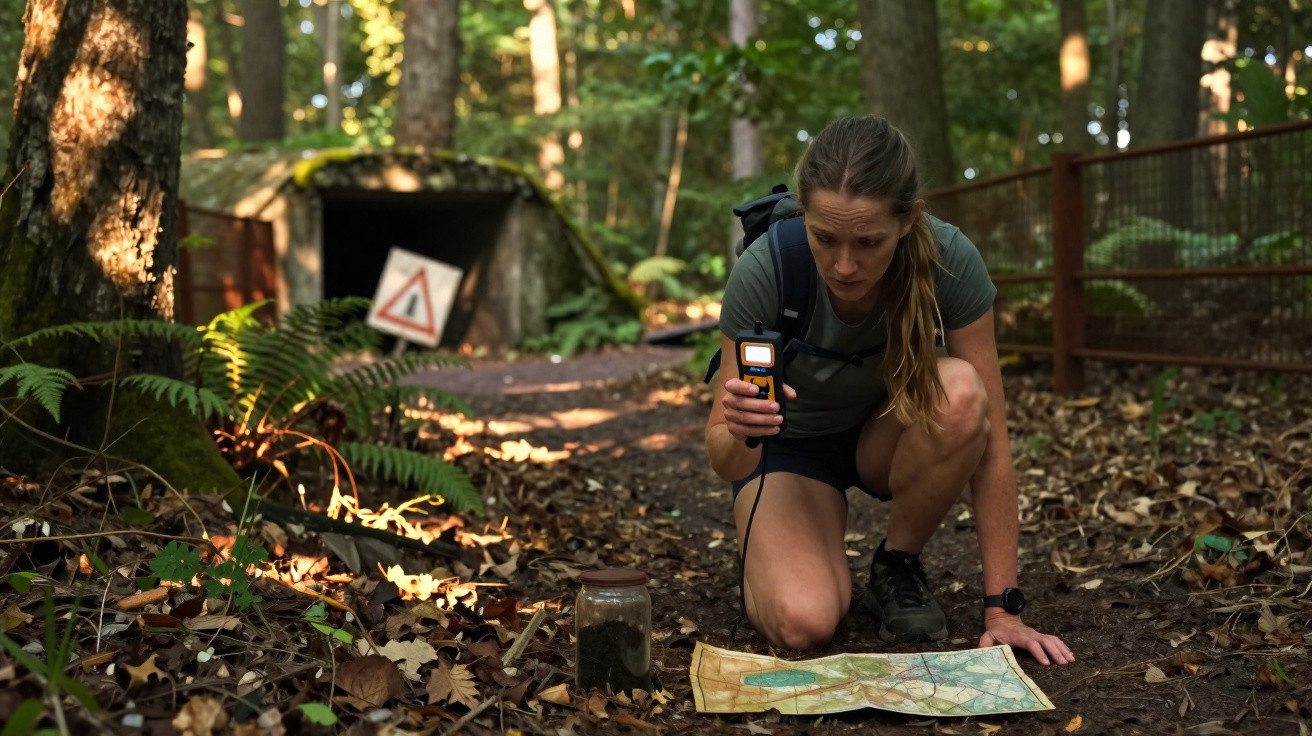
The path was still wet, leaves stuck to trainers, and breathing grew slightly shorter on the climb. A runner who had come to the woods for an hour of peace did not expect their route to turn into a story involving radioactivity, old maps and military history. The information has only just come to light: measurements taken within the boundaries of a former military site have identified thorium in the soil. At first glance, there is nothing cinematic about it: simply a detector, a wooded area and an anomaly recorded beside a path well known to regular visitors. Yet beneath the ferns and tree roots, the past appears to have left a more enduring mark than expected. The discovery also raises very practical questions.
An ordinary run, then an anomaly in the woodland
We all know those moments when we run almost on autopilot, eyes fixed on the ground ahead and giving little thought to what may lie beneath it. On this former military site, now largely reclaimed by vegetation, thorium has been detected in a wooded area used for walking, cycling and jogging. The warning did not come from a rusting sign or an open bunker; it followed surveys conducted around the site after an unusual reading was reported. The contrast is striking: on one side, a peaceful forest where people go to breathe; on the other, the discreet legacy of activities carried out decades ago.
Thorium is a naturally radioactive metal found in trace amounts in certain rocks and soils. In this case, its mere presence is not the most intriguing factor; it is the localised concentration and its possible connection with the site's former military use. Archives, witness accounts or abandoned equipment can sometimes help explain this kind of reading, although they may not provide an immediate answer. One point remains essential: detecting thorium does not automatically mean that walkers have faced a serious hazard. There is considerable expert work between an anomalous measurement and an actual health risk.
The history of French military sites is often complicated. Storage areas, workshops, exercises, technical depots and backfilled ground may have followed one another, without every detail remaining visible today. Thorium has also had industrial and technical uses, particularly in certain alloys, equipment and specialist materials. A forest never reveals its full history at first glance. Specialists are therefore trying to establish whether the observed radioactivity is natural, connected to historic fill material, or caused by a specific object buried in the ground. That distinction changes everything, including the decisions that may follow.
What to do if you visit the affected area
The most useful initial response is straightforward: follow local guidance as soon as it is issued by the town hall, prefecture or site manager. If part of the forest is marked out, closed or advised against, it is better to alter your route rather than try to get around the tape. For runners who carefully map every metre of their regular circuit, that is never particularly welcome. However, a two-kilometre detour is preferable to taking an unnecessary risk or creating a difficult intervention for inspection teams. You should also avoid picking up metal fragments, unusual stones or old objects spotted away from the path.
A common mistake is to assume that a Geiger counter bought online can check everything within minutes. Such devices can identify a variation, but their readings require context, calibration and, above all, technical interpretation. Let us be honest: hardly anyone does that every day. A displayed figure with no clear unit, no background measurement and no understanding of the equipment can cause needless concern. Conversely, the absence of a signal does not necessarily mean that an area is free from issues. The appropriate course of action involves the relevant services and supervised sampling.
For local residents, sports clubs and families, it is equally important to remain level-headed while investigations are under way. An area being studied is not necessarily an area beyond use, but it does require clear, regular and understandable information.
“When faced with an unusual measurement, the right response is neither panic nor denial: it is verification.”
A few habits can prevent many misunderstandings:
- check official orders or statements before heading out;
- remain on authorised paths;
- do not handle suspicious objects found on the ground;
- report the exact location of any discovery;
- wait for expert findings before spreading a rumour.
Thorium at a former military site: soil to investigate and collective memory to revive
This discovery is a reminder that familiar landscapes are never entirely neutral. A former barracks turned into meadowland, a training ground converted into municipal woodland, or a military brownfield opened for recreation can retain invisible traces. The authorities must now produce detailed mapping: where is the thorium located, at what depth, in what form and in what quantities? This field investigation will determine whether monitoring, remediation, temporary access restrictions or simply an explanation of a geological feature are needed. Transparency over the findings will be crucial to prevent concern from replacing facts.
The issue extends far beyond this single runner and a jog interrupted by unexpected news. It raises questions about how former military sites are recorded, passed down through generations and monitored. Many local authorities are now rediscovering incomplete archives, inaccurate plans and forgotten uses when turning land into natural spaces. This work can appear administrative and almost invisible, until a measurement reveals an unusual point. A former military site is not necessarily dangerous, but its history deserves to be understood before its paths become part of everyday routines.
There is also a more personal lesson in this situation. Running in the woods can feel like getting away from noise, screens and complicated files; yet sometimes it is precisely there that reality returns in its raw form, beneath our feet. Residents have every reason to ask for readable information, accessible maps and explanations that play nothing down. Experts, meanwhile, must be able to work without pressure to deliver a dramatic answer. The concerned walker, the local councillor and the technician taking samples each view the same undergrowth with different expectations. This story deserves to be followed because it concerns both public health and our relationship with the places where we live.
| Key point | Detail | Value for the reader |
|---|---|---|
| Presence of thorium | A radiological anomaly has been recorded within a wooded former military site. | Understand that a detection calls for analysis, not hasty conclusions. |
| Risk to assess | The concentration, depth and origin of the thorium must be established. | Know how to distinguish an unusual reading from a proven health hazard. |
| Practical response | Follow marked routes and do not handle objects found on the ground. | Take a cautious approach when visiting woodland. |
FAQ:
- Is thorium always dangerous? No. Thorium occurs naturally in the environment at low levels. The degree of risk depends on the quantity, the form of the material and the realistic possibilities for exposure.
- Can people still run near a former military site? Yes, provided that no official restriction prohibits it. If routes are marked off or temporary guidance is in place, it is best to choose another route.
- Why might thorium be found on this type of land? It may come from the natural subsoil, fill material, historic waste or past technical activities. Only testing can establish its origin.
- Should I see a doctor after running in the area? A single walk or occasional run does not automatically justify a medical consultation. Where official health guidance is issued, or where the authorities report a particular exposure, their recommendations should be followed.
- Who can provide reliable information? The prefecture, town hall, site manager and relevant public radiation-protection bodies remain the preferred sources over unverified posts.





Comments
No comments yet. Be the first to comment!
Leave a Comment