
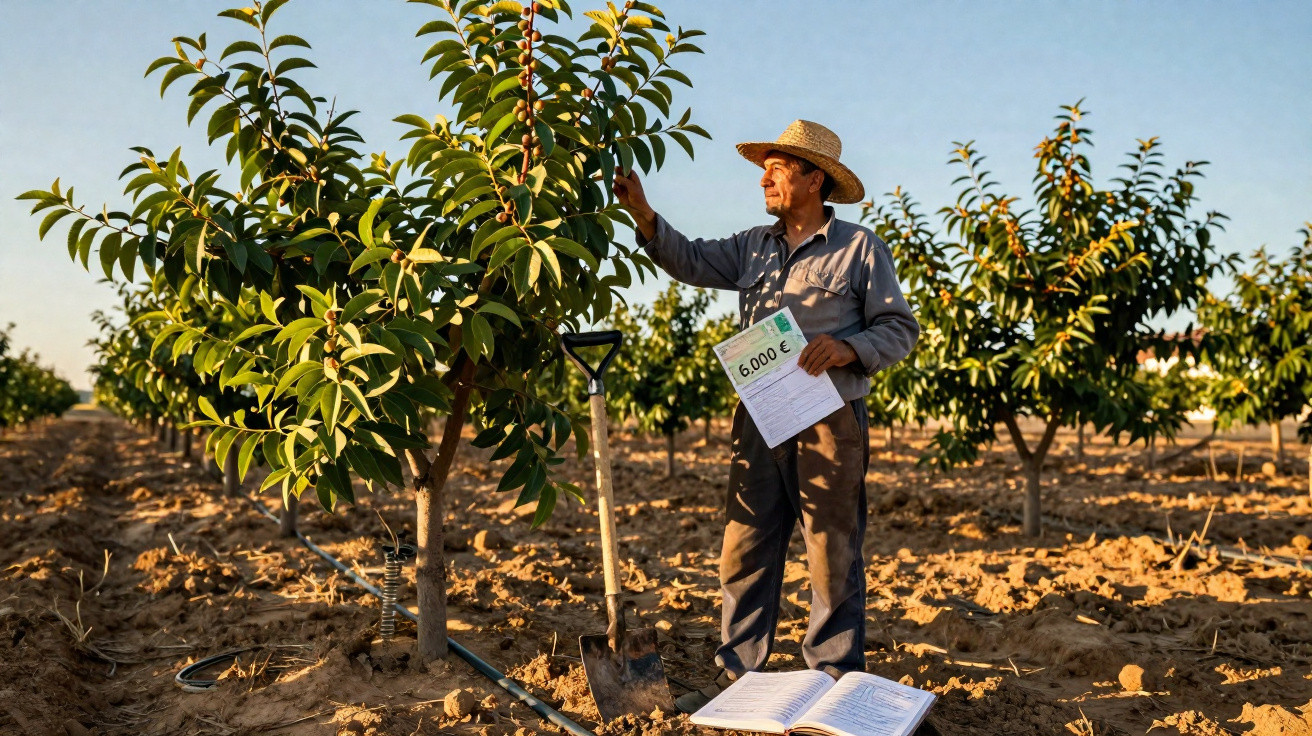
In Spain, a farmer in Castilla-La Mancha explains how a modest loan redirected his agricultural business towards pistachios.
In Pozuelo de Calatrava, in the province of Ciudad Real, Juan José Chacón gradually moved away from cereal crops and olive growing. The Spanish online newspaper El Español, which published his account on 25 July 2026, recounts the journey of a farmer who backed a crop that was then little known in the country.
A €6,000 loan as the starting point
The change began in 2010, when Juan José Chacón applied for a €6,000 bank loan to start planting pistachio trees. The sum was only the first stage of an investment that would grow considerably over the years.
Previously, the farmer grew cereals and olives. According to his account, these activities generated €40,000 in income. His holding now includes around 160 hectares devoted to pistachios.
“I went from earning €40,000 from cereals and olives to €650,000 a year thanks to pistachios,” Juan José Chacón says.
The €650,000 is the annual amount he says he earns from his business. The source does not specify how this figure is divided between turnover, operating costs, loan repayments, staff costs or net profit. His account therefore illustrates the particular case of a farm that has expanded strongly, rather than a guaranteed income for pistachio growers.
Reinvesting income in land
Juan José Chacón credits part of his development to a policy of continual reinvestment. Rather than immediately taking the profits generated by harvests, he says he used them to buy, or allocate, more land for this crop.
“What I earn, I reinvest in land for pistachios,” the farmer explains.
He makes no secret of his confidence in this direction. “We believed in the future of pistachios and we committed to them,” he says. In his view, this crop provides prospects that are hard to match within agriculture, in terms of investment, production and profitability alike.
His ambitions remain substantial. If the holding continues to develop at its current pace, Juan José Chacón believes it could reach between one and two million euros. This forecast comes from the farmer himself and will depend, among other factors, on harvests, prices and changes in demand.
Key stages in his switch to pistachios
- An initial business based on cereal crops and olive growing.
- A €6,000 loan taken out in 2010.
- Plantations expanded gradually across Castilla-La Mancha.
- A holding now covering around 160 hectares of pistachio trees.
- A strategy based on reinvesting in additional land.
A crop supported by climate and demand
Castilla-La Mancha plays a central role in the rise of pistachios in Spain. According to the source, the climate of this vast inland region, with its hot, dry summers, is an advantage for establishing the crop.
Spanish and international demand for the nut has also encouraged producers’ interest. In recent years, Spain has become one of Europe’s pistachio producers, with plantations largely concentrated in this central region of the country.
That momentum does not mean the crop is easy or profitable straight away. Pistachio trees require time before reaching a production level considered financially viable. Juan José Chacón himself stresses this waiting period, during which farmers must fund their operations without immediately receiving significant harvests.
“You can make a living from pistachios, even like a marquis, but at the start you have to put in a lot of money. It takes four or five years before it becomes profitable,” Juan José Chacón warns.
He adds that those who manage to get through this period can, in his words, “become millionaires”. This claim reflects his own experience and optimism, rather than a promise of returns for every plantation.
Pistachio trees require patience
The pistachio tree is a fruit tree that does not bear crops immediately. Establishing an orchard involves costs at planting time, followed by regular care for several years. The choice of plot, suitability of the climate, water availability and protection from weather-related risks can all affect a project’s financial balance.
Another characteristic is that the pistachio tree is a dioecious species. Male and female flowers grow on separate trees. An orchard must therefore include male trees to pollinate the female trees, which bear the fruit. Wind plays a role in this natural process.
The wait before the first commercial harvests explains why this crop may not suit a farm that needs immediate income. Juan José Chacón acknowledges this: the initial investment is high and the first few years are a challenging period.
What is the situation in France?
In France, pistachio cultivation mainly exists as a planned venture or through agricultural initiatives in the warmest, driest areas, particularly around the Mediterranean basin. Climatic conditions remain decisive: the tree tolerates drought, but frost events can damage flowering and reduce a harvest.
For a French farmer, the Spanish example therefore cannot simply be replicated. Land costs, water resources, commercial outlets, planted varieties and harvest organisation vary between areas. Agricultural chambers can support project holders in making technical and financial choices suited to their department.
Juan José Chacón’s account above all highlights an agricultural reality: diversification can transform a farm when the climate, production timetable and market are favourable. It also requires the capacity to finance several years of waiting, with no certainty about future price levels.



Comments
No comments yet. Be the first to comment!
Leave a Comment