
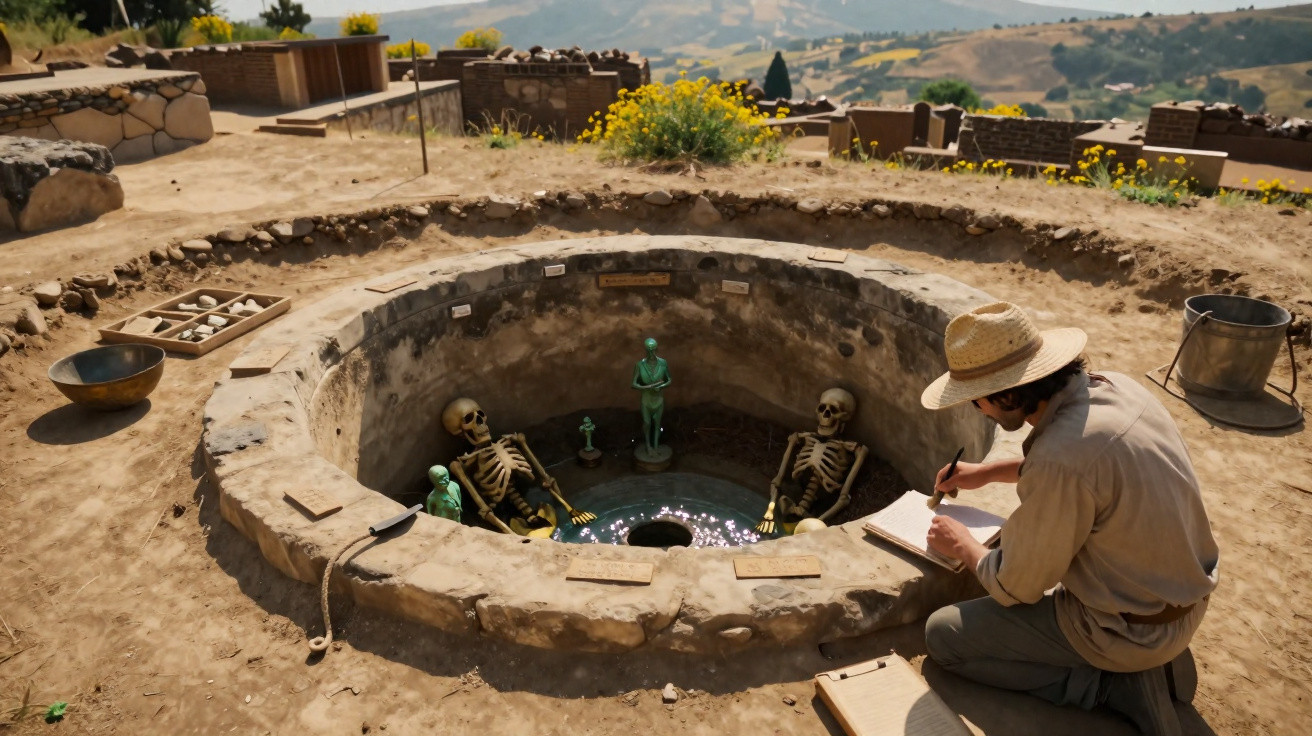
Two human skeletons, two small female bronze figurines and a rare metal plate lay concealed for around 2,500 years at the bottom of a well in Italy. The find was made at Kainua, an ancient Etruscan city near Marzabotto, revealing a structure that seemingly served both as a source of water and a setting for religious ceremonies.
What was found at the bottom of the Etruscan well?
The well was uncovered during the University of Bologna’s 39th excavation campaign, led by archaeologist Elisabetta Govi. At its base, the team discovered two female figurines and an exceptionally rare dish-shaped object, all made of bronze. Govi said the pieces still retained some of the metal’s original sheen.
Researchers have dated these offerings to between the end of the 6th century BC and the first decades of the 5th century BC, a period that coincides with the city’s own foundation. The objects are thought to have been placed there as part of a solemn ritual marking the well’s foundation, underlining that the structure held a purpose far beyond supplying water.
Why was water so significant at this site?
The well stood within an important sacred area of the city. Its position and the artefacts deposited inside it indicate to researchers that water also carried religious importance. The discovery sheds light on how resources essential to survival could acquire symbolic meaning during the establishment and planning of an Etruscan city.
- Two female bronze figurines were placed at the bottom as offerings.
- A rare bronze dish was also part of the ritual assemblage uncovered by archaeologists.
- Two adults were placed in the structure later, during its ritual closure.
- The well was built at roughly the same time as Kainua was being founded.
There is another intriguing point: Kainua means approximately “new city”, and local sources describe its foundation as having been accompanied by complex religious rituals. The city contained orderly streets, residential districts, workshops, necropolises and sacred spaces, making it a valuable case today for understanding Etruscan urban planning.
Which gods were worshipped near the well?
Large temples in the same area have been linked through Etruscan inscriptions to Tinia and Uni, regarded as a central divine couple in the Etruscan pantheon. Tinia is often compared with Zeus and Jupiter, while Uni corresponds to Hera and Juno in Greek and Roman traditions.
There is also evidence of worship of Vei, a deity associated with human and agricultural fertility and linked to Demeter and Ceres. According to Elisabetta Govi, the newly discovered well must be understood within precisely this religious setting, providing further clues about the foundation rites of Etruscan cities.
Why were two skeletons inside the structure?
The two skeletons belong to adults and, according to the University of Bologna and Italy’s Ministry of Culture, appear to be connected to a ritual that marked the end of the well’s use. This means the human deposits would have taken place at a different stage from the offerings placed there at its foundation.
However, the discovery does not allow researchers to claim that human sacrifice took place. Further study of the remains is needed to establish when these people died and under what circumstances they were placed there. Distinguishing archaeological evidence from interpretation is particularly important in unusual discoveries such as this one.
What can this well reveal about Kainua?
Kainua was founded at the end of the 6th century BC and abandoned during the 4th century BC, a time of migration and Celtic presence in the region. Since no major modern city was built over its ruins, its ancient layout has remained exceptionally clear, enabling researchers to reconstruct streets, houses, workshops, temples and necropolises.
Now, a seemingly ordinary well adds another piece to that puzzle. The objects will be studied and conserved before they can be incorporated into the refurbished MNEMA, the National Etruscan Museum of Marzabotto. Following these analyses may uncover fresh clues about how the Etruscans connected water, religion and the birth of cities, turning an everyday structure into an extraordinary record of their beliefs.



Comments
No comments yet. Be the first to comment!
Leave a Comment