
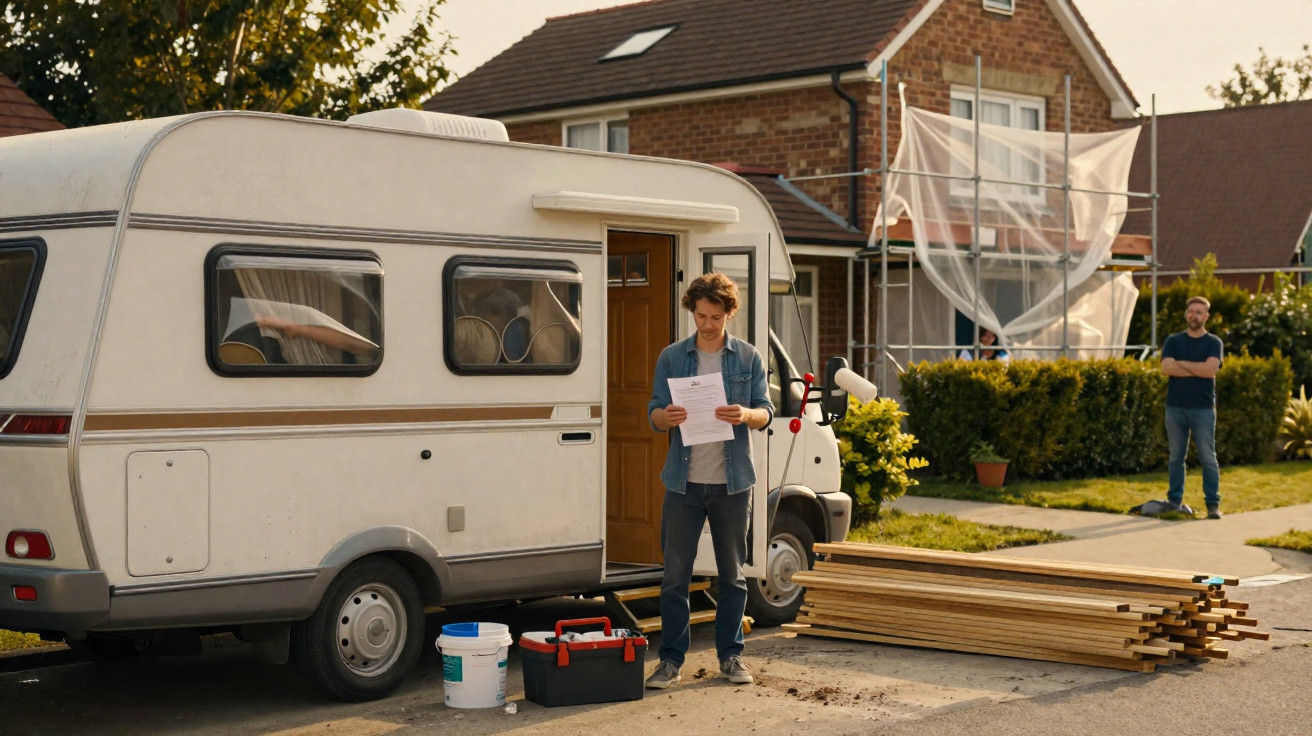
Laurent’s motorhome arrived on a Tuesday in November, squeezed between a rubble skip and two pallets of plasterboard. It has stood in the drive of his small house ever since, on a plot where workmen arrive each morning with mud-covered boots. Inside are a bed, a camping stove, a kettle, and the unsettling feeling of being at home without properly living in the house. Laurent expected to manage for a few weeks while the electrics were redone and the damp walls were treated. Weeks turned into months. His neighbours, meanwhile, began counting the days.
A motorhome on the drive that became a long-term arrangement
At first, nobody was especially concerned by the white vehicle parked behind the gate. In many villages, renovation periods are familiar: people sleep with relatives, in a caravan or in a half-finished room. Laurent wanted to remain on site to keep an eye on the building work and avoid paying additional rent. The arrangement seemed practical, almost obvious. Every evening, he shut the motorhome door and looked out at his house, opened up by the renovation work. It was not comfortable; it was meant to be temporary.
For the first few months, neighbours mainly saw a man working tirelessly. Laurent left early to collect supplies, returned with bags of cement, and spent his weekends sanding beams. Then winter arrived, bringing an awning attached beside the motorhome, visible extension leads and several boxes piled beneath a tarpaulin. One local resident says the set-up “did not look untidy”, but it appeared to be becoming permanent. Three months, then five, then eight: the vehicle had not moved a single metre.
The issue is not solely the appearance of the plot. In France, keeping a motorhome parked at home is generally accepted when it remains a vehicle and is not left immobile for an extended period as accommodation. The boundary becomes less clear once it is connected to utilities, stabilised on the ground, surrounded by fixed additions or used as long-term living space. The permanent nature of the use often matters just as much as the number of days involved. Local rules may also be stricter.
When the council receives the first complaints
Laurent might have avoided some of the unease by approaching the council from the outset. A visit to the planning department, with a few photographs of the project and a realistic renovation timetable, will often clarify the position. Depending on the municipality and its local planning scheme, a prior declaration may be required for certain arrangements, particularly where the motorhome is treated as a mobile residence installed on a lasting basis. It is better to obtain confirmation in writing, even when the stay is expected to last only a few weeks. Renovations rarely take as little time as planned.
The most common mistake is assuming that a garden or drive is exempt from rules because it is private. That is understandable: Laurent was not obstructing traffic, making noise or attempting to create a second home to rent out. Even so, a vehicle occupied throughout the year may raise issues around hygiene, drainage, safety or visual impact. Let us be honest: hardly anyone deals with this every day. The necessary procedures are often discovered only when a letter arrives through the door.
In Laurent’s case, the municipality eventually responded after receiving several reports. An officer visited to note the motorhome and its visible connections, after which the council requested details about the intended duration of the occupation. This was not necessarily an immediate penalty, but rather a reminder of the rules and an invitation to regularise his position.
“We do not seek to put residents in difficulty when they are renovating their home. We simply have to check that the installation does not become permanent accommodation outside the intended framework,” explains a local councillor contacted in a rural municipality facing similar cases.
- Check the local planning scheme or municipal planning map before any extended installation;
- Ask the planning department whether a declaration is required;
- Avoid fixed utility connections and additions that make the vehicle appear permanent;
- Inform neighbours when the work is likely to continue for a long time.
Renovation work, but also a question of neighbourly relations
Laurent’s situation reflects something very ordinary: the gap between the reality of a building project and regulations designed to organise collective life. Renovating an old house takes time, money and a level of stamina that is difficult to judge before the first partition wall is knocked down. The motorhome allowed him to stay close to his tools, safeguard the site and keep a roof over his head on evenings when exhaustion took over. Yet some people around him saw an arrangement that seemed to be settling in without end, bringing their own concerns with it.
The council’s response does not necessarily mean Laurent will have to leave his plot overnight. Everything will depend on local rules, the actual state of his installation and his ability to show that the work is progressing. A calm discussion may make way for an extension, formal regularisation or a more closely regulated temporary solution. Dialogue often prevents a case from turning into a dispute. Photographs of the work, quotations and a timetable can sometimes carry far more weight than a lengthy explanation.
This story also prompts debate because it touches on a sensitive question: how far can people adapt their home when life no longer fits neatly into the rules? With high rental costs, tradespeople’s delays and houses in need of major restoration, many understand Laurent’s choice. Others point out that a street remains a shared space, even behind hedges and gates. Both views can coexist. A motorhome is never merely a vehicle when, month after month, it becomes the refuge of a renovation that seems never to end.
| Key point | Detail | Value for the reader |
|---|---|---|
| Parking at home | A motorhome may be parked on private land, subject to local rules. | Understand that private ownership does not remove planning-law requirements. |
| Extended use | Utility connections, stabilising supports and fixed installations can shift the vehicle towards residential use. | Identify the features likely to draw the council’s attention. |
| Council response | An inspection may lead to a request for information, regularisation or extra time. | Prepare practical evidence before the situation becomes strained. |





Comments
No comments yet. Be the first to comment!
Leave a Comment