
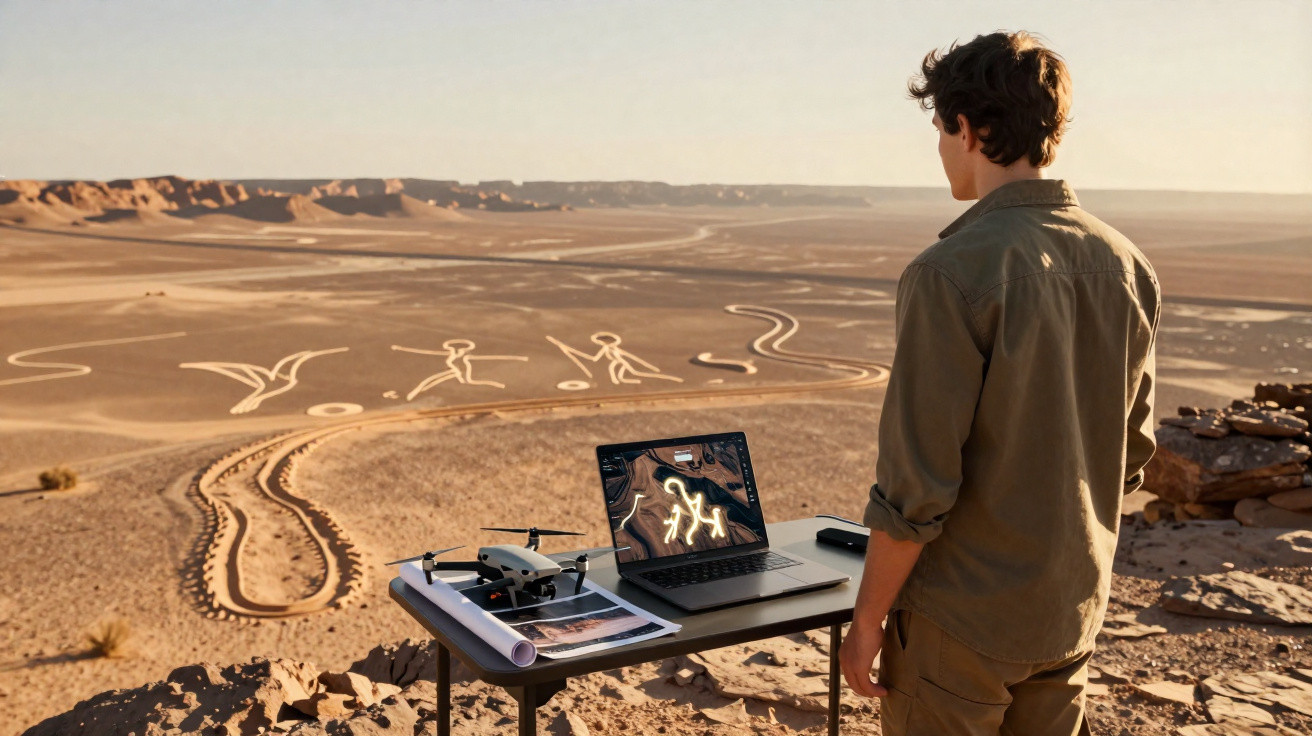
For centuries, hundreds of figures remained almost invisible in Peru’s Nazca Desert. Now, artificial intelligence has helped archaeologists identify 303 previously unknown figurative geoglyphs, nearly doubling the number of documented drawings of this kind and offering fresh clues about who made them and what they may have been used for.
How did artificial intelligence find hidden figures in the desert?
Researchers examined high-resolution aerial images spanning roughly 629 square kilometres of the Nazca Pampa. Since many of the smaller geoglyphs measure only around nine metres across and are difficult to spot from above, the team trained an AI system to detect signs that could point to ancient ground drawings.
According to the study published in the Proceedings of the National Academy of Sciences, the AI generated 47,410 candidate areas. Following human screening, 1,309 sites were judged to be particularly promising. Archaeologists then visited hundreds of them between September 2022 and February 2023 to establish what was actually present on the ground.
How many new geoglyphs did archaeologists confirm?
Fieldwork confirmed 303 new relief figurative geoglyphs. Of these, 178 had been flagged directly by the artificial intelligence. A further 66 were found in places where the system had already identified at least one figure, while 59 were detected during the researchers’ own inspections.
- The system assessed imagery covering approximately 629 square kilometres of desert.
- Artificial intelligence marked 47,410 areas that could potentially contain geoglyphs.
- Archaeologists selected 1,309 candidates considered the most promising.
- The research confirmed 303 new figurative geoglyphs and 42 previously unknown geometric drawings.
Before this research, 430 figurative Nazca geoglyphs were known, including 380 relief drawings and 50 larger linear figures. With the new discoveries, the dataset studied reached 733 figurative figures, giving scientists a substantially larger sample for understanding patterns across the region.
What do the new Nazca geoglyph figures depict?
The expanded catalogue exposed a striking contrast between the different kinds of drawings. Among the smaller relief geoglyphs, 81.6% portray humans or features connected with human activity. Humanoids account for 33.8%, decapitated heads for 32.9%, and domesticated camelids for 14.9% of the analysed collection.
By contrast, 64% of the 50 known large linear figurative geoglyphs depict wild animals. The newly found figures include people, camelids, birds, felines and orcas, as well as scenes featuring both humans and animals. For the team led by researchers at Yamagata University, this distinction may indicate different social functions.
Watch the video shared by the History Brazil YouTube channel about the mysterious Nazca Lines drawings.
Why did the location of the drawings also attract attention?
The researchers found that clusters of relief geoglyphs lie, on average, just 43 metres from ancient pathways. Some figures could be viewed directly by people walking along these routes, whereas others became visible only as people drew closer, suggesting they may have communicated information to individuals or small groups.
The large linear drawings follow a different pattern. On average, they are 34 metres from the lines and trapezoids that form Nazca’s geometric network. The study’s authors, whose work also involved collaboration with IBM Research, suggest that these larger figures may have been connected to communal or ritual activities.
What does this discovery change for Nazca archaeology?
The research shows that artificial intelligence did not replace archaeologists’ work, but made it possible to search an enormous area far more efficiently. Screening the results required about 1,200 hours, while field verification took a further 1,440 hours, showing that the technology chiefly served as a tool for directing specialists towards the most promising locations.
Most intriguing of all, hundreds of figures remained hidden in one of the world’s most extensively studied archaeological landscapes. If AI was able to reveal so much at Nazca, other areas may still hold comparable discoveries. This combination of archaeology and technology is worth watching closely, because part of human history may be waiting to be recognised in images we already possess.




Comments
No comments yet. Be the first to comment!
Leave a Comment