
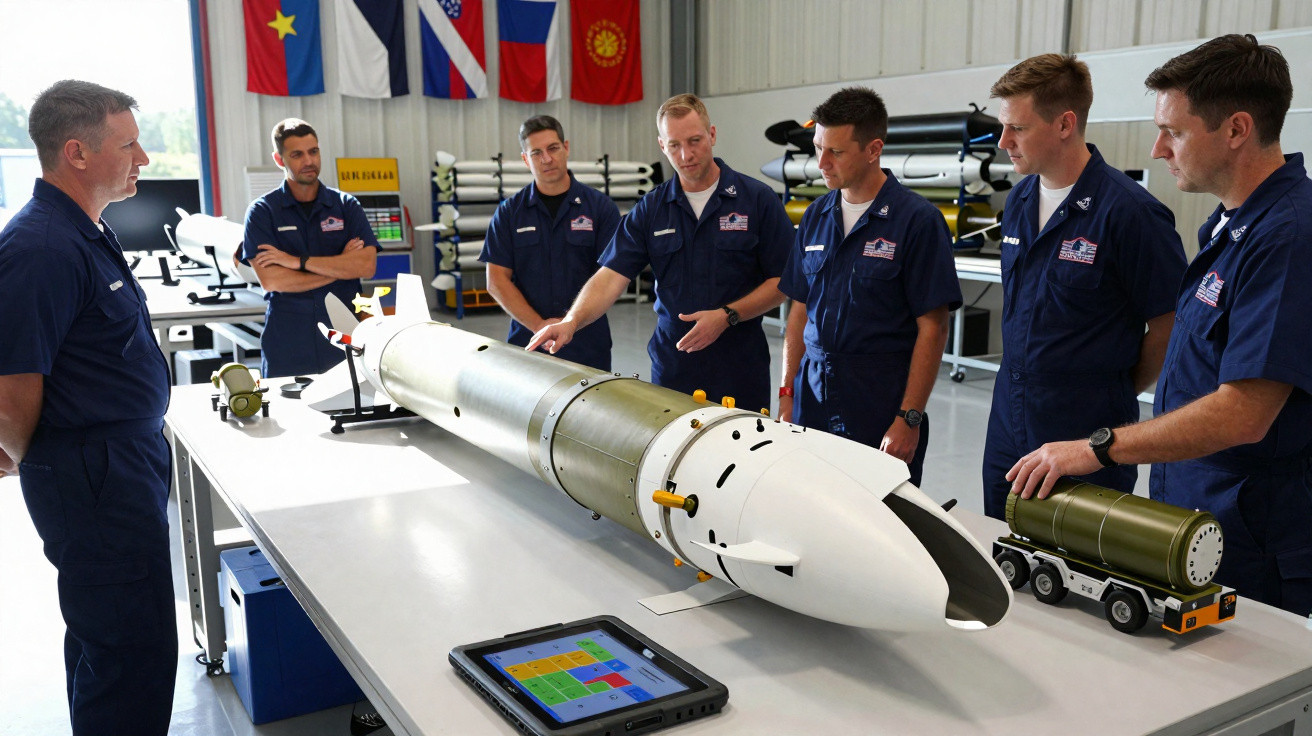
The U.S. Navy is pressing ahead with plans to create a new generation of low-cost, modular cruise missiles under the Coalition Heterogeneous Affordable Offensive Strike (CHAOS) programme. The initiative is designed to equip U.S. forces, allies and partner countries with cheaper precision-strike weapons, with exportability and interoperability built into the programme from the beginning.
Instead of designing a weapon solely around U.S. needs, CHAOS is being developed with international operators in mind. The programme is expected to accommodate several launch configurations and allow partner nations to contribute to its future development, production and integration.
U.S. Navy chooses new industrial partners for CHAOS
The Navy’s Precision Strike Weapons Program Office, PMX-201, has issued two new contracts to move the programme forward. Zone 5 Technologies, a Kongsberg company, secured one award to develop its low-cost Rusty Dagger cruise missile, while CoAspire was chosen to develop the Rapidly Adaptable Affordable Cruise Missile-Extended Range, or RAACM-ER.
The programme is being advanced through Other Transaction Authority (OTA), a mechanism intended to speed up prototyping and lessen certain administrative demands linked to conventional defence procurement programmes. The Navy says this method offers more flexibility to adjust development work as operational requirements evolve.
Van Hendrey, who is responsible for munitions acquisition, characterised the latest awards as a further move towards giving U.S. security partners a more affordable maritime strike capability.
Rusty Dagger and links to the ERAM programme
Rusty Dagger joins the CHAOS competition with a significant benefit: based on information published by Zone 5 and Naval News, the missile is already being manufactured for Ukraine. Known as the AGM-188A in U.S. service, the weapon forms part of wider efforts to expand the availability of long-range strike capabilities. Its selection for CHAOS could consequently enable the Navy to use an established production base rather than begin with a completely new design.
The initiative also has a wider link to development of the Extended Range Attack Munition (ERAM). In March, the U.S. Air Force carried out tests intended to hasten the weapon’s integration on to F-16 fighters operated by Ukraine. The trials covered missile-loading procedures for the aircraft as well as additional validation of its operation.
A cruise missile architecture built for allies
A central feature of CHAOS is its focus on international collaboration. Sarah Abbott, who heads PMX-201, has highlighted the increasing threat presented by adversaries’ anti-access and area-denial systems, which have made the development of modern, yet affordable, anti-ship capabilities ever more important.
CHAOS is intended to meet this need through a weapon architecture adaptable to different operators and operational needs, while remaining exportable.
To deliver this, the programme uses the Modular Open Systems Approach (MOSA) and the Weapons Open Systems Architecture (WOSA). This should simplify software and hardware upgrades throughout the missile’s service life, while potentially enabling partner nations to undertake domestic integration or join shared assembly arrangements.
Ground-launch plans and future variants
The programme’s initial version is expected to be an expeditionary, ground-launched capability. The U.S. Navy intends to place this system into production by 2028, before extending the weapon to naval launch platforms. Air-launched versions may also be developed according to operational requirements identified by future users.
Ray Owens, director of the Navy’s International Programs Office, stressed that the service is giving priority to developing capabilities with allies and partners, rather than exclusively for U.S. forces. Zone 5 has likewise said that Rusty Dagger is intended to deliver strike capability for both the U.S. Navy and allied customers.
Via the Foreign Military Sales (FMS) process, PMX-201 is also encouraging partner countries to help define future CHAOS requirements. This approach is part of a broader U.S. Navy effort to develop a family of affordable cruise missiles whose modular design, production model and export potential could support adoption by a larger network of allied forces.





Comments
No comments yet. Be the first to comment!
Leave a Comment