
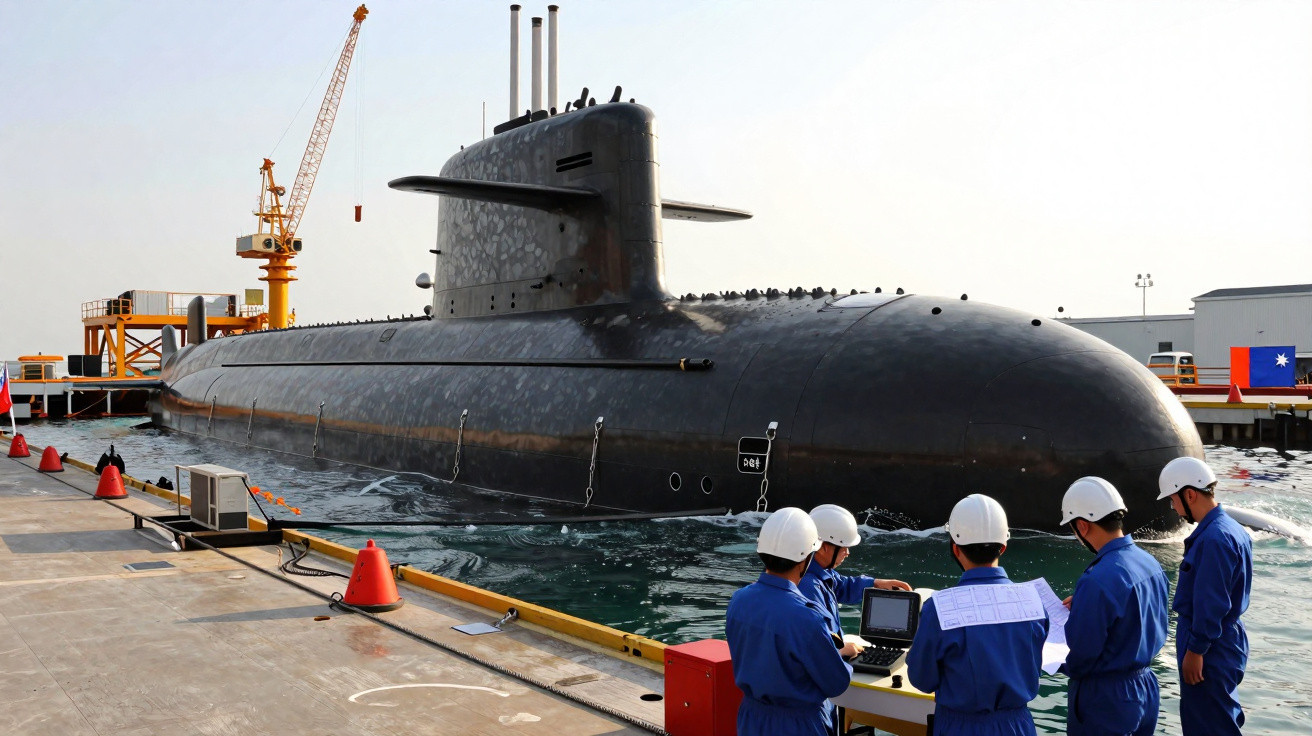
Taiwan’s first domestically built submarine, Hai Kun (SS-711), has recently concluded another round of surface-navigation trials in waters off the port of Kaohsiung. The programme is now approaching one of the most important milestones in its assessment timetable: its first static dive, which is scheduled to take place in the coming weeks. The Chung-Shan National Institute of Science and Technology (NCSIST) and Navy sources quoted by local media confirmed the tests had been completed, stressing that the prototype remains “following the planned schedule” despite delays accrued during the year.
During the latest trials, the submarine performed navigation manoeuvres, system calibration work and on-water stability assessments. These included turning trials, directional-control checks and confirmation of the diesel-electric engines’ performance. Each activity was completed without incident and is a necessary preliminary step before approval can be granted for the first shallow static dive, a crucial test of the pressure hull’s structural integrity.
Taiwan’s IDS submarine programme advances after months of uncertainty
Hai Kun is the first prototype produced through the IDS (Indigenous Defense Submarine) Programme, among the most ambitious technological projects in Taiwan’s military history. Its development, however, has experienced repeated delays linked to the integration of foreign systems, the supply of sensitive components and the requirement to obtain technical certifications that had previously been available to only a limited group of submarine-building nations.
It emerged in October that Hai Kun’s sea trials had fallen behind the initial timetable, with the first dive then expected only towards the end of 2025. Recent operations by the submarine nevertheless point to steady progress towards entry into operational service, which under the revised schedule is planned for before 2027.
Hai Kun: a crucial submarine for the future Taiwanese Navy
The Hai Kun has an approximate displacement of 2,600 tonnes. Its design follows Western standards and incorporates diesel-electric propulsion, advanced sonar and integrated combat systems. The project was launched in 2018, after then US President Donald Trump authorised a technology transfer to Taiwan for the development of indigenous attack submarines. A year later, the government presented a scale model of the design selected for the first prototype, allowing construction to begin in 2020. Since then, the programme has received foreign assistance from several countries.
Compatibility with US weapons is also a central element of the programme. In 2023 and 2024, the United States authorised the supply of Mark 48 Mod 6 AT heavyweight torpedoes and associated systems for both Hai Kun and future IDS Programme boats. Under the official budget proposal, the Taiwanese Navy is due to receive four torpedoes next year for training purposes. A further fourteen are set for delivery in 2027, followed by another ten in 2028, bringing the total to the quantity originally requested by Taipei.
Latest Hai Kun tests: navigation, stability and calibration
Since being unveiled in 2023, the submarine has undergone a range of trials - Harbour Acceptance Tests (HAT) and Sea Acceptance Tests (SAT) - covering surface speed, steering-system verification and combat-system calibration, as well as communications testing and structural-vibration assessments. The first tests have been conducted since 2024 and have been monitored by analysts, with images circulated by Open-Source Intelligence (OSINT) and official sources. These showed Hai Kun operating alongside support vessels and rescue teams assigned specifically to this phase.
Next milestone for Hai Kun: the first static dive
The first dive - during which the submarine submerges while stationary to assess watertightness, buoyancy and depth control - will represent one of the programme’s most critical stages. Only once it has successfully completed this test will the Taiwanese Navy’s Hai Kun be cleared to undertake dynamic dives and later full simulated combat manoeuvres.
Subject to the outcome of the current trials, Taiwan’s submarine programme provides for the construction of eight domestically designed vessels, including the Narwhal, to join the two Chien Lung-class submarines. Taiwan’s Ministry of Defense previously underlined that this capability would strengthen deterrence in the Taiwan Strait through a fleet of modern submarines equipped with state-of-the-art weapons. Although Hai Kun’s development has involved technical difficulties arising from the integration of systems supplied by different countries, subsequent units are expected to benefit from a more efficient construction process based on experience gained with the prototype.
You may also like: The US seeks to accelerate deliveries of F-16V Block 70 fighters to the Taiwanese Air Force to compensate for delays

Comments
No comments yet. Be the first to comment!
Leave a Comment